
Mouse Symbolism: Gods, Fables and the Tooth Mouse
Robert Burns, Apollo, Ganesha, the Chinese zodiac, La Fontaine and the mouse who collects milk teeth: what the mouse stands for, where each meaning comes from, and what older sources document versus what belongs to modern interpretation.
The story goes that in 1785, a young farmer was ploughing at Mossgiel Farm when his blade tore through a mouse’s nest, the little shelter it needed to survive the winter. The farmer was Robert Burns. The poem he wrote about that moment, To a Mouse, contains the line: ‘The best-laid schemes o’ mice an’ men / Gang aft agley’. In plain English, they often go awry.
Mouse symbolism lives in that scene: a creature so small we barely notice it, and yet one people have long used to talk about themselves. Across cultures, the mouse mostly stands for the cunning of the small against the mighty, for agility, for caution and for a rite of passage in childhood. The Greeks linked it to Apollo, India made it Ganesha’s mount, China puts its cousin the rat, written with the same character, at the head of the zodiac, and La Fontaine gave it three faces in his fables. Where do these meanings come from, and which of them stand on firm ground?
What does a mouse symbolise?
There is no single, universal meaning. The mouse is cunning in the story of the Chinese zodiac, cautious in La Fontaine and a sign of growing up in the milk-tooth traditions of France and Spain. Here are the meanings that the texts and traditions actually support:
- cunning, when the smallest gets the better of something bigger;
- agility, slipping through where the powerful cannot pass;
- caution, often learned the hard way;
- a rite of passage, with the mouse who takes away milk teeth;
- disappointment, even mockery, when a mountain gives birth to a mouse;
- the fragility of our plans, ever since Burns and the mouse’s ruined nest.
A neighbour in the field and the nursery
Before it was a symbol, the mouse was a neighbour. The house mouse, Mus musculus, lives under our roofs, from lofts to kitchen cupboards. Burns met his in a field, and turned a wrecked nest into a lesson for everyone: whatever mice and men may plan can still go wrong. The line travelled so far that John Steinbeck borrowed from it for the title of his 1937 novel, Of Mice and Men.
British children meet mice long before they read Burns. ‘Three Blind Mice’ is an English nursery rhyme and round, published by Thomas Ravenscroft in 1609. In a familiar modern version, the three mice run after the farmer’s wife, who cuts off their tails with a carving knife. Here the mouse is the intruder the household chases away, a part it was already playing in ancient Greece.
Mice among the gods
A mouse in a temple sounds unlikely. Yet two great traditions gave it a place beside the gods, each in its own way.
Apollo, lord of the mice
In the opening lines of the Iliad, the priest Chryses calls on Apollo by a strange name: Smintheus. The epithet is thought to come from sminthos, a regional Greek word for mouse, although another theory links it to a town called Sminthe. In the Troad, in what is now Turkey, a sanctuary near the village of Gülpınar was dedicated to Apollo Smintheus. There, the god was honoured as the protector against a plague of mice that was ravaging the region. In this story, the mouse is the pest, and the god is the one who rescues the farmers from it.
Mushika, Ganesha’s mount
In India, Ganesha, the elephant-headed god who removes obstacles, travels neither on horseback nor by chariot. His mount is a mouse or a rat called Mushika. The pairing may raise a smile, but it has its own logic: the elephant brings weight, strength and thought, the little rodent brings speed and mischief, and together they have everything needed to solve the world’s problems. One interpretation goes further: like the rat, the god can reach even the most secret places.
Strength on one side, agility on the other. We tell the elephant’s half of this story in our article on elephant symbolism.
First of the twelve: the Rat in the Chinese zodiac
In the Chinese zodiac, the first sign is written 鼠 (shǔ), a character that means rat and can also mean mouse. Legend tells of a great race organised by the Jade Emperor. To cross the river, the little rodent climbs onto the back of the ox, then jumps ahead of it just before the finish. It wins by cunning, not by strength, and opens the cycle of twelve animals. The last Year of the Rat was 2020; the next will be 2032.
Three lessons from La Fontaine
Jean de La Fontaine, France’s great 17th-century fabulist, often gave rodents a part to play. Three of his fables give the mouse three very different faces: the pupil, the letdown and the one who goes home.
The young mouse who trusted appearances
In The Cockerel, the Cat and the Young Mouse (Book VI), a young mouse sets out to see the world. A flapping cockerel terrifies him, while a gentle-looking cat seems charming. His mother soon puts him right: that soft-mannered cat is the sworn enemy of the whole family. The moral, in short: as long as you live, never judge people by their looks. Here the mouse becomes a symbol of caution, the kind you have to learn. The cat gets a far better press elsewhere, as our article on the lucky cat and its raised paw shows.
The mountain that gave birth to a mouse
This one is far older than La Fontaine. The Mountain in Labour: Aesop and Phaedrus had already told it, and Horace alluded to it. A mountain groans so loudly that everyone expects a great birth; in La Fontaine’s version, people imagine a city bigger than Paris. What comes out is a mouse. Ever since, the image has described great promises that end in something tiny, and the mouse plays the part of disappointment.
The mouse who went back to her roots
Stranger still, The Mouse Metamorphosed into a Maid (Book IX) comes from an Indian collection that La Fontaine credits to Pilpay. A Brahmin rescues a mouse dropped from the beak of a screech owl and has her turned into a girl. He wants to find her the mightiest husband there is. The Sun sends him to the cloud, the cloud to the wind, the wind to the mountain, and the mountain to the rat. The girl chooses the rat. La Fontaine’s conclusion: we always take after the place we come from.
The mouse who collects milk teeth
In Britain, a lost milk tooth goes under the pillow for the tooth fairy. Cross the Channel and the night visitor changes. In France and French-speaking Belgium, as the English-language Wikipedia article on the tooth fairy notes, the job belongs to La Petite Souris, the Little Mouse. The French-language Wikipedia suggests this tradition may go back to a 17th-century tale by Madame d’Aulnoy, La Bonne Petite Souris, in which a fairy turns into a mouse to help a queen against a cruel king. Hidden under the king’s pillow, she makes his teeth fall out.
Why a mouse, of all creatures? An old belief held that if you gave your lost teeth to a rodent, your new ones would grow as strong as its own. The character then travelled, and changed along the way:
- in France, Belgium and Switzerland, it is the Little Mouse;
- in Spain, it is Ratoncito Pérez, created by the writer Luis Coloma for the young King Alfonso XIII, who had just lost a milk tooth;
- in English-speaking and German-speaking countries, the tooth fairy takes over;
- in Catalonia, little angels do the job, els angelets;
- in the Maghreb, the child turns towards the sun and asks to swap a ‘donkey’s tooth’ for a ‘gazelle’s tooth’.
Here the mouse stands for a rite of passage: the moment a child grows up and lets a small piece of themselves go, in exchange for a surprise.
From Mickey to the mouse on your desk
In the 20th century, the mouse changed its image. On 18 November 1928, in New York, Walt Disney and Ub Iwerks presented Steamboat Willie, a cartoon with synchronised sound. Its hero was Mickey Mouse. He might have been called Mortimer: it was Lillian, Walt Disney’s wife, who came up with the name Mickey. His design is built from simple circles, including two large round ears. The mouse was no longer the pest of the granary: it had become a cartoon hero.
It even ended up on our desks. In 1963, the engineer Douglas Engelbart built a wooden prototype of a small box that steered a cursor on a screen. He showed it to the public on 9 December 1968. Its name probably came from the cord at the back, which looked like a tail. Every time you click, you are holding a little mouse in your hand.
Spiritual meaning of a mouse: history or belief?
Look up the spiritual meaning of a mouse and you will come across pages about the mouse as a totem or spirit animal that teaches attention to detail, or about what it means to see one at home, or to dream of one. These readings are recent and personal. They do not appear in the older traditions examined for this article. Here, ‘documented’ means that a story, a text or an identifiable tradition ties the meaning to a source. The table below tells the two apart:
| Idea | Where it comes from | Status |
|---|---|---|
| The cunning mouse | Chinese zodiac race legend | Traditional story, documented |
| The nimble mouse that gets past obstacles | Mushika, Ganesha’s mount | Hindu tradition, documented |
| The mouse as a plague on farmland | Apollo Smintheus, in the Troad | Ancient cult, documented |
| The cautious or disappointing mouse | Aesop, La Fontaine | Literature, documented |
| The mouse whose plans go wrong | Robert Burns, To a Mouse (1785) | Poetry, documented |
| The mouse who takes milk teeth | Madame d’Aulnoy’s tale, folklore | Popular tradition, probable origin |
| The mouse as a totem, attention to detail | Present-day spirituality websites | Modern interpretation, not attested in the sources examined |
| Seeing or dreaming of a mouse | Dream books and websites | Personal interpretation |
The same sorting works for every animal. Our article on animal symbolism explains how these meanings take shape, between ancient stories and recent beliefs.
Wearing a mouse brooch
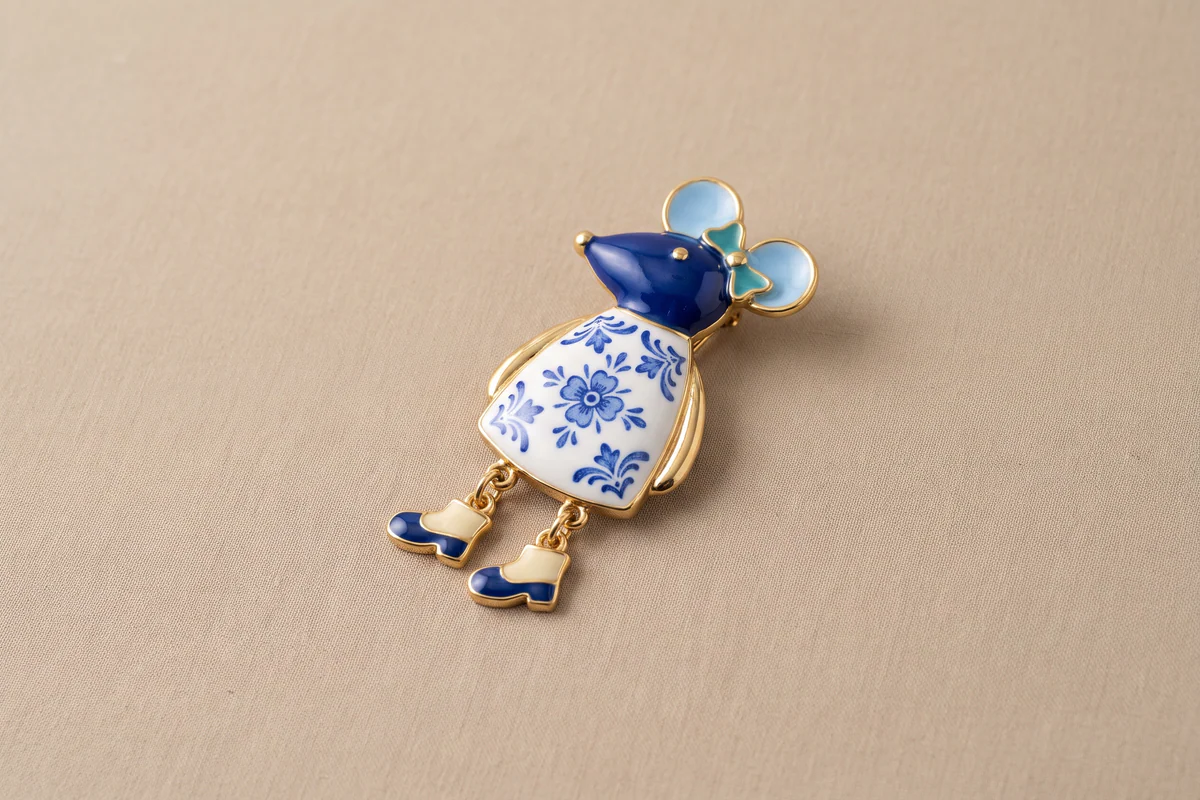
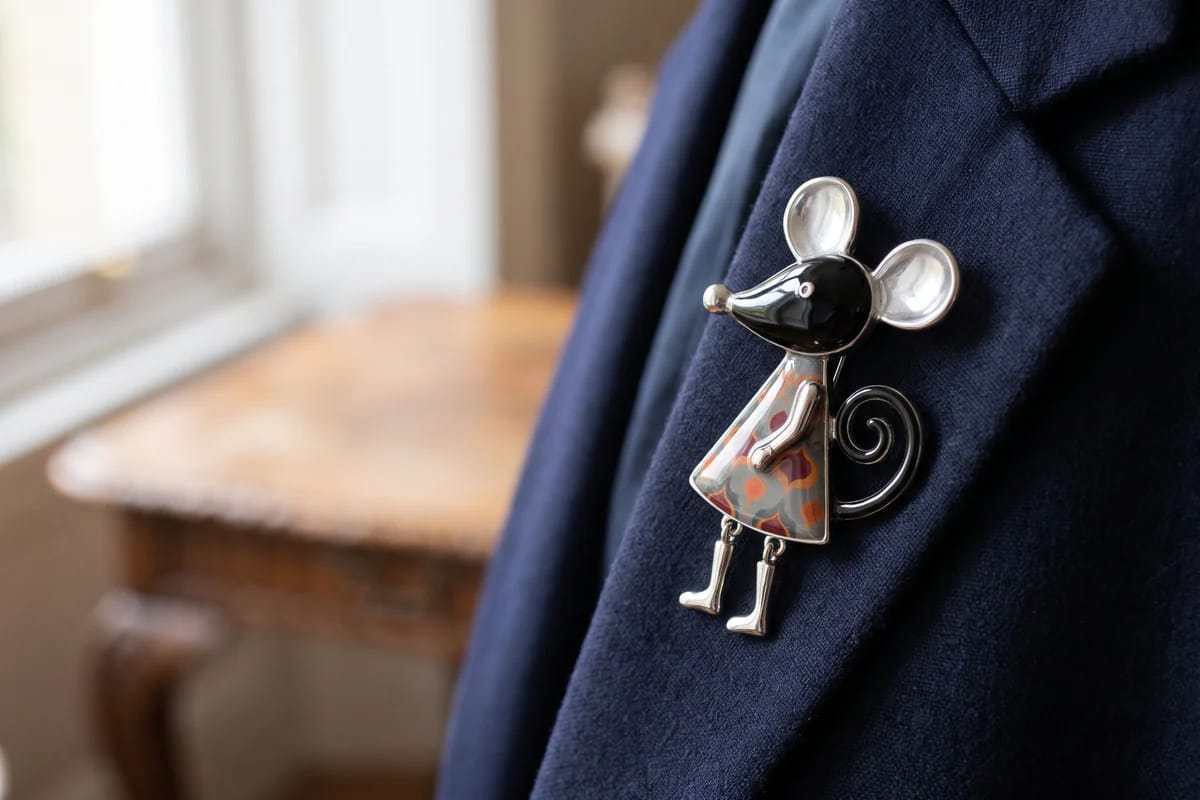
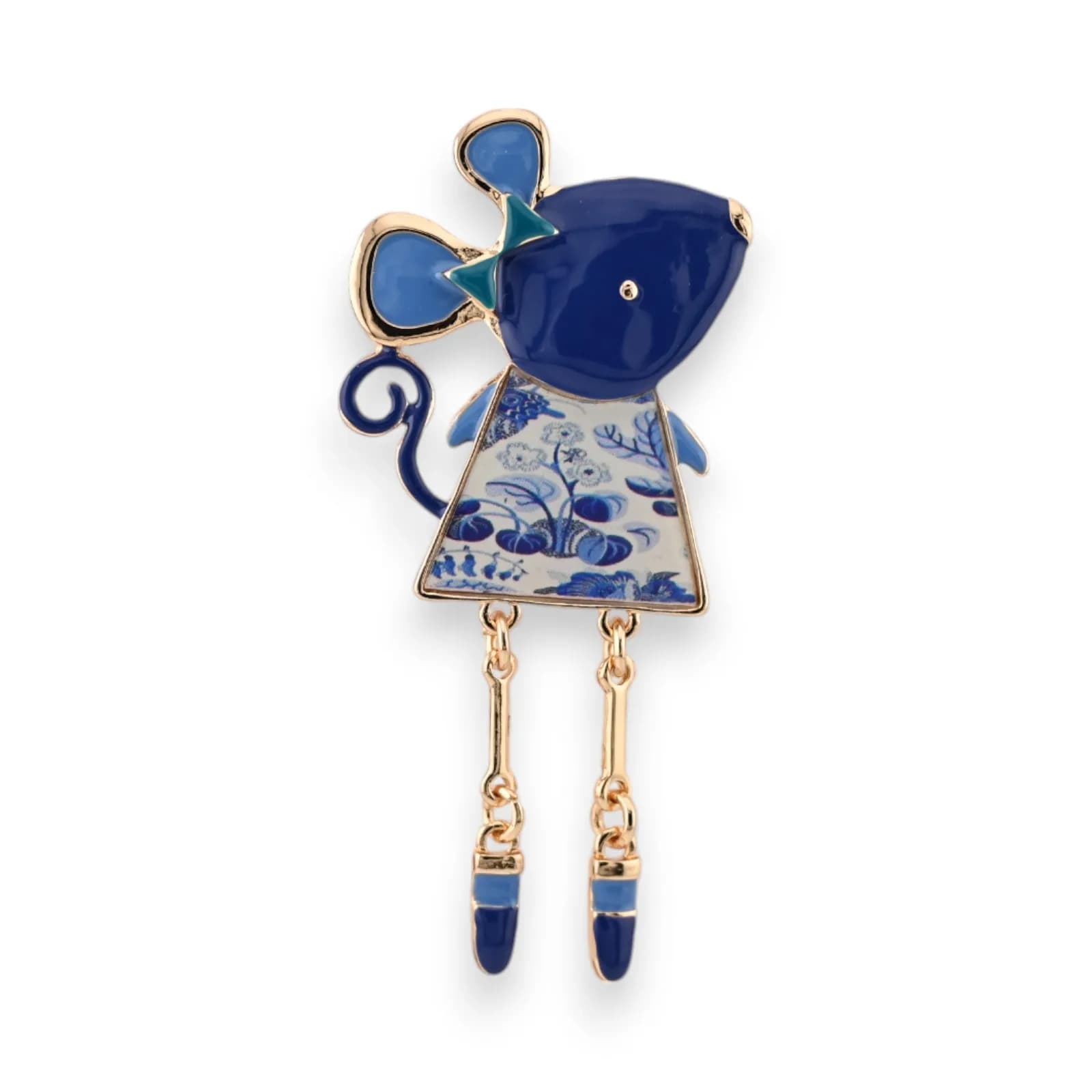
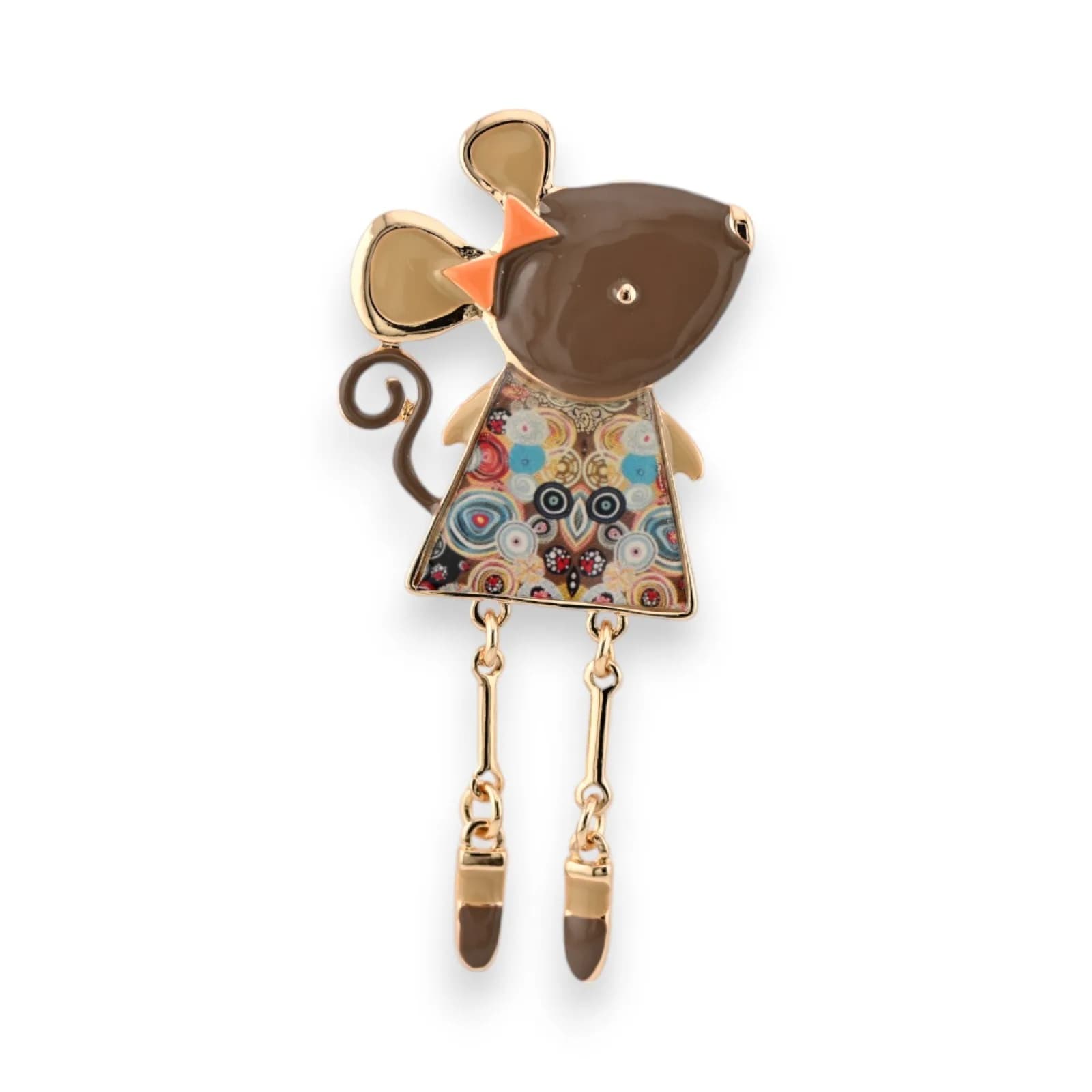
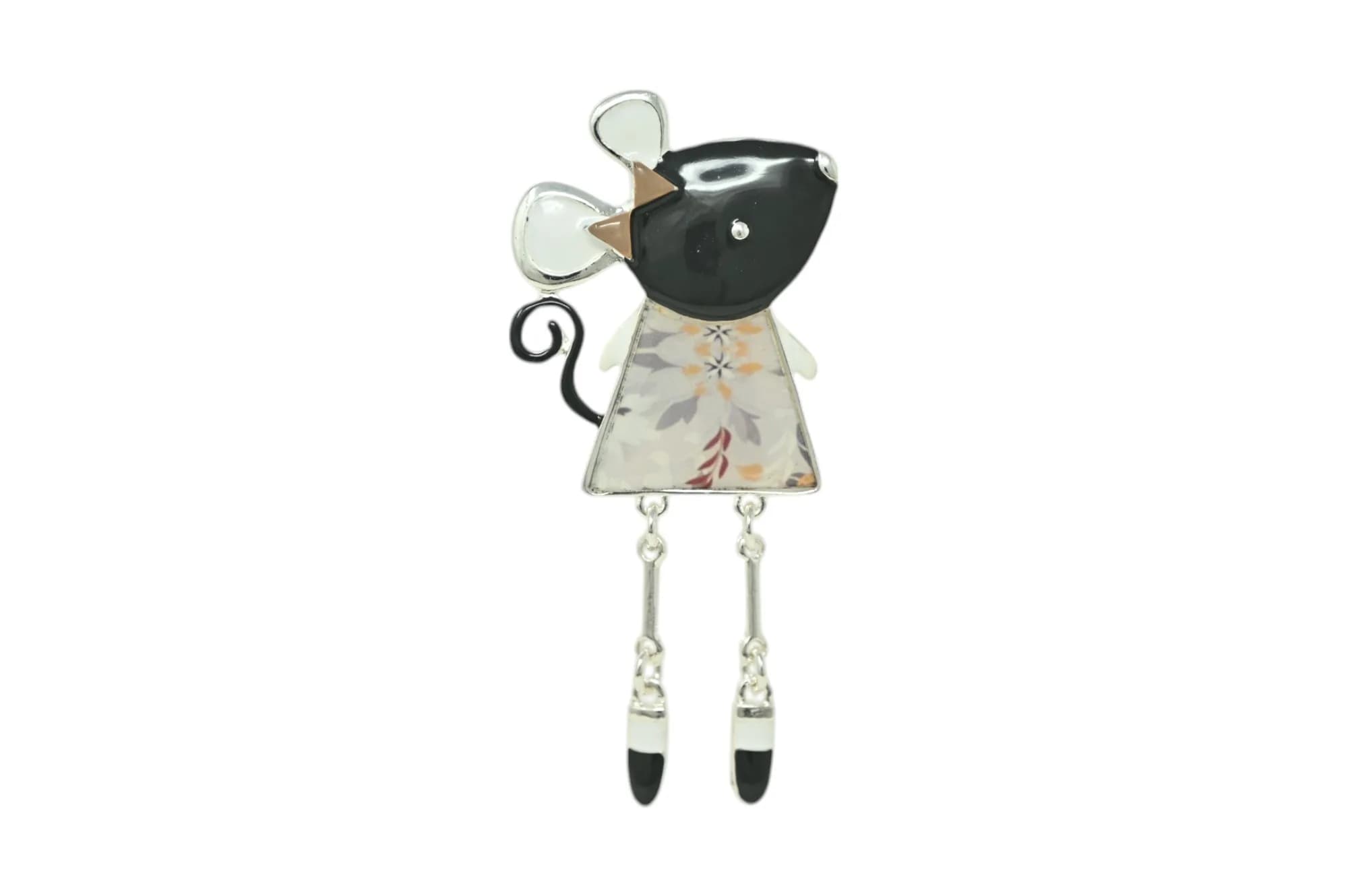
Small and a little mischievous, the mouse makes a natural piece of jewellery. Our mouse jewellery show her standing up in a patterned A-line dress, with two legs hanging from small rings that move as you do. Three personalities to choose from:
- a mouse with a deep blue head, in a white dress with blue flowers that recall blue-and-white pottery;
- a chocolate-brown mouse with a little orange bow, in a dress of multicoloured circles and rosettes;
- a mouse with a black head and a silver-tone muzzle, in a floral dress of grey, orange and dark red.
The first two are gold-coloured, the third silver-tone. To match the rest of your jewellery, have a look at our gold-tone jewellery and our silver-tone designs. These mice fasten with a magnet and a plate worn inside the garment, like all our brooches that hold without a pin.
As a small motif, a mouse shows up best against a plain background: a blazer lapel, a coat collar, the shoulder of a jumper. Leave a little room below her so her legs can hang freely, away from buttons and edges. Our guide on where to pin a brooch goes through the other spots, garment by garment.
Giving a mouse
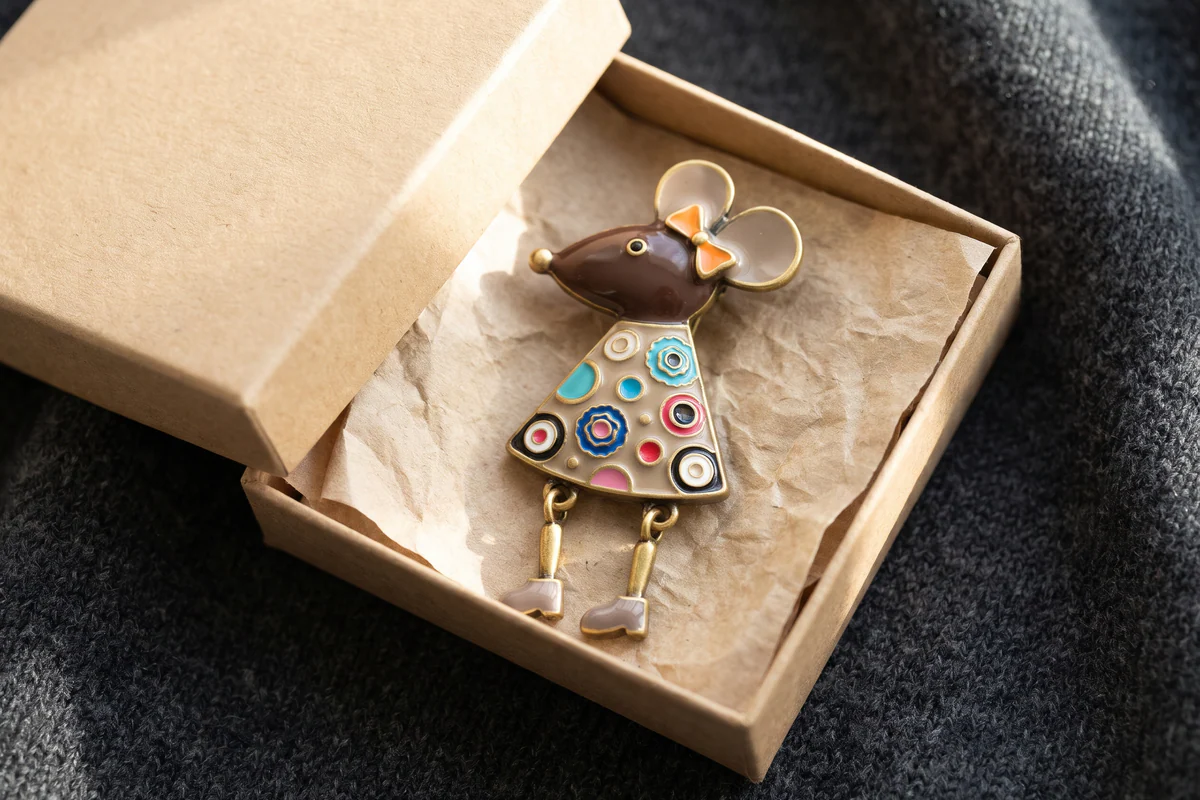
A mouse brooch speaks to several kinds of people: someone who collects animal motifs, someone who grew up with the mice of picture books and cartoons, or someone who likes a playful detail on a sober outfit. Its story also gives you something to write on the card:
- for a parent who has already played the tooth fairy, or the Little Mouse;
- for a friend born in a Year of the Rat, if they enjoy Chinese astrology;
- for a Burns lover, with the line about the best-laid schemes copied out by hand.
For other creatures, browse our animal designs, or the whole range of fashion brooches.
Mouse symbolism at a glance
| Tradition | Where you find the mouse | What it says |
|---|---|---|
| Ancient Greece | Apollo Smintheus, the Iliad | The pest the god protects against |
| India | Mushika, Ganesha’s mount | Agility that gets past obstacles |
| China | First sign of the zodiac | Cunning that beats strength |
| Fables | The young mouse, the mountain, the mouse turned girl | Caution, disappointment, roots |
| Scotland, 1785 | Burns, To a Mouse | Plans that go awry |
| Folklore | The Little Mouse and Ratoncito Pérez | A rite of passage in childhood |
| 20th century | Mickey (1928), Engelbart’s mouse (1968) | Warmth, everyday life |
Tiny as it is, the mouse has found its way into temples, fables, a Scottish field, children’s bedrooms and the desk in front of you. Perhaps that is its real message: the smallest are often more resourceful than we think.
Frequently asked questions
What does a mouse symbolise?▾
Above all, the cunning of the small against the mighty, agility, caution and a rite of passage in childhood. Depending on the story, it can also stand for a pest, a disappointment or plans that go wrong.
What is the spiritual meaning of a mouse?▾
Readings that make the mouse a totem or spirit animal teaching attention to detail are modern spiritual interpretations. They do not appear in the older traditions examined here. Documented traditions link the mouse to Ganesha in India, to Apollo in Greece and to the first sign of the Chinese zodiac.
Why does a mouse take children’s milk teeth in some countries?▾
An old belief held that giving lost teeth to a rodent would make the new ones as strong as its own. The French Little Mouse may go back to a 17th-century tale by Madame d’Aulnoy, La Bonne Petite Souris. In Spain, the same role goes to Ratoncito Pérez.
Which god is associated with the mouse?▾
In India, the mouse or rat Mushika is the mount of Ganesha, the elephant-headed god. In ancient Greece, Apollo was called Smintheus, a name thought to come from sminthos, a word for mouse.
What does ‘the best-laid schemes of mice and men’ mean?▾
It comes from Robert Burns’s 1785 poem To a Mouse, written after a plough destroyed a mouse’s nest. It means that even the most carefully laid plans often go wrong.