
Elephant Symbolism: Why the Elephant Never Forgets
In 1255, Louis IX of France sent Henry III an elephant, and London came to stare. Memory, Ganesha, the white elephant: what the elephant symbolises.
Sandwich, on the Kent coast, early 1255. An elephant has just crossed the Channel from Wissant, near Calais. It is a gift from Louis IX of France to Henry III, and it is on its way to the Tower of London. When it arrives, crowds flock to see it.
So what does an elephant symbolise? Memory, wisdom, quiet strength, family leadership and the removal of obstacles. These meanings come from three different places: field observations, religious traditions and royal history. First, memory: the old saying that an elephant never forgets turns out to rest on real observations in the wild. Then wisdom and quiet strength, the strength of a giant that lives in families guided by its oldest females. In India, the elephant lends its head to Ganesha, the god who removes obstacles, invoked at the start of many ceremonies. In the Buddhist story of his conception, the Buddha’s mother dreams of a white elephant, and in Southeast Asia the white elephant became a royal symbol. And in medieval Europe, as Henry III found out, an elephant was a gift of prestige between rulers.
Let’s take these stories one at a time, and keep what science has observed apart from what tradition tells us.
A gift fit for a king: elephants at Europe’s royal courts
Henry III’s elephant at the Tower of London
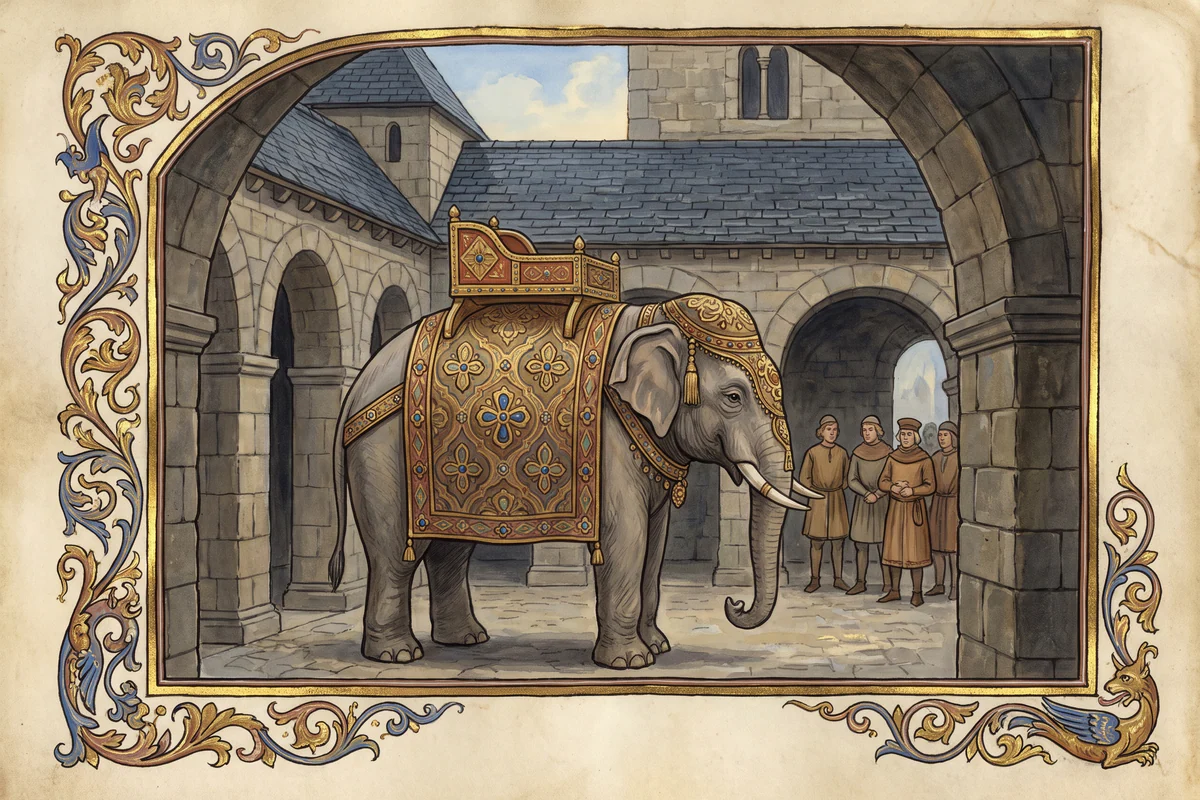
The story begins on the road. In late 1254, Henry III was travelling home from Gascony by way of Orléans and Paris, where he met Louis IX. The French king is thought to have given him the elephant around the time of their meeting. Back in England, the sheriff of Kent went to Dover and arranged for the animal, then kept at Wissant, to be shipped across.
At the Tower of London, a wooden house 40 feet long and 20 feet wide was built for the newcomer. The chronicler Matthew Paris drew the elephant from life, in his Chronica Majora and his Liber Additamentorum, and gave its age as ten years.
It did not live long in England. The elephant died on 14 February 1257 and was buried in the Tower’s bailey. In August 1258, Henry ordered the Constable of the Tower to dig up its bones and hand them to the sacristan of Westminster Abbey. Nobody knows quite why: perhaps for the valuable ivory, perhaps to bury them again. The Wikipedia article on the Elephant of Henry III follows the animal from Wissant to Westminster.
Abul-Abbas, Charlemagne’s elephant
Henry’s elephant had a famous predecessor. More than four centuries earlier, Harun al-Rashid sent an elephant to Charlemagne: Abul-Abbas. According to the Royal Frankish Annals, Isaac, who travelled with the animal, reached Aachen on 20 July 802; the annals call the elephant Abul Abaz.
Two kings, two elephants, the same message. In medieval Europe, a living elephant was a gift only a ruler could give, and one that drew crowds.
Does an elephant really never forget?
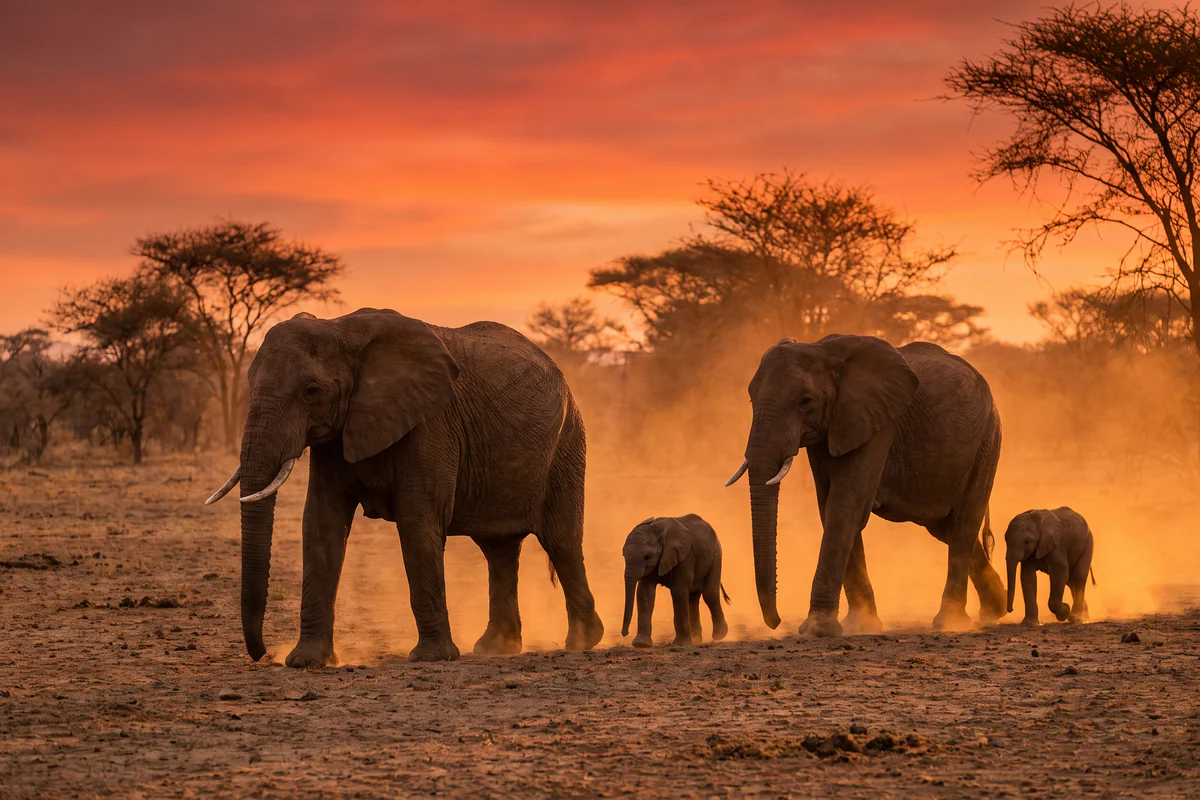
They say an elephant never forgets. The saying is old, and it is backed by more than folklore. In January 2009, in Scientific American, James Ritchie brought together several studies under the title “Fact or Fiction?: Elephants Never Forget”. They are field observations of particular elephant families, not a law of nature, and they do not prove that every elephant remembers everything. But they are striking.
The drought at Tarangire
In 1993, the rains failed in Tarangire National Park, in Tanzania. Scientists from the Wildlife Conservation Society followed three herds through the drought, in a study later published in the journal Biology Letters. Two families, led by matriarchs aged 38 and 45, left the park. The third, led by a 33-year-old matriarch, stayed where it was.
The toll was heavy. In nine months, 16 of the 81 calves born in the park died: a 20% death rate, compared with 2% in a normal year. Ten of those calves came from the group that stayed behind. The researchers’ explanation: the two older matriarchs remembered the drought of 1958 to 1961. The younger one had no such memory. Scientific American sums it up in one sentence: “None of the elephants that stayed behind were old enough to remember the previous dry spell.”
The matriarch, the family’s living memory
Among elephants, the females lead the herd. Footprints found at the Mleisa 1 site, in the United Arab Emirates, offer evidence about how elephant ancestors moved in family groups more than seven million years ago.
At Amboseli, Karen McComb and her colleagues at the University of Sussex made a telling observation, published in the journal Science. Faced with an unfamiliar elephant, families led by a 55-year-old matriarch took up a defensive position more often than families led by a 35-year-old. With age, a matriarch seems better able to judge what might threaten her family.
Twenty-three years on, they still knew each other
This memory does more than help elephants through droughts. It also seems to keep old friends in mind. In 1999, at the Elephant Sanctuary in Hohenwald, Tennessee, two elephants, Jenny and Shirley, were brought together. They had spent only a few months side by side, at the Carson & Barnes circus, twenty-three years earlier. According to Carol Buckley’s account, the meeting was full of emotion. Scientific American reports their reunion as an example of recognition after a long separation, without treating it as proof on its own.
A gentle giant: strength, patience and wisdom
For all its size, the elephant rarely makes us think of violence. An adult male African elephant weighs five to six tonnes, and yet everything in its life happens slowly:
- pregnancy lasts 20 to 22 months, the longest of any land mammal;
- a calf weighs around 120 kilos at birth, and suckles for three to four years;
- an elephant lives 60 years on average.
This slow pace feeds its reputation for wisdom. As far back as antiquity, Aristotle saw the elephant as the animal that surpasses all others in intelligence and understanding. Experiments with Gallup’s mirror test have been interpreted as evidence that elephants can recognise themselves, a possible sign of self-awareness. Another slow, long-lived animal shares this reputation for wisdom: you can read its legends in our article on what the turtle stands for.
Ganesha, the elephant-headed god who removes obstacles
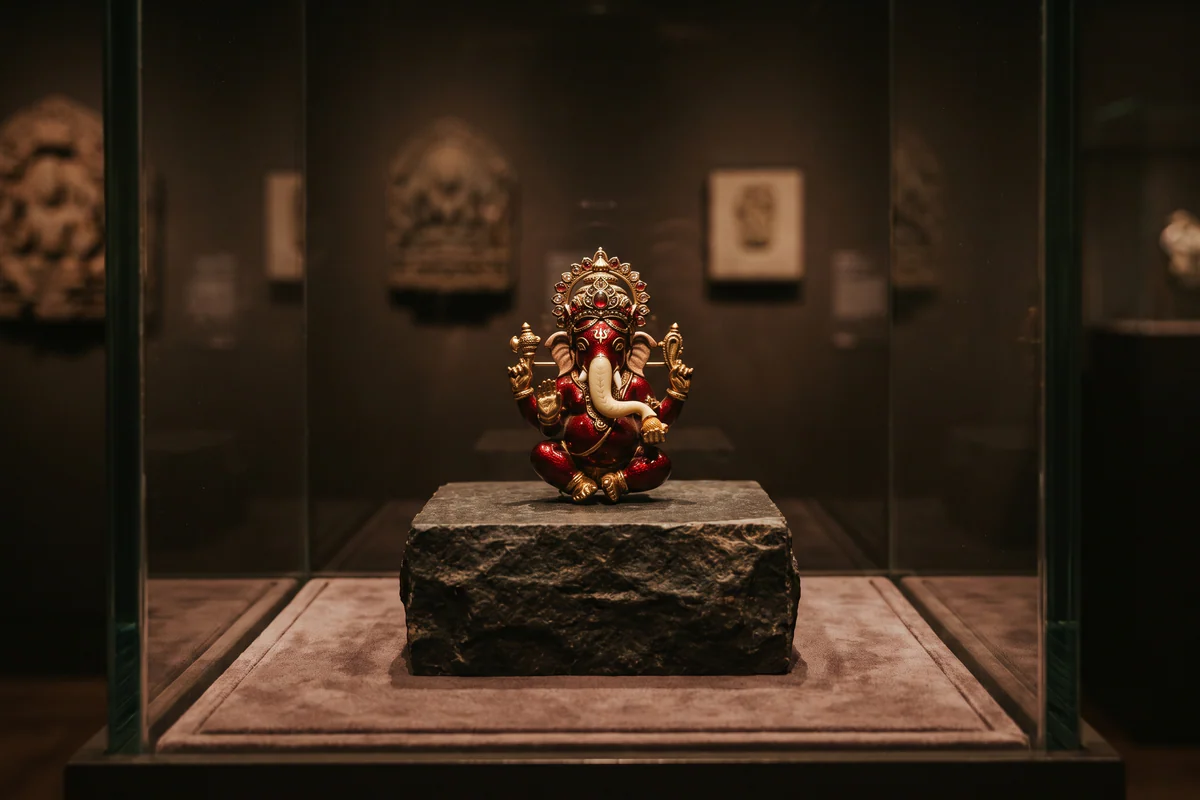
In India, the elephant has a divine face. Ganesha, with his elephant’s head, is one of the major deities of Hinduism.
Why an elephant’s head?
The myths tell the story in several ways. One of the best known, often traced to the Shiva Purana, begins at a closed door. Parvati is bathing. The goddess has shaped a son herself, from the dust and ointments scraped from her skin, and the boy is guarding the door. Shiva, her husband, comes home from meditating. The young man blocks his way. Shiva cuts off his head.
To give the boy a face again, Shiva takes the head of the first creature he meets: a baby elephant, whose mother was sleeping with her back to it.
Ganesha is usually depicted with a plump, red child’s body, often four arms, and an elephant’s head with a single tusk. One myth says he used that tusk to write down the Mahabharata as the sage Vyasa dictated it. A tusk turned into a pen.
The god of beginnings
Ganesha is the god who removes obstacles. He is also the god of wisdom, intelligence, education and prudence. He is invoked especially at the start of many Hindu ceremonies: before setting out, you ask for a clear road. In the Indian state of Maharashtra, he is celebrated for ten days, starting with Ganesh Chaturthi. The Wikipedia article on Ganesha sets out his stories and images in detail.
Ganesha is not the only elephant in Indian myth. Airavata, a white elephant born from the churning of the ocean of milk, carries the god Indra. One of his names means “the one who weaves or binds the clouds”: he is said to draw up water with his trunk and send it to the clouds. Here, the elephant links earth and sky.
The white elephant, from Queen Māyā’s dream to the kings of Asia
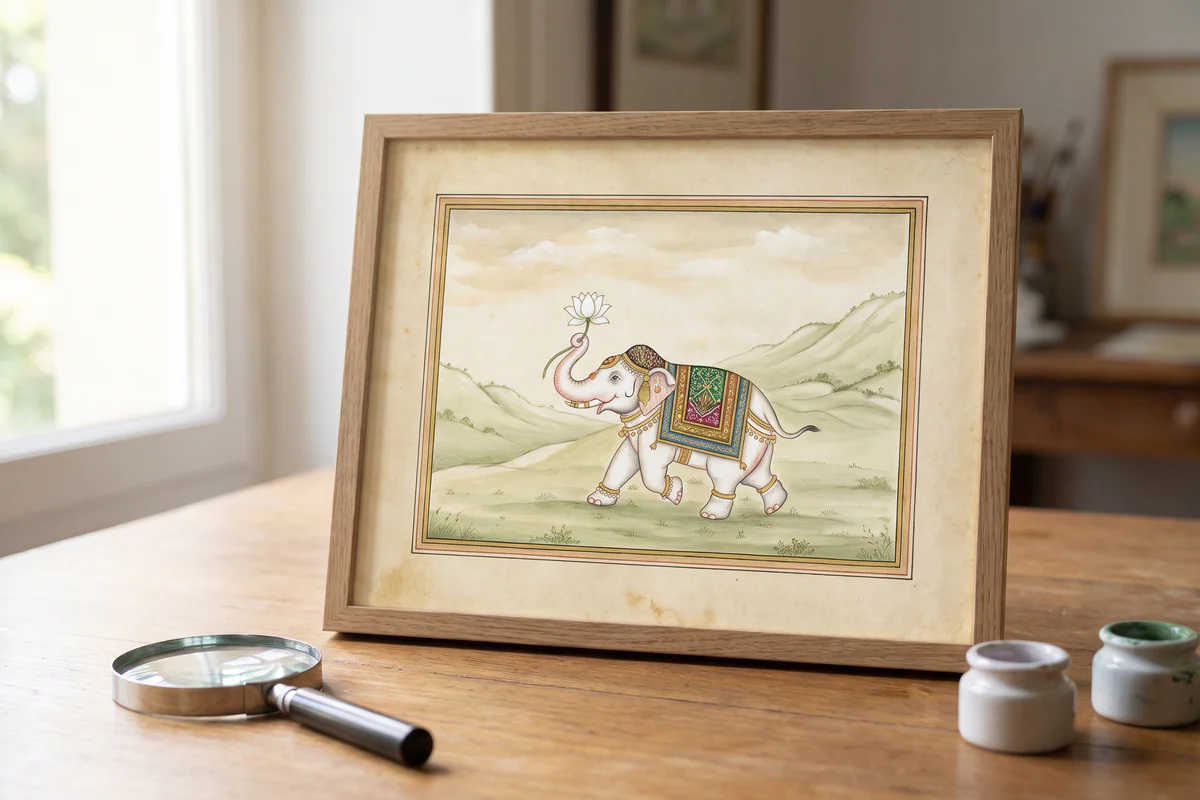
Queen Māyā’s dream
In Buddhism, the elephant appears before the Buddha is even born. In the story of his conception, his mother, Queen Māyā, dreams during her pregnancy of a white elephant offering her a lotus flower. Another version sharpens the picture: coming down from the Tusita heaven, a bodhisattva takes the form of a white elephant calf with six tusks, holds a white lotus in its trunk and enters her body through her side. From this conception, Siddhartha Gautama would be born at Lumbini, near Kapilavastu.
It is an arresting image: a small elephant, as white as the lotus it carries, heralding the one who will become the Buddha. One story goes further still, and says that the Buddha was a white elephant reborn as a man.
A royal symbol in Southeast Asia
But what exactly is a white elephant? In several Asian traditions, the term means an elephant with exceptionally pale colouring, often described as an albino. In Southeast Asia, owning one was a privilege of kings and princes: a royal symbol of sovereignty.
- In Burma, the white elephant gave its name to a royal title: Hsinbyushin.
- In Thailand, King Rama IV created the Order of the White Elephant in 1861.
- In Laos, a three-headed white elephant appeared on the flags of the French protectorate (1893 to 1954) and of the kingdom (1946 to 1975).
Elephant spiritual meaning: what we know and what we believe
If you are looking for the spiritual meaning of the elephant, it helps to untangle three threads:
- what science has observed: the memory of the matriarchs, family life, self-recognition in the mirror;
- what the myths tell: Ganesha, Airavata, Queen Māyā’s dream;
- what history has kept: the kings of the white elephant, and the elephants of Charlemagne and Henry III.
The three threads do not say the same thing, but they draw the same portrait: an animal that remembers, that guides its family and, in the stories, that opens the way. And if an elephant simply reminds you of a journey or a childhood book, that meaning counts too. The dog is another animal whose meaning comes from the stories told about it: read why the dog stands for loyalty.
An elephant brooch as a gift: who it’s for and what to write
Who it’s for
With these stories in mind, an elephant suits many occasions:
- a fresh start (a new job, a move, a business getting off the ground), in honour of Ganesha, invoked at the start of many ceremonies;
- a new school year, exams or a graduation, as a nod to the god of wisdom and education;
- a grandmother, a mother or a godmother, the matriarch who keeps the family’s memory;
- a friendship rekindled after many years, like Jenny and Shirley’s;
- a birth, echoing Queen Māyā’s dream.
A few words for the card
- “May the road ahead be clear.”
- “For someone who never forgets.”
- “A memory like an elephant’s, and a heart to match.”
Wearing an elephant
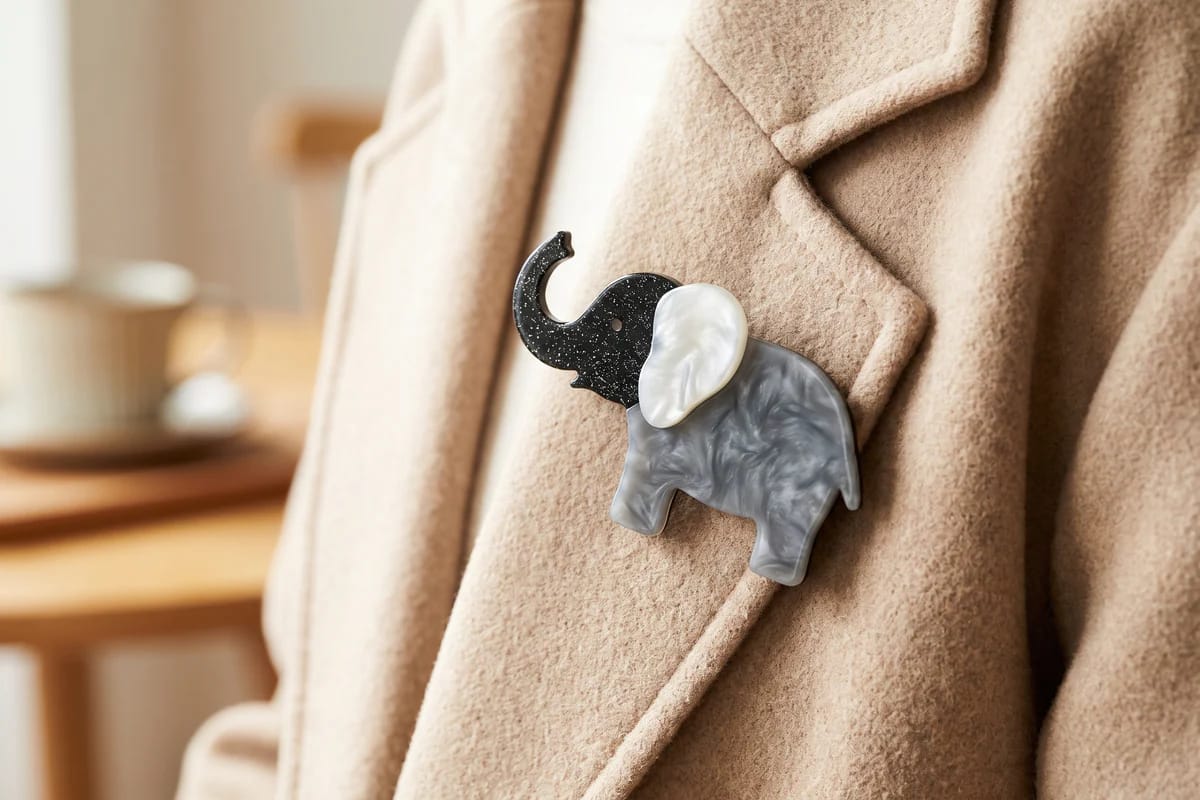
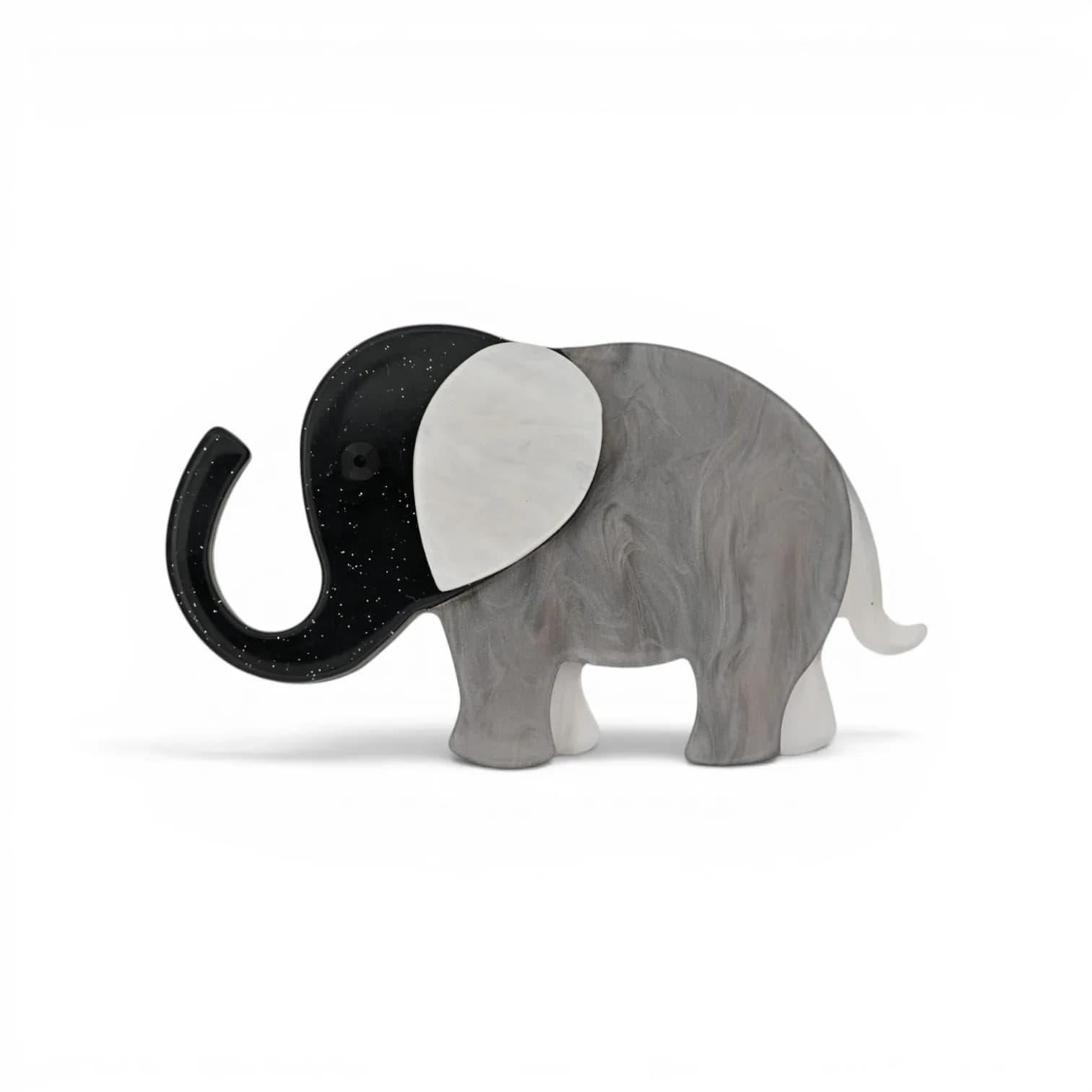
Wearing an elephant means keeping a little of that quiet strength about you. Among our magnetic brooches, there is a resin elephant, a piece of fashion jewellery: a grey marbled body, a glittery black head and trunk, and a large white ear with a pearly finish. Its raised trunk stretches the silhouette forward. It fastens with a magnetic clasp.
On the lapel of a wool coat, a blazer or a cardigan, it gets noticed without trying too hard. You will find it in the elephant selection in our shop. And if you are still deciding, other creatures are waiting among our animal brooches.
Elephant symbolism at a glance
From one culture to the next, the elephant changes costume but keeps its character.
| Tradition or source | Story or figure | What the elephant stands for |
|---|---|---|
| England (1255 to 1257) | Henry III’s elephant at the Tower of London | A royal gift that drew crowds |
| Europe (802) | Abul-Abbas, sent to Charlemagne | A gift of prestige |
| Science (Tanzania, 1993) | The matriarchs of Tarangire | Memory that protects the family |
| Science (Amboseli) | The 55-year-old matriarch | Experience that protects the group |
| Hinduism | Ganesha | Wisdom, obstacles cleared away |
| Hinduism | Airavata, Indra’s mount | Clouds and water |
| Buddhism | The white elephant of Queen Māyā’s dream | The coming of the Buddha |
| Southeast Asia | The white elephant of kings | Sovereignty |
Frequently asked questions
What does “a white elephant” mean in English?▾
A white elephant is a costly, prestigious project that makes no economic sense: a money pit that is more trouble than it is worth.
What animal does Ganesha ride?▾
Despite his elephant’s head, Ganesha gets about on a very small animal: his mount is a rat or a mouse called Mushika.
How many heads does Airavata, Indra’s elephant, have?▾
Airavata is shown with three heads, or even thirty-three. In Thai, he is called Erawan.
Is Ganesha worshipped outside India?▾
Yes. In Japan, he is found in Shingon esoteric Buddhism, under the names Shōten or Kangiten.
What happened to Charlemagne’s elephant?▾
Abul-Abbas lived in Aachen and Augsburg from 802 until his death in 810. Pneumonia is often given as the cause, but this remains uncertain.