
Lucky Cat Meaning: Maneki-Neko and Black Cat Lore
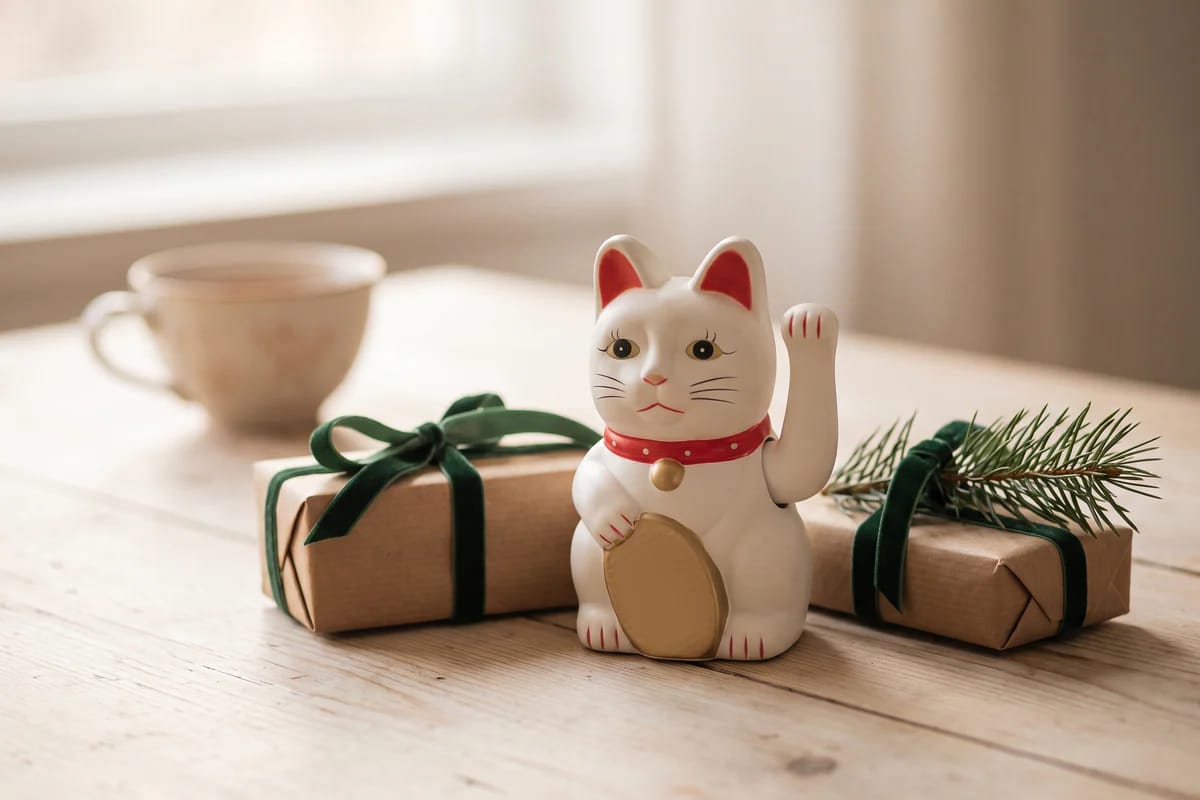
Why do cats bring good luck? The maneki-neko’s raised paw and colours, why black cats are lucky in Britain, Bastet, Dick Whittington and ideas for giving a lucky cat.
The best-known lucky cat in the world is the maneki-neko, the little Japanese cat that sits with one paw raised to beckon good fortune, customers and prosperity through the door. Yet cats have carried luck far beyond Japan. They were associated with the goddess Bastet in ancient Egypt, they pulled the chariot of the Norse goddess Freyja, and in Britain a black cat crossing your path is traditionally a good sign. In much of continental Europe, the same black cat has had a far gloomier reputation. So the meaning of a lucky cat depends on where you are, its colour and its gesture. Here is how to read those symbols, where they come from, and how to give a lucky cat that truly means something.
What is a lucky cat? The maneki-neko explained
Its name means “beckoning cat”: maneki comes from the verb maneku, to invite or call in, and neko simply means cat. You will spot it by the tills of shops and restaurants, usually in ceramic, sometimes with a paw that swings up and down on a small battery. In Britain it is often called the “Chinese lucky cat”, because the waving version is so familiar from Chinese restaurants and supermarkets. The figurine was, however, born in Japan, during the Edo period.
The legend of Gōtoku-ji temple
The most famous story takes place at Gōtoku-ji temple, in Tokyo’s Setagaya ward. In the seventeenth century, Ii Naotaka, lord of the Hikone domain, was riding home from a falconry trip when a cat sitting by the temple gate seemed to wave him inside. Moments after he took shelter, a violent storm broke. Grateful, the lord became the temple’s patron, and it was rebuilt in 1633 thanks to his support, as the official Gōtoku-ji temple website explains.
Today visitors leave thousands of white figurines there to give thanks for a wish come true. One detail sets them apart: the Gōtoku-ji cat raises its right paw and holds no coin. According to the temple’s teaching, it brings encounters, and it is up to each of us to turn them into good fortune.
Other places claim to be the birthplace of the maneki-neko, such as the Imado shrine in Tokyo’s Asakusa district. Among the earliest written records is the Edo chronicle Bukō nenpyō (1852); the same year, a woodblock print by Utagawa Hiroshige, Jōruri-machi hanka no zu, shows ceramic cats on sale at Sensō-ji temple.
Left paw or right paw?
In the most common reading, a raised right paw attracts money and good luck, while a raised left paw attracts customers and visitors. Some people say it is the other way round, and you will also find cats waving both paws, a way of hedging your bets.
What the colours mean
Maneki-neko were originally white or black, but today they come in every shade, each with its own wish:
| Colour | What it is said to bring |
|---|---|
| Calico (white, black and ginger) | The most popular, said to be the luckiest of all |
| White | Purity, good luck and general prosperity |
| Black | Protection from bad luck and a safe home |
| Red | Good health; it was once thought to ward off illness |
| Gold-tone | Wealth and financial success |
| Green | Success in studies and exams |
| Pink | Love and relationships, a more recent reading |
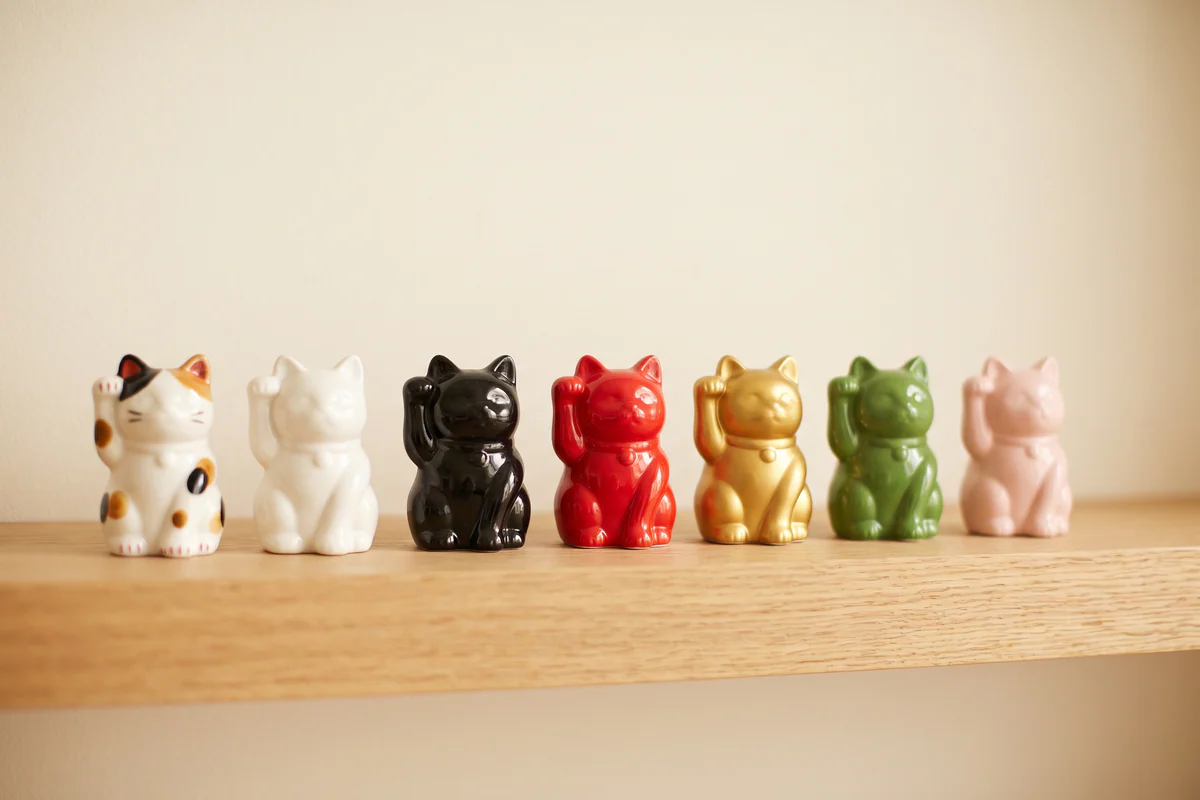
These meanings, partly borrowed from feng shui, vary from one seller to the next, so treat them as a guide rather than a rule. In Japan the beckoning cat even has its own day: in 1995 the Japan Maneki Neko Club chose 29 September, because the date can be read as kuru fuku, “good fortune is coming”. And in 2007 the little station of Kishi, in Wakayama Prefecture, appointed a calico cat called Tama as its stationmaster. Nicknamed the “living maneki-neko”, she brought passengers back to a line that had been threatened with closure.
Black cats: lucky or unlucky?
The short answer: it depends where you grew up. The black cat that still makes some people on the Continent shiver is generally seen as a lucky omen in Britain.
Why black cats are lucky in Britain
In much of Britain, a black cat crossing your path is traditionally a sign of good luck. A Dictionary of Superstitions, by Iona Opie and Moira Tatem (Oxford University Press, 1989), records many British beliefs along these lines, although they sometimes contradict each other from one region to the next. The Scottish Highlands have a legend of their own, the cat-sìth or fairy cat: in Superstitions of the Highlands and Islands of Scotland (1900), John Gregorson Campbell, minister of Tiree, describes it as a black cat as large as a dog, with a white spot on its breast, and notes that many Highlanders took it for a witch in disguise rather than a fairy.
The black cat’s good name is still being championed today. The charity Cats Protection launched National Black Cat Day on 27 October 2011, after finding that black and black-and-white cats in its care waited around a week longer for a new home than cats of other colours. It has been celebrated every October since.
Where the bad reputation comes from
From the Middle Ages onwards, black cats in Europe became linked with the night, witchcraft and the devil. That is the root of the superstition, still alive in many countries, that a black cat crossing your path foretells misfortune. In Italy, the prejudice is proving hard to shake: ANSA calls it “un preconcetto duro a morire”. The Italian association AIDAA (Associazione Italiana Difesa Animali ed Ambiente) promotes a black cat day every 17 November, to fight superstition and protect black cats. The date is no accident: in Italy it is 17, not 13, that is considered unlucky.
Ypres and its Cat Parade
In Ypres, Belgium, the Kattenstoet recalls a darker chapter. For centuries, live cats were thrown from the belfry of the Cloth Hall; according to a report by Flemish public broadcaster VRT, the last time live cats were thrown was in 1817, as the town’s first archivist noted. Since 1938, the town jester has thrown toy cats instead, and a grand feline parade, first held in 1955, now takes place every three years on the second Sunday in May: the official Cat Parade website announces the next edition.
Cats as sacred and lucky animals through history
Long before the Japanese figurines, cats already had devoted followers.
Bastet and the cats of ancient Egypt
In ancient Egypt, cats kept granaries free of rodents and were associated with Bastet, protective goddess of the home, women and childbirth, often shown with a cat’s head. Her great sanctuary stood at Bubastis, in the Nile Delta. The Greek historian Herodotus writes in Book II of his Histories (fifth century BC) that the people of a household shaved their eyebrows when their cat died, and that the animal was embalmed. At the British Museum in London, the famous Gayer-Anderson cat, a bronze dated to around 600 BC, shows the goddess in the form of a seated cat.
Freyja, Dick Whittington and nine lives
In Norse mythology, Freyja, goddess of love, rides in a chariot drawn by two cats, according to the Prose Edda of Snorri Sturluson (around 1220). England has its own lucky cat story: Dick Whittington and his cat. The real Richard Whittington was Lord Mayor of London in 1397, 1398, 1406 and 1419, and died in 1423. As the City of London recalls, he came from a wealthy family rather than being the poor orphan of the tale, and no one is quite sure whether the cat said to have made his fortune, by ridding a faraway king of his rats, is myth or reality. The legend was already well known in 1605, when the comedy Eastward Hoe mentioned “the famous fable of Whittington and his puss”. Charles Perrault’s Puss in Boots (1697), in which a cunning cat helps a miller’s youngest son, is another tale of a cat making its owner’s fortune. And the belief that a cat has nine lives was already familiar to Shakespeare: in Romeo and Juliet (Act 3, Scene 1), Mercutio calls Tybalt “king of cats” and threatens to take “one of your nine lives”.
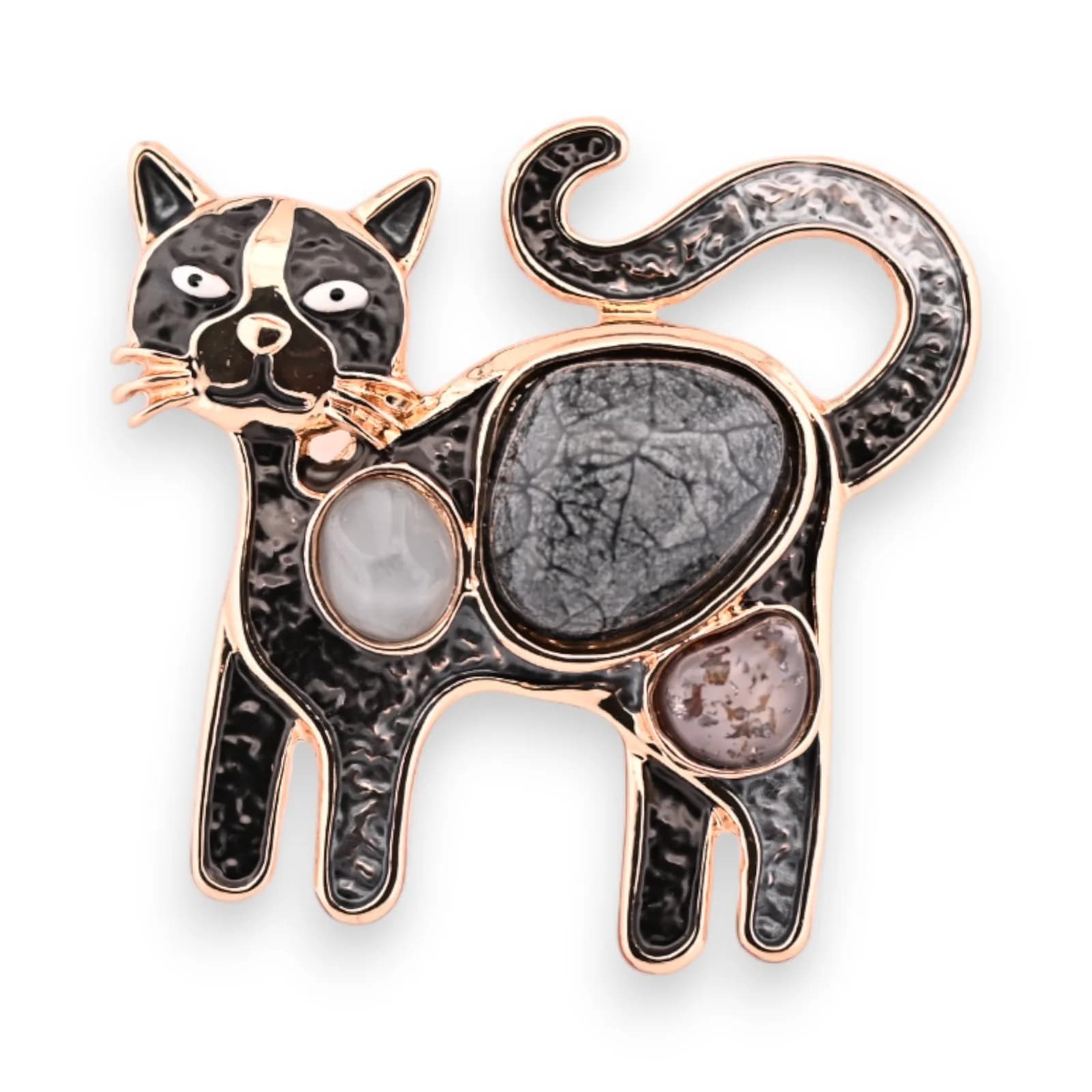
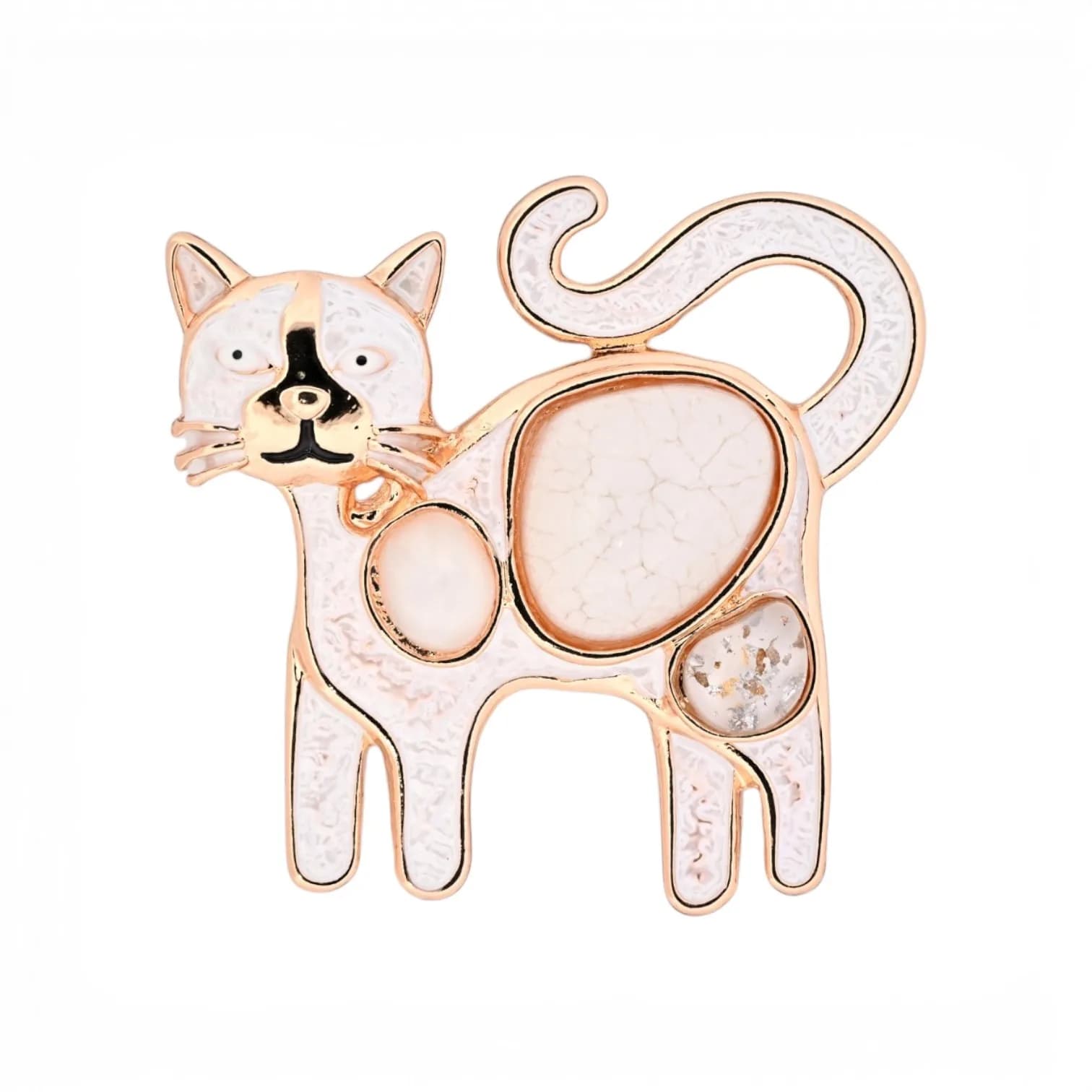
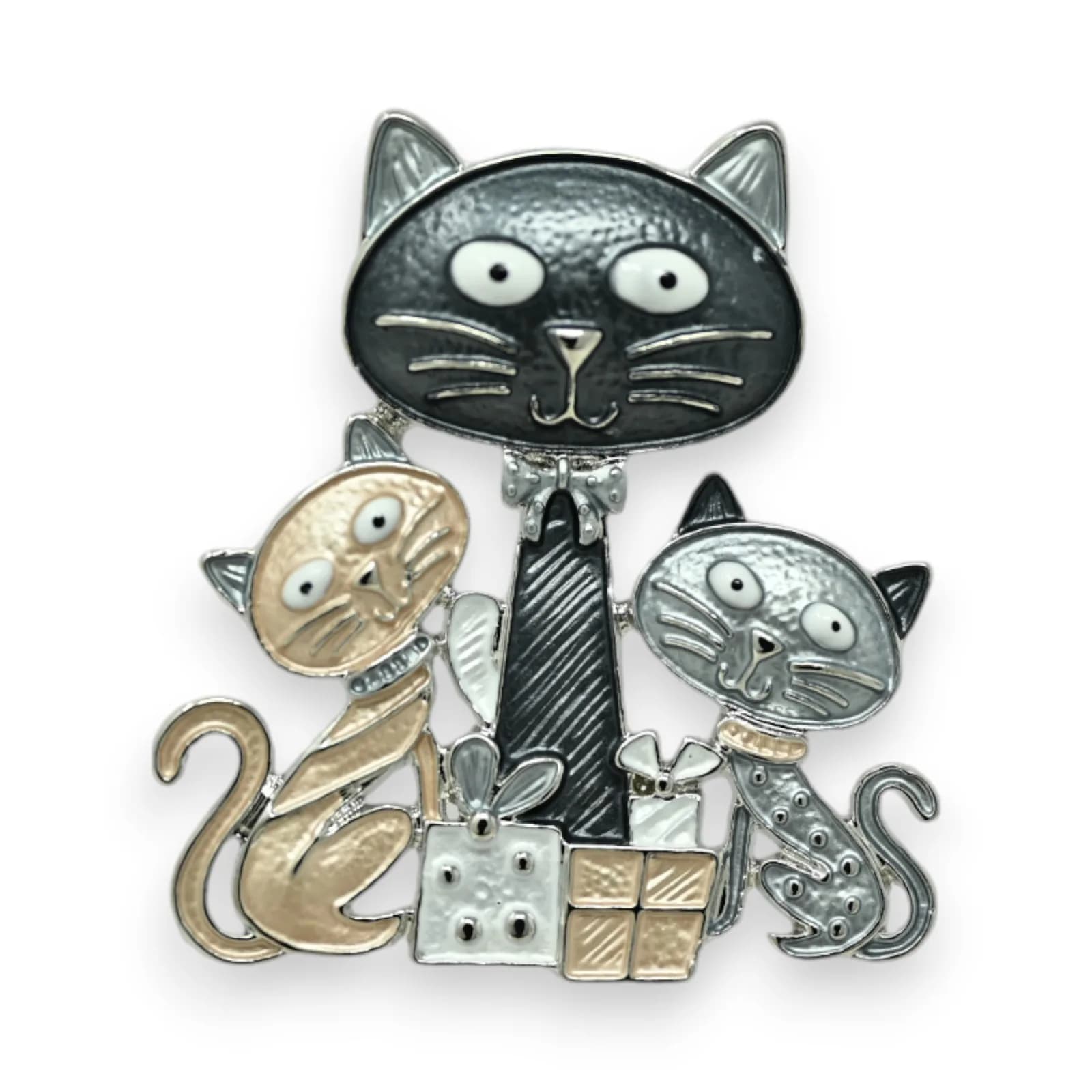
The cat is not the only animal credited with such powers. Ladybirds, elephants and tortoises have their own beliefs too, and that is what gives meaning to animal brooches with a story to tell: each one carries its own belief.
What does a cat symbolise today?
Beyond luck, the cat brings together several meanings found from one culture to another:
- Independence: it chooses its friends, and that is often what we admire about it.
- Protecting the home: a legacy of its role as a mouser in granaries, shops and ships.
- Mystery and intuition: a creature of dusk, it sees in the half-light.
- Agility: we say someone who gets out of a tight spot has “landed on their feet”.
Each of these meanings can guide a choice: a peaceful, curled-up cat for a friend who loves her home comforts, a black cat for one who laughs at superstition. It is also a lovely way to choose among our cat-shaped brooches: start from the trait you would like to give.
Giving a lucky cat
A lucky cat is a charming present for a new job, a new home or simply a new year. For it to really touch the person you give it to, start from her rather than from the object:
- for a friend opening a shop or going freelance, a maneki-neko with its left paw raised, the one that beckons customers;
- to go with a get-well wish, Japanese tradition links red with protection against illness;
- for a cat lover, a lucky charm she can wear rather than one more ornament for the mantelpiece;
- and in every case, a little note explaining what the symbol means.
If you are still hesitating, our guide to choosing a brooch as a gift helps you start from what she already wears.
Keeping your lucky cat close
A maneki-neko stays on the shelf; a cat you wear goes everywhere with you. That is the very spirit of the costume jewellery brooches by Ma Broche: a discreet lucky charm, worn on a coat lapel, a jumper or a bag.
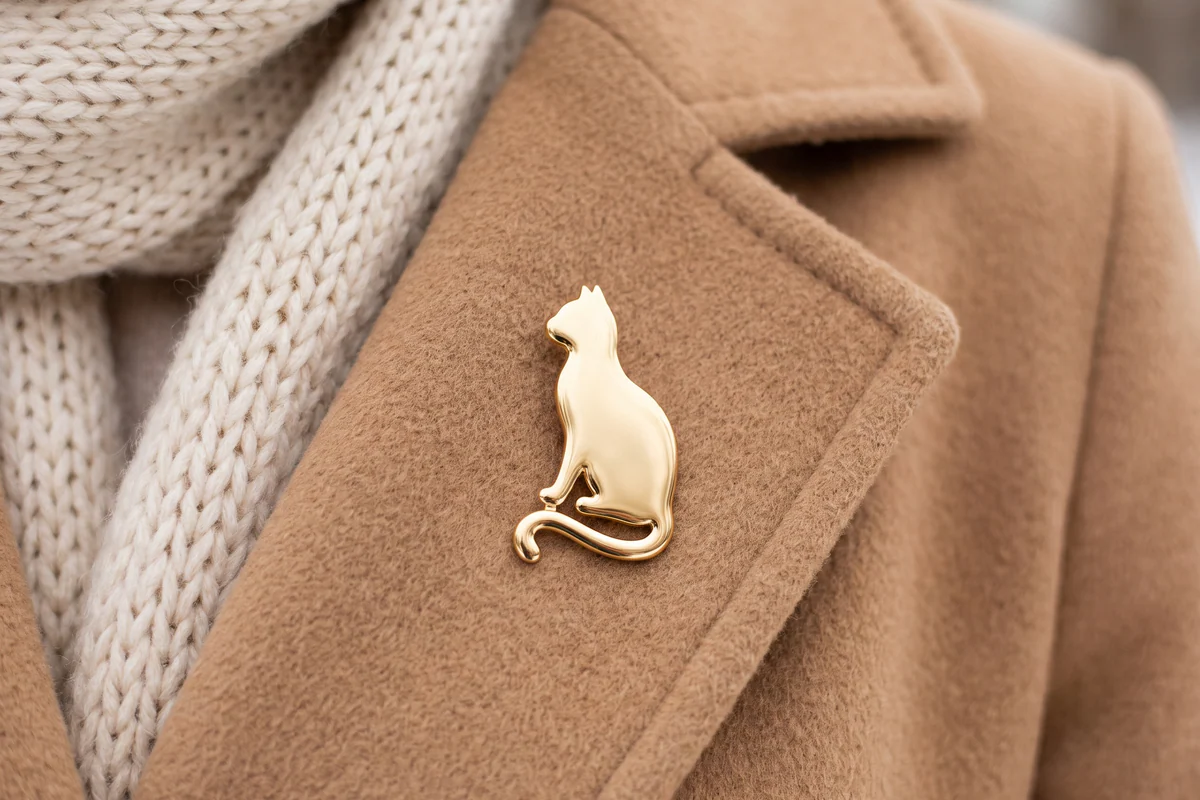
As for tones, gold-tone echoes the maneki-neko of prosperity, silver-tone suits the greys and blues of winter, and rose gold-tone warms up a camel coat or cream knitwear. Most of our cats fasten with a magnet, so fine cashmere or delicate wool stays intact. For a softer look, a little cat on a knotted scarf works beautifully: follow our tips to wear a scarf with a brooch without pulling on the fabric.
In short
The lucky cat par excellence is the Japanese maneki-neko: right paw for fortune, left paw for customers, and a colour for every wish. The black cat, for its part, is seen as a good omen in Britain and, as a black maneki-neko, is said to keep bad luck away; its poor reputation elsewhere in Europe comes mostly from superstitions inherited from the Middle Ages. From Bastet to Dick Whittington, the cat is still one of the richest symbols to give, or to treat yourself to.
Frequently asked questions
Where should you put a maneki-neko at home?▾
Tradition places it near the entrance, facing the door, since its job is to beckon good luck and visitors inside. In a shop, it sits in the window or by the till. What matters most is that it can be seen clearly from the doorway.
Why does the maneki-neko wear a red collar and a bell?▾
The detail is said to date back to the Edo period, when wealthy households, for whom a cat was a costly companion, dressed it in a red fabric collar with a little bell, both to adorn it and to hear it coming. The figurines have kept this touch of coquetry.
What does the writing on the maneki-neko’s coin mean?▾
On its tummy you will often read the character 福, fuku, “good fortune”, or 開運, kaiun, “luck opening up”. The coin, a koban, frequently bears the words “ten million ryō”, a fabulous sum in the Edo period, as a wish for boundless prosperity.
Is there a day to celebrate cats in the UK?▾
Yes. International Cat Day falls on 8 August: it was launched in 2002 by the International Fund for Animal Welfare (IFAW) and has been run since 2020 by the UK charity International Cat Care. Cats Protection also runs its own day for black cats in October (see above).
Can you give a real cat as a Christmas present?▾
It is best to avoid the surprise. As the Dogs Trust slogan has reminded us since 1978, a dog is for life, not just for Christmas, and the same goes for cats: adopting one is a commitment of many years and should stay the decision of the person who will live with it. At Christmas, a cat symbol she can keep close is the better gift.