
Lizard Symbolism: The Animal That Waits for the Sun
Still on a warm stone, ready to drop its tail and run: what the lizard symbolises, from Apollo to the Bible, and where history ends and belief begins.
Walk to the southern tip of Cornwall and you reach the Lizard, where the southernmost point of the British mainland lies. You might expect the place to be named after its reptiles. It isn't. The name most probably comes from the Cornish Lys Ardh, "high court", and any link with the animal is pure coincidence.
The real lizard is easier to read. Picture it on a warm stone, perfectly still, soaking up the sun, then gone in a flash, sometimes leaving a wriggling piece of tail behind. Lizard symbolism grows out of that scene. In the stories, texts and artworks we looked at, the lizard is linked with the sun and warmth, with renewal (its tail can grow back) and with patient stillness. Praxiteles placed one beside Apollo, Proverbs counts it among the small but wise in modern translations, and Christian art saw contemplation in its basking pose. Here is where each meaning comes from, and how much of it you can trust.
What does a lizard symbolise?
In the behaviour, texts and artworks we looked at, six readings come up again and again:
- the sun, warmth and the art of taking your time;
- renewal, through the tail that grows back;
- patience and discretion, since it can stay motionless for minutes on end;
- small but real wisdom, in a proverb from the Bible;
- contemplation of the light, in Christian art;
- in ancient Greece, depending on the reading, either the threat of disease or healing by the sun.
Several of these ideas begin with something you can watch for yourself on a sunny bank: basking, keeping still and, in some species, dropping and regrowing the tail.
Britain's lizards: small sun worshippers
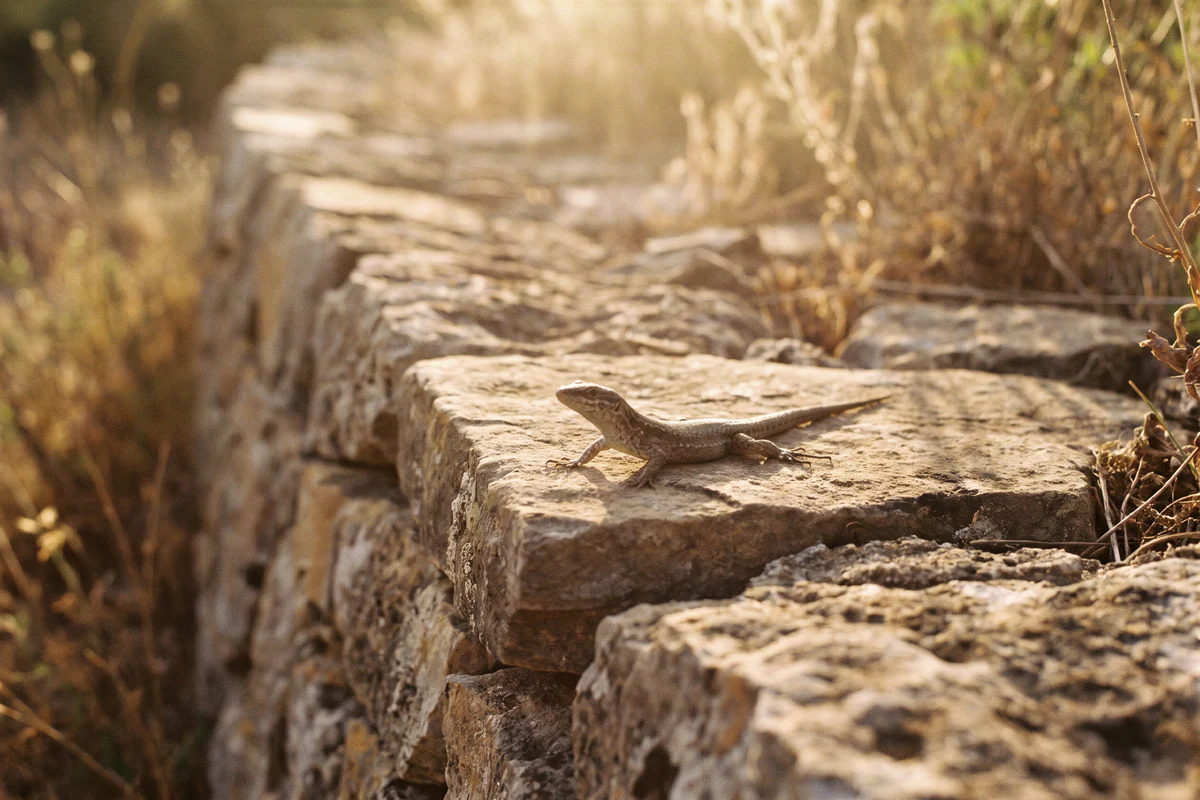
Britain is not lizard country, and that makes each sighting feel like a small event. The sand lizard, for instance, is one of Britain's six native reptile species. In colder places like Great Britain it needs sand to incubate its eggs, so it is restricted to coastal habitats, and it is strictly protected under UK law. The Amphibian and Reptile Conservation Trust has even run a captive breeding and reintroduction programme for it.
Ireland's only native land reptile
The lizard you are more likely to meet is the viviparous lizard, or common lizard. Its name says something unusual: it usually gives birth to live young instead of laying eggs. It is Ireland's only native land reptile. It spends much of its time basking in the sun to regulate its temperature, and it hibernates between October and March.
Why a lizard needs the sun
None of this is laziness. A lizard is an ectotherm: it produces very little heat of its own. To warm up it relies on its surroundings, the sun above all, moving between shade and light to keep its body at the right temperature. People often say "cold-blooded", but the word is inaccurate: its blood is not necessarily colder than ours.
Across the Channel, the wall lizard shows how far this goes. It lives in almost all of mainland France, loves old walls and sunny stone heaps, and is described as the French lizard that lives closest to people. According to the French Wikipedia, it can spend up to 95% of its time warming up or cooling down to stay around 33.8 °C, its preferred temperature. The French even have a phrase for it: "faire le lézard" (literally "to do the lizard"), meaning to laze in the sun.
The tail that grows back: a symbol of renewal
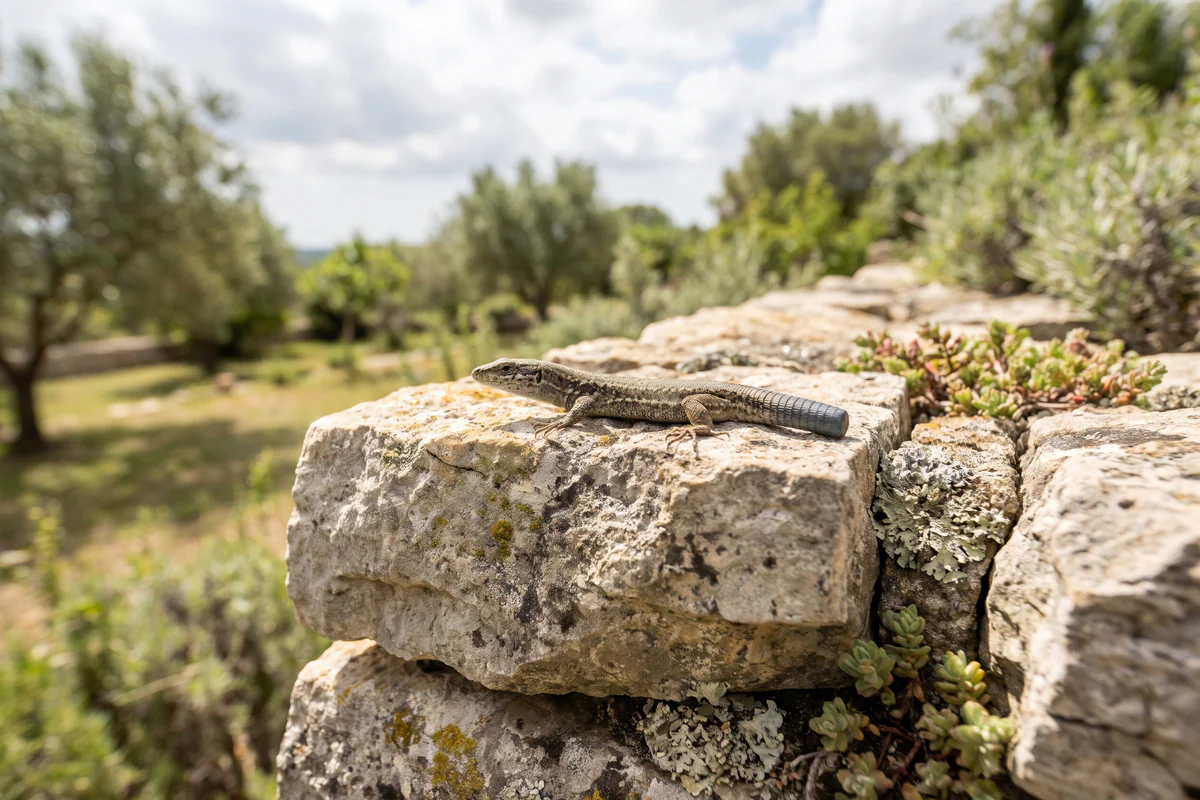
This is the lizard's most surprising trick. Caught by the tail, it lets go of it and runs. Biologists call this autotomy, from the Greek for "self" and "cutting".
What really happens
The tail does not snap just anywhere. As the autotomy entry explains, it breaks at built-in weak points inside the vertebrae, where a bridge of cartilage links the two halves of each bone. The dropped piece keeps wriggling, sometimes for more than an hour, which keeps the predator busy while the lizard slips away.
The tail can then grow back, but never quite the same:
- it is often shorter, a different colour and less mobile;
- in the wall lizard, it regrows without its original scales, in a plain dark grey;
- in some reptiles it can even grow back split in two;
- the ability to regrow weakens with each loss.
And not every lizard can do it: only certain families are able to shed their tails.
Why the idea stuck
It is easy to see why this captured the imagination. The lizard gives up part of itself to save the rest, then rebuilds. This is where a modern symbolic reading comes from: letting go of what puts you in danger, getting back on your feet, starting again in a new form. Biology makes the symbol more honest still, because the tail returns, but different. The lucky lizard tail you may come across on websites today belongs to the same idea: a recent belief, not found in any of the older sources we consulted. The snake, which sheds its skin, carries a similar idea, as our article on snake symbolism explains.
Lizard symbolism in the Bible: small but wise
In chapter 30 of the Book of Proverbs, a sage lists four creatures that are small on the earth yet extremely wise: ants, hyraxes, locusts and lizards. The New International Version puts the last line like this: "a lizard can be caught with the hand, yet it is found in kings' palaces."
British readers raised on the King James Bible may not recognise it. The 1611 translation reads "The spider taketh hold with her hands, and is in kings' palaces." Same verse, different animal: modern translations such as the NIV give the lizard.
Read this way, the verse is about discretion. You can be small and easy to catch, and still slip in anywhere, right up to the homes of the powerful. You don't need strength to find your place.
A picture of contemplation
Christian art read the basking lizard in its own way. In Christian iconography, the French Wikipedia explains, the basking lizard came to stand for contemplation of the divine light, because of the way it stays still in the sun. The little animal turned towards the light becomes an image of a person at prayer, calm, face lifted.
Lizards in ancient art: Apollo and the potters of Peru
The lizard has neither the strength of the lion nor the size of the elephant. Yet some very old works of art give it a place of honour.
Apollo the Lizard Slayer
The Greek sculptor Praxiteles is credited with a famous bronze made between about 350 and 340 BC: the Apollo Sauroctonos, or "lizard slayer". It shows the god as a young man about to catch a lizard climbing a tree. The original is lost, and the work is known from ancient copies, notably in the Louvre and the Vatican. You don't have to cross the Channel to see one: National Museums Liverpool also holds a copy.
So what is a lizard doing next to the sun god? Scholars disagree. For some, it stands for disease and contagion, which Apollo, a protecting god, is about to drive away. For others, it recalls an old belief: a lizard that has lost its sight is healed by looking at the sun. Both readings tie the little reptile to health and light, as if lizard and sun belonged together.
On the pottery of ancient Peru
Across the ocean, the Moche, an ancient people of Peru, loved animal decoration. They often painted lizards on their pottery, as the French Wikipedia points out. The sources we consulted do not say what it meant to them: we only know it mattered enough to be painted again and again.
A lizard in the house: what does it mean?
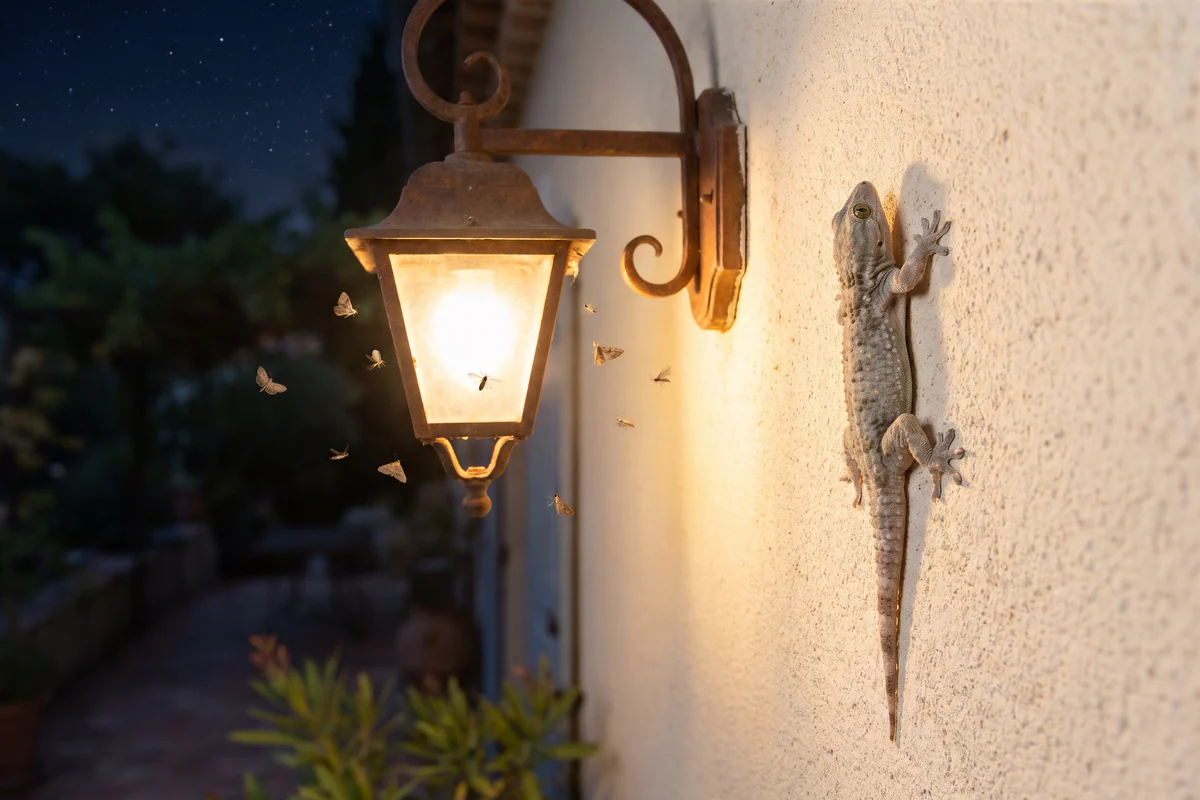
If you've ever spent a summer evening in Provence or Corsica, you may have seen a small lizard pressed against the wall beside the terrace lamp. That is no accident. It may well be a Moorish gecko, a mostly nocturnal species found in France near the coast and further inland, in Provence, Corsica or Occitanie. The Moorish gecko's Wikipedia entry notes that it is often seen on walls near lights, where insects gather at night. It has come to hunt.
By day, it is more often the wall lizard basking on sunny walls near houses. So a lizard around the house is, first of all, a sign of a warm spot, stones or cracks to hide in, and insects to eat.
And the symbolic meaning? Some websites today see it as a sign of luck, of protection for the household or of light returning. These readings are recent: none of the older sources we consulted supports them. If you want a meaning with history behind it, hold on to the biblical one: the lizard, so easy to catch, is "found in kings' palaces". The little animal that slips into the house without a sound fits a very old image.
Seeing a lizard: spiritual meaning, and what is documented
Many spirituality websites treat a lizard crossing your path as an omen. They read it as an invitation to slow down, step into the sun and leave behind whatever weighs on you. They also talk about the lizard as a spirit animal, its role in shamanism, or what it means to dream of lizards. These are personal interpretations, sometimes lovely ones, but none of the older sources we consulted supports them.
Other traditions are documented. In Australian Aboriginal mythology, Wikipedia notes, Tarrotarro is a lizard god who split the human race into male and female and gave people the ability to express themselves in art. Among the Arrernte people, stories tell of Mangar-kunjer-kunja, a lizard being who, the stories say, created humans. The table below separates what rests on a text, a work of art, a recorded story or an observed fact from what belongs to present-day belief:
| Idea | Where it comes from | Status |
|---|---|---|
| The lizard as a friend of the sun | An ectotherm that basks to warm up | Observed fact |
| Renewal | A tail that drops off and regrows in some species | Observed fact, modern symbolic reading |
| Small but wise | Proverbs 30:24 to 28 | Biblical text |
| Contemplation of the light | Christian art | Reported tradition |
| Disease, or healing by the sun | Apollo Sauroctonos by Praxiteles | Debated interpretations |
| A lizard being who created humans | Arrernte stories, Australia | Recorded myth |
| A lizard in the house as an omen | Present-day spirituality websites | Modern interpretation |
| Lucky lizard, spirit animal | Present-day spirituality websites | Modern interpretation, not found in the sources consulted |
| Dreaming of a lizard | Dream interpretation books and websites | Personal interpretation |
The same sorting works for every animal. Our guide to the meanings we give animals explains where these meanings come from, between old stories and recent beliefs. The tortoise, another patient reptile, has its own story too: what the turtle and tortoise stand for.
The lizard's cousins: salamander and chameleon
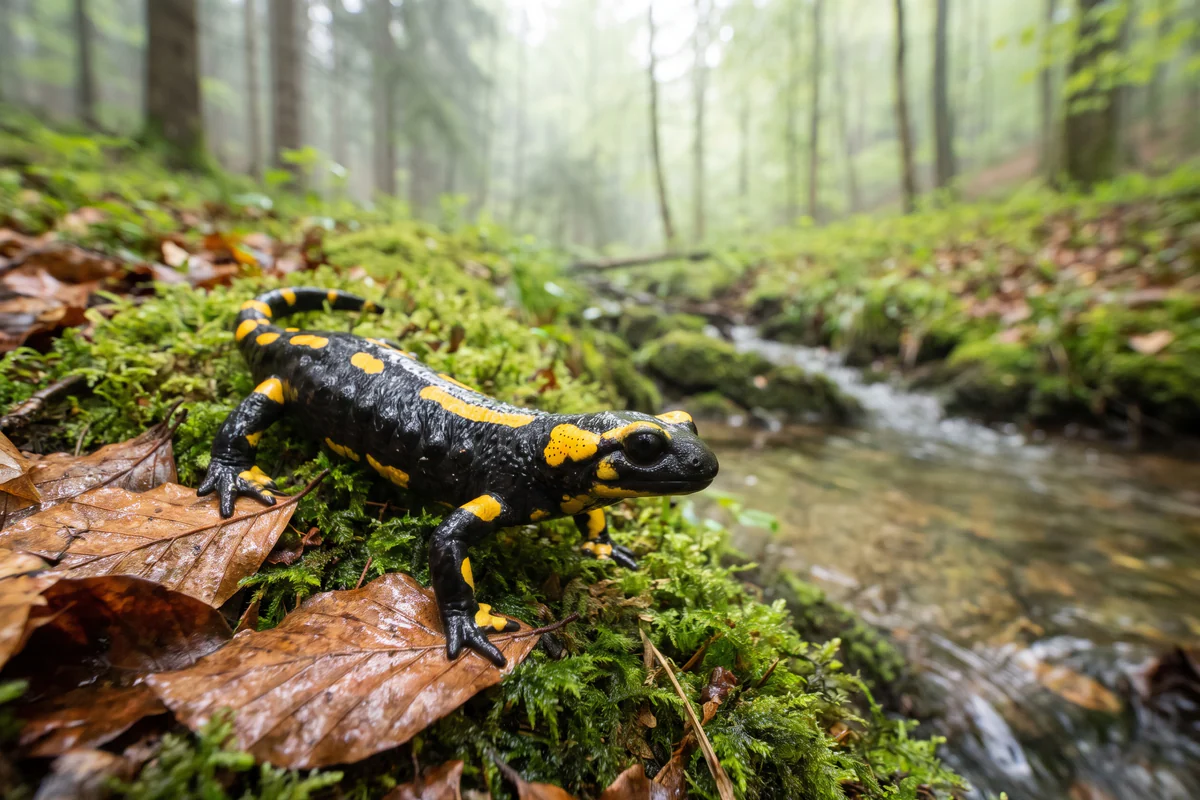
Two animals are often filed next to the lizard. The first is not a lizard at all; the second is the real thing.
The salamander, which is not a lizard
With four legs and a long tail, the salamander looks like a lizard. Yet it is an amphibian, like the frog: it has no scales and lives near water. Its symbolism is quite different. Aristotle and Pliny the Elder said it could withstand fire, or even live in it, and the belief lasted through the Middle Ages.
Francis I of France took it as his emblem before he was even king: a medal from 1504, struck when he was still only Count of Angoulême, already shows it. His motto, "Notrisco al buono, stingo el reo", translates as "I nourish the good, I extinguish the bad". The salamander in flames decorates several Loire châteaux, including Azay-le-Rideau. Where the lizard looks for warmth, the salamander is meant to master it.
The chameleon, a lizard that speaks in colour
The chameleon really is a lizard. People often think it changes colour to hide. The French Wikipedia's entry on the chameleon explains that the colour change is first and foremost a way of communicating: dark tones for anger, bright colours for a male courting a female. Each eye moves on its own, so it can watch all around itself. In a Zulu story from southern Africa, recorded in the nineteenth century by the missionary Henry Callaway, the chameleon is sent to tell people that they will not die. Too slow, it arrives after a lizard carrying the opposite message. Its changing colours can stand for adaptation, the ability to respond to a situation.
Wearing a little reptile as a brooch
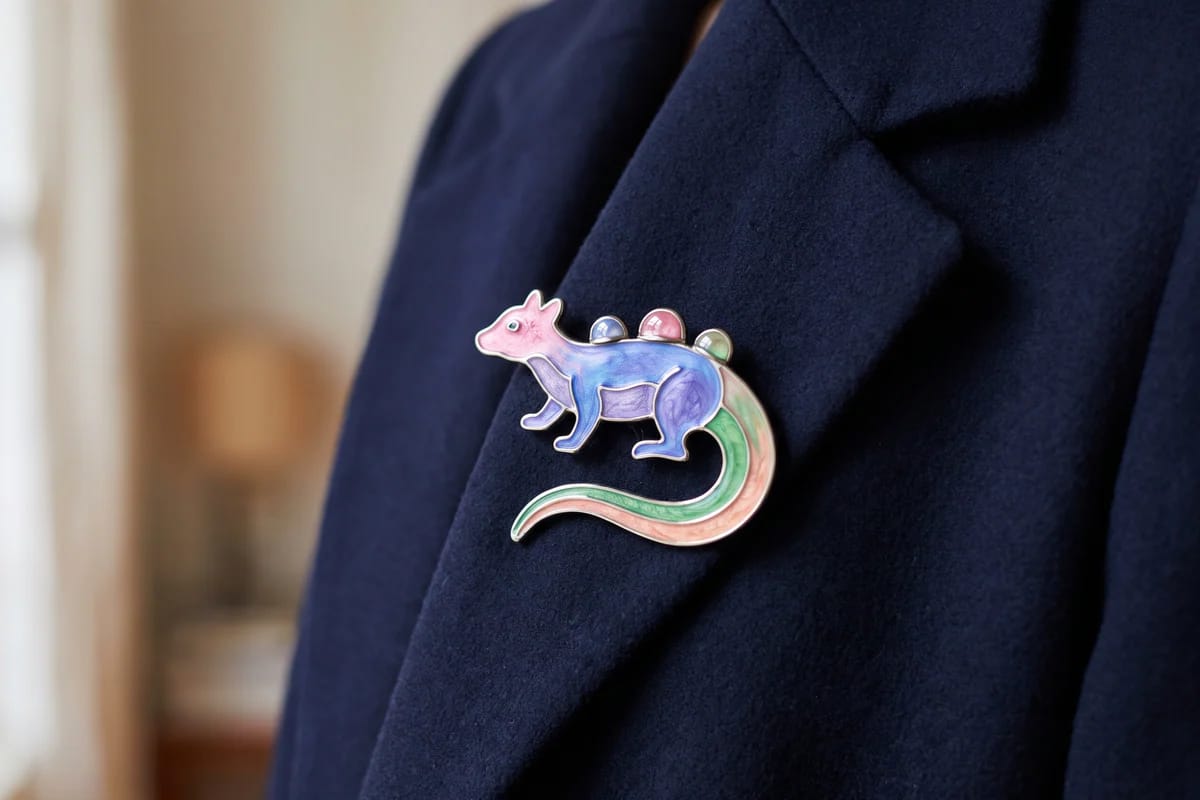
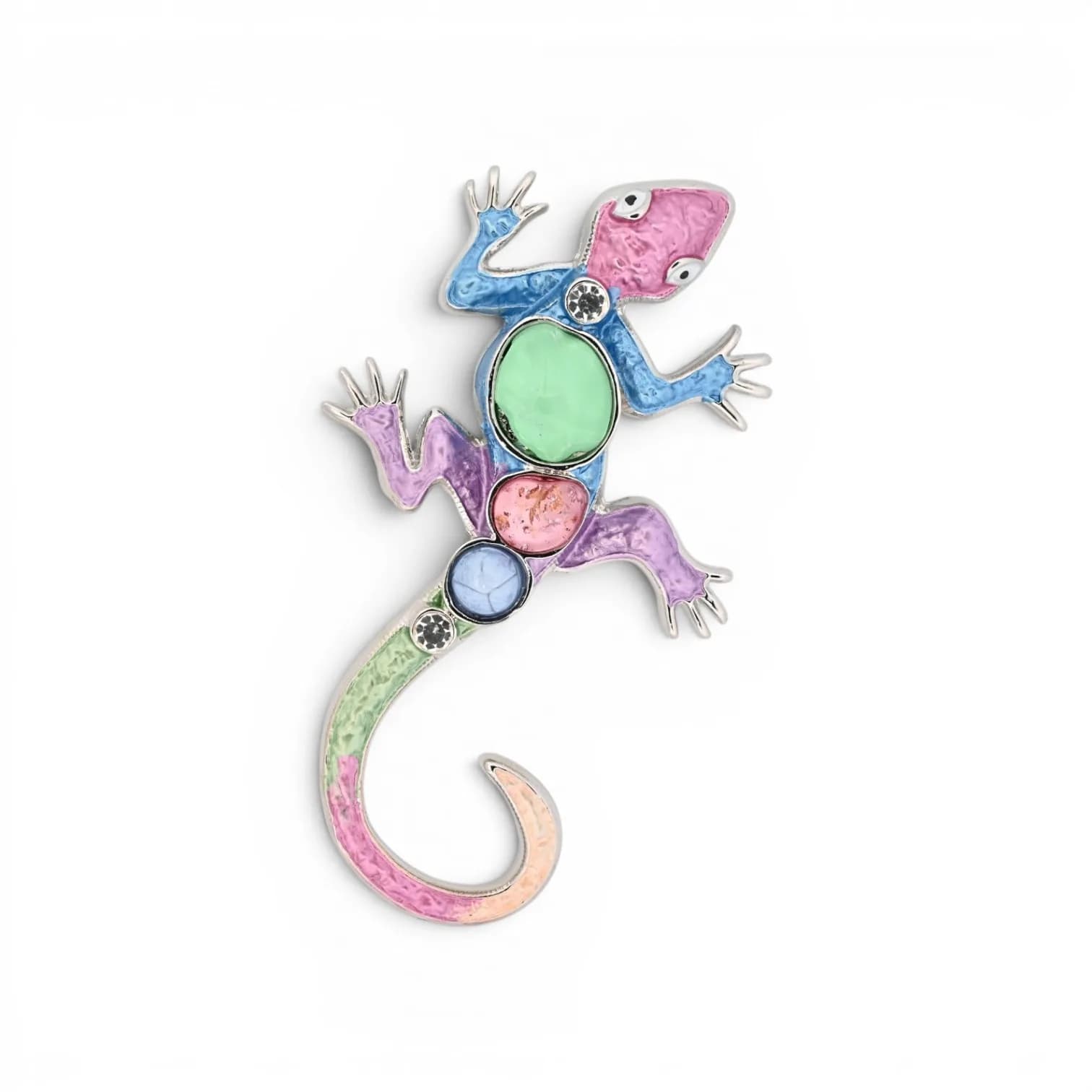
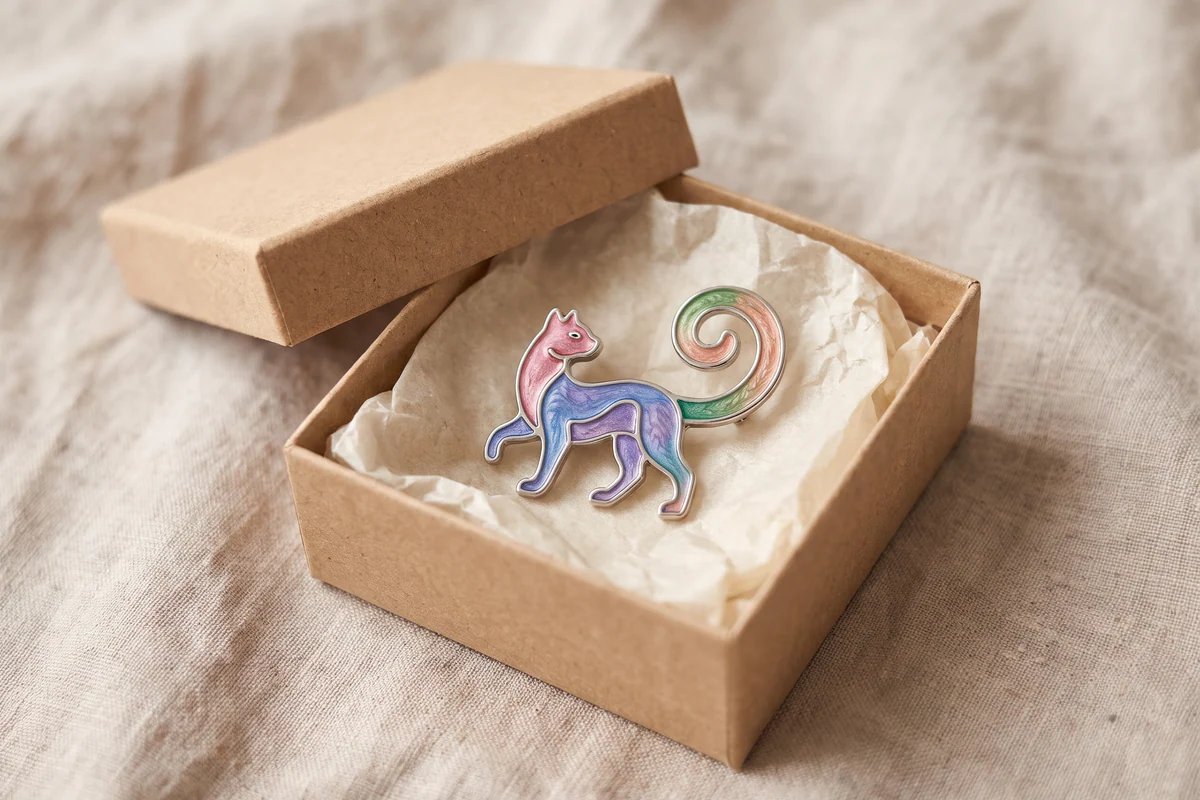
Lizard, snake, salamander, chameleon: you will find all these motifs among our reptile brooches. One of them shows a stylised animal with four legs and a long curled tail, which some will see as a lizard or a gecko. It measures 9 × 5 cm, in silver-coloured steel: pink head, blue and purple body, green, pink and peach tail, with three domed details along the back. It belongs to our magnetic brooches: it is held in place by a magnet and a backing plate slipped behind the fabric.
A motif this colourful reads best on a plain background: black or navy for contrast, grey or denim to echo the blue, ecru or beige to bring out the silver-tone outline. Choose a flat area wide enough for it (jacket lapel, coat collar, shawl) and keep the tail away from buttons. Our guide on where to pin a brooch goes through each spot. For other bright shades, browse our brooches by colour.
A lizard as a gift
The lizard speaks to many people: the friend who waits for the first spring sunshine, someone who has just come through a hard time, the person who prefers watching to being watched. Its story gives you plenty to write in a card:
- for a fresh start, with the tail that grows back;
- for a holiday or a well-earned retirement, with the art of basking in the sun;
- for a quiet achiever, with the proverb of the kings' palaces;
- for a lover of antiquity or museums, with the Apollo of Praxiteles, perhaps the copy in Liverpool;
- for someone who loves the Loire châteaux, with the salamander of Francis I.
Other animals are tied to the sun as well: the Egyptian scarab, for instance, said to roll the sun across the sky, as our article on scarab meaning explains. For another motif, browse our animal brooches, or all our fashion brooches.
Lizard symbolism at a glance
| Tradition | Where the lizard appears | What it says |
|---|---|---|
| Nature | On warm walls and banks, with a tail that regrows | The sun, renewal |
| Britain and Ireland | The rare sand lizard, the common lizard | A small sun worshipper, worth protecting |
| The Bible | Proverbs 30:28 (a spider in the King James Version) | Small but wise, discretion |
| Ancient Greece | Apollo Sauroctonos by Praxiteles | Disease driven away or healing by the sun, depending on the reading |
| Christian art | The lizard still in the sun | Contemplation of the light |
| Ancient Peru | Moche pottery | A frequent motif, meaning unknown |
| Aboriginal Australia | Arrernte stories | A lizard being who created humans |
| Modern beliefs | A lizard in the house, a lucky tail | Luck and protection, with no older source |
| The cousins | Salamander of Francis I, Zulu chameleon | Fire mastered, adaptation |
Catch it in your hand and it slips between the stones. Take its tail and it grows another. The lizard makes no noise; it waits for its moment in the sun. Perhaps that is its best lesson: take the time to warm up before setting off again.
Frequently asked questions
What does a lizard symbolise?▾
The lizard is often linked with the sun and warmth, because many species bask to regulate their temperature. In some species a lost tail grows back, which has inspired a modern reading of renewal. Older readings come from texts and art: the Book of Proverbs counts it among four small creatures that are "extremely wise", and Christian art saw contemplation of the light in its basking pose.
Why do lizards bask in the sun?▾
A lizard is an ectotherm: it produces very little heat of its own. It depends on the sun to warm up and moves between shade and light to regulate its temperature. The wall lizard can spend up to 95% of its time doing this.
Does a lizard's tail really grow back?▾
In some species, yes. The tail breaks at precise points in the vertebrae, wriggles to distract the predator, then regrows. The new tail is often shorter, a different colour and less mobile, and the ability to regrow weakens with each loss. Not every lizard can shed its tail.
Why does the King James Bible say spider instead of lizard?▾
In Proverbs 30:28, the King James Version of 1611 reads "The spider taketh hold with her hands, and is in kings' palaces", while modern translations such as the New International Version give "a lizard can be caught with the hand, yet it is found in kings' palaces". It is the same verse, translated differently. In both, the lesson is that a small creature can find its way anywhere, even into the homes of kings.
What is the difference between a lizard and a salamander?▾
A lizard is a scaly reptile. A salamander is an amphibian, like the frog: its skin has no scales and it lives near water. Their symbolism differs too: the salamander has been linked with fire since Aristotle and Pliny, and Francis I of France made it his emblem.