
Scarab Meaning and the Beetle Who Pushed the Sun
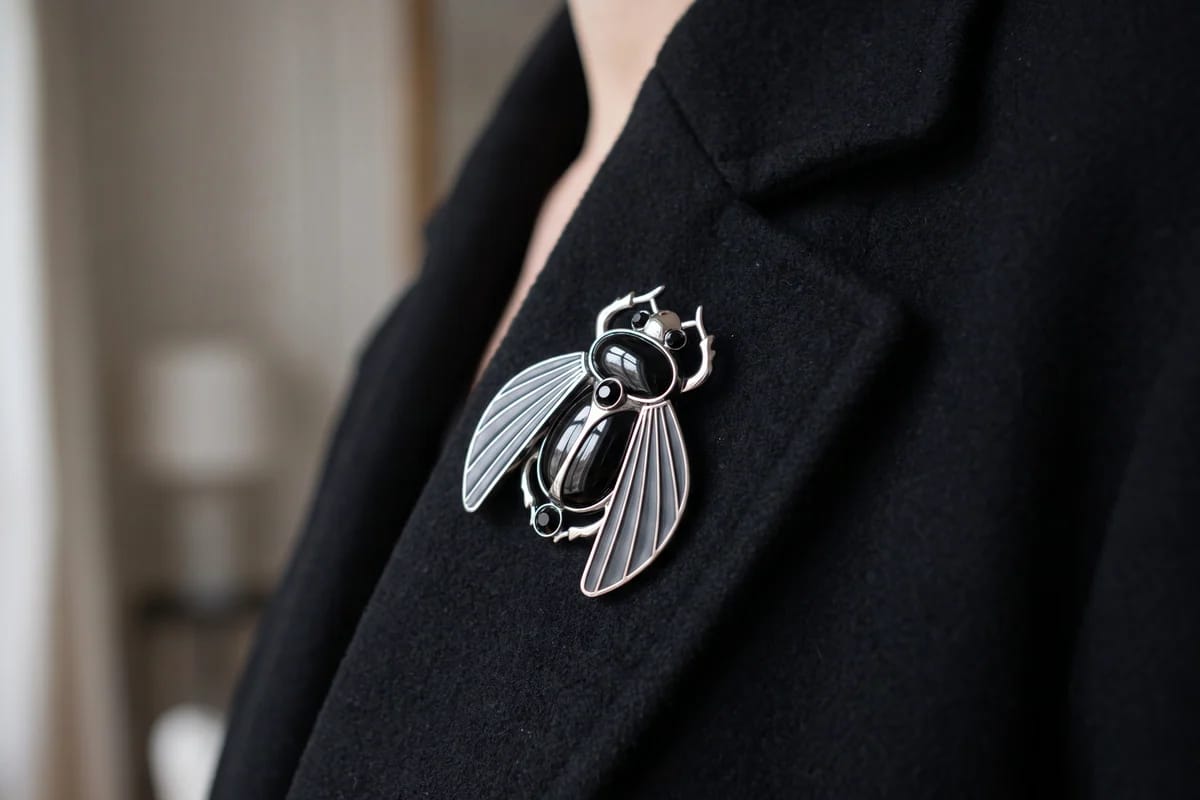
A two-tonne beetle at the British Museum, a god of the rising sun, heart scarabs laid on mummies: what the scarab means, from ancient Egypt to the Milky Way.
In Room 4 of the British Museum, among the great stone statues of Egypt, rests a beetle more than one and a half metres long. Carved in diorite, it weighs over two tonnes. The museum describes it as a monumental scarab, probably representing Khepri, the god of the sun at dawn. It most likely stood in a temple of the sun cult at Heliopolis, then travelled to Constantinople, where Lord Elgin, then British ambassador to the Ottoman Empire, bought it. It entered the museum’s collection in 1816.
Why carve a dung beetle on such a scale? Because the scarab meaning the ancient Egyptians had in mind was nothing less than the sun coming back to life. They watched a small black beetle roll a ball along the ground and saw in it the sun being pushed above the horizon each morning. The scarab became the image of Khepri, the rising sun, and from there came the meanings people still give it: transformation, rebirth and protection. Egyptians wore it as an amulet, laid it on the chests of mummies, and one pharaoh even used scarabs to announce the great events of his reign.
The giant in London is where this story ends. It begins much smaller, on the ground.
From dung ball to sun god: meet the sacred scarab
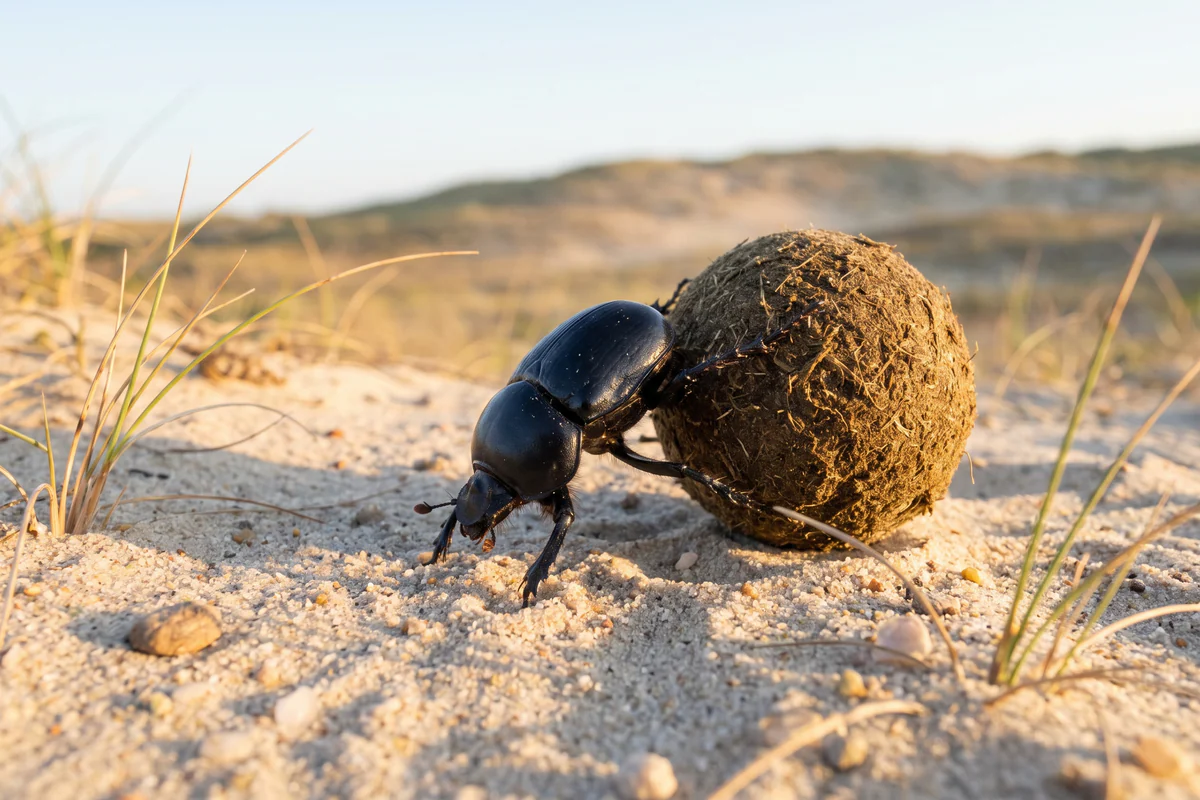
The beetle the Egyptians revered has a scientific name, Scarabaeus sacer, given to it by Linnaeus in 1758. In English it is the sacred scarab, a dung beetle 26 to 40 mm long. Its life’s work fits in one sentence: it shapes balls of dung, often several times bigger than itself, and rolls them to a burrow.
Underground, it lays an egg. The larva that hatches finds its food all around it. A ball goes into the earth, and a new life comes out of it. Long before anyone studied insects, that was enough to capture the imagination.
When people look up what a scarab means, this is almost always the beetle they have in mind: the dung beetle of Egypt, rather than any of its many cousins.
Khepri, the sun that comes into being every morning
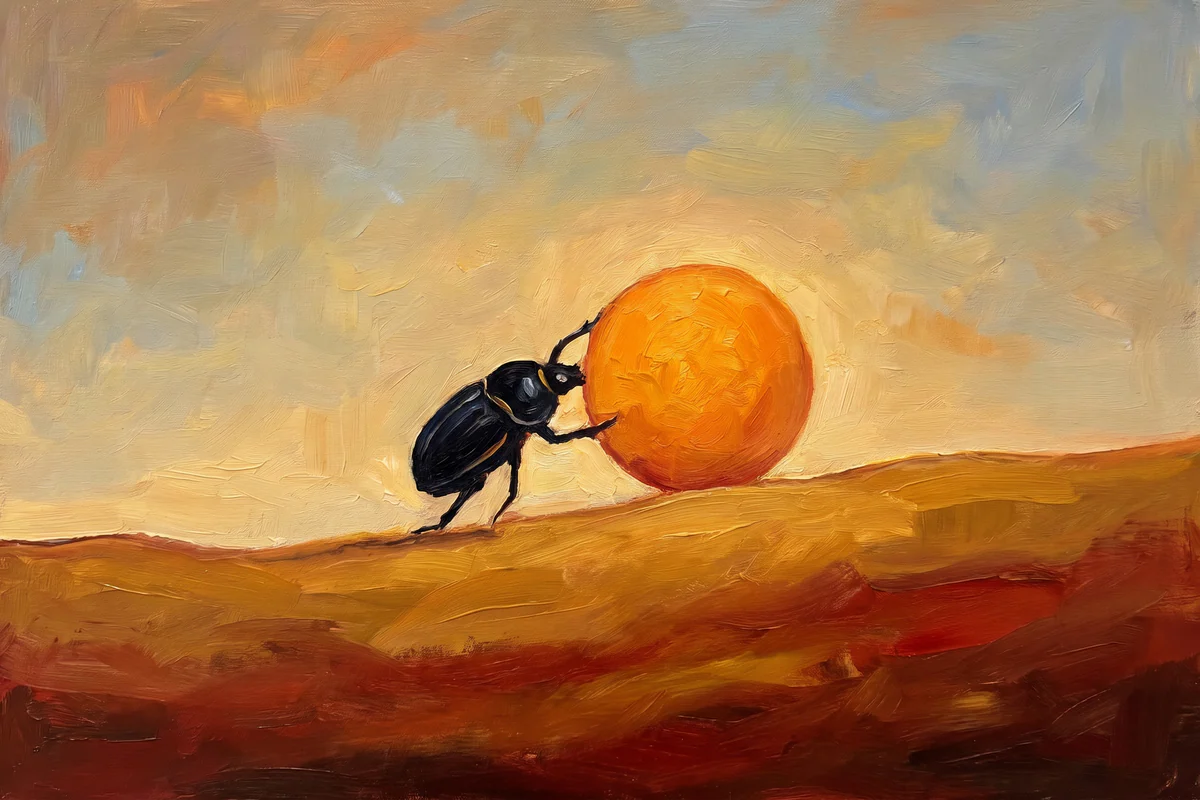
In Egyptian mythology, Khepri is a figure linked to the sun and a symbol of rebirth. He is shown in two ways: as a man with a scarab for a head, or as a scarab pushing the sun’s disc in front of it. His main place of worship was Heliopolis, the city where the giant scarab now in London probably once stood.
A name that means “becoming”
The god and the beetle share almost the same name, and that is no accident. The Egyptian word for the scarab, kheperer, is very close to the verb kheper. The English-language Wikipedia entry on Khepri translates that verb as “to develop” or “to create”; the French-language one gives “to come into being” and “to become”. Hence the god’s name: he who comes into being. To say “scarab” was almost to say “to be born”.
The morning shift
Khepri was not the whole sun, only its morning. Later in the day, the sun took other names, but dawn belonged to him. In Egyptian belief, Khepri brought the sun back to life every morning and rolled it above the horizon, then carried it through the underworld at night, ready to raise it again the next day. For believers, the scarab was a promise that every night ends in a morning. Its image turns up everywhere in Egyptian religious and funerary art.
Scarab amulets: worn by the living, laid on the dead
The scarab did not remain just an idea. It became an object, and long before today’s statement brooches, people were already wearing it.
Seals you could wear
According to the French-language Wikipedia, scarab-shaped objects appear as early as the Sixth Dynasty. The everyday ones are small, and most are made of steatite (soapstone). Their flat underside carries figures or inscriptions, so these little scarabs served both as amulets and as seals. From the Eighteenth Dynasty onwards, some also bear inscriptions wishing good fortune.
Heart scarabs, guardians of the dead
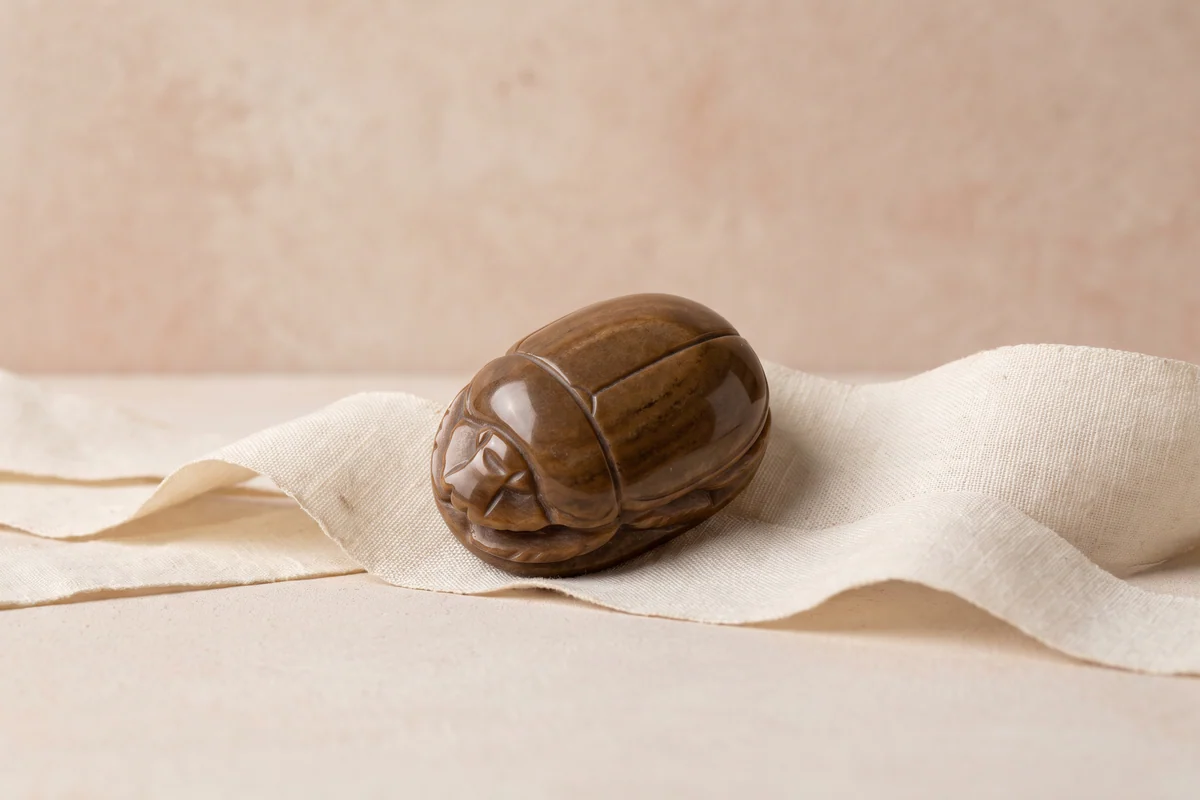
There was also a larger, more solemn version. Heart scarabs were carved from hard stone and made for mummies: they were placed on the chest or among the linen wrappings.
The Louvre in Paris holds one in brown stone, dated to the late Eighteenth or the Nineteenth Dynasty. The Louvre’s record for this heart scarab lists nine lines of hieroglyphs taken from chapter 27 of the Book of the Dead, a text meant to protect the dead person’s heart in the afterlife. The object is not pierced: it was never worn in life, but made to go with the dead.
Why the heart? In a famous scene of the Book of the Dead, a pair of scales weighs the dead person’s heart, which stands for their conscience, against the feather of Maat, goddess of truth and justice. The heart scarab kept watch over the very organ about to be weighed.
Amenhotep III and his news in stone
The pharaoh Amenhotep III had a famous series of scarabs carved to announce the events of his reign: his marriage to Queen Tiye, the creation of a lake, his hunts, his alliances. They were sent to allied rulers as prestige objects, and the French-language Wikipedia counts 250 of them found so far. A scarab could carry news, rather like an announcement card you keep in a drawer.
Steering by the Milky Way: what scientists found in 2013
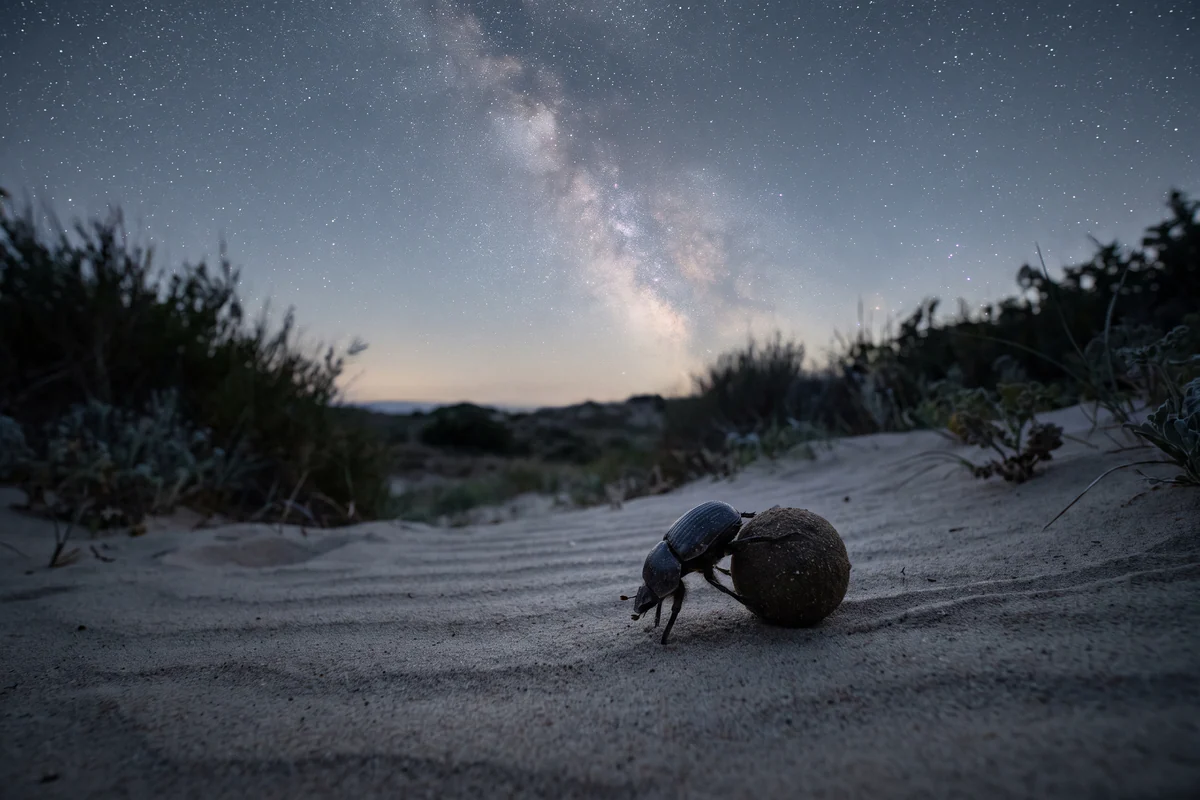
The Egyptians linked the scarab with the sun. In 2013, researchers showed that a close cousin of the sacred scarab really does look to the sky, only at night. The study, led by the University of the Witwatersrand in Johannesburg and Lund University in Sweden, appeared in the journal Current Biology. It focused on Scarabaeus satyrus, a dung beetle that also rolls its ball in a straight line to get away from the dung heap.
Tiny caps and a planetarium
The team fitted some beetles with tiny caps, either opaque or clear, then tested them outdoors and under the artificial sky of a planetarium. The French science magazine Futura Sciences reported how long the beetles took to reach the wall of the set-up:
- with the Moon: 21 seconds;
- no Moon, but stars: 40 seconds;
- no Moon and no stars: 117 seconds;
- wearing an opaque cap: 125 seconds on average;
- in the planetarium, with only the Milky Way showing: 53 seconds.
In other words, the pale band of our galaxy is enough to guide the insect. According to the study, this is the first documented case of an animal finding its way by the Milky Way, and the English-language Wikipedia article on dung beetles counts this species among the few invertebrates known to do so. None of this proves the Egyptian myth. But a beetle that reads the night sky makes a lovely echo of it.
Scarab beetle symbolism today: what is known, what is believed
With the scarab, fact and belief quickly get tangled. Here is how to tell them apart:
- documented: the dung beetle really does roll balls and lay its eggs in a burrow; the Egyptians did link it with Khepri and the rising sun; the amulets, the heart scarabs and Amenhotep III’s series exist, and museums in London and Paris hold scarabs you can go and see;
- belief: the idea that a scarab protects you, brings you back to life or brings you luck. That was the faith of the ancient Egyptians.
Today, anyone can find in it an image that speaks to them: a fresh start, a hard time coming to an end, a morning after a long night. It is a meaning you choose to give it, and that is no small thing.
Giving a scarab: who it suits
With such a long past, a scarab makes a gift with a story to tell. It will especially appeal to:
- someone opening a new chapter: a new job, a house move, a fresh start after a difficult time;
- people who love ancient Egypt and museum visits;
- nature lovers who enjoy watching insects;
- fans of graphic jewellery, who prefer a bold motif to a quiet one.
A black and silver-coloured scarab
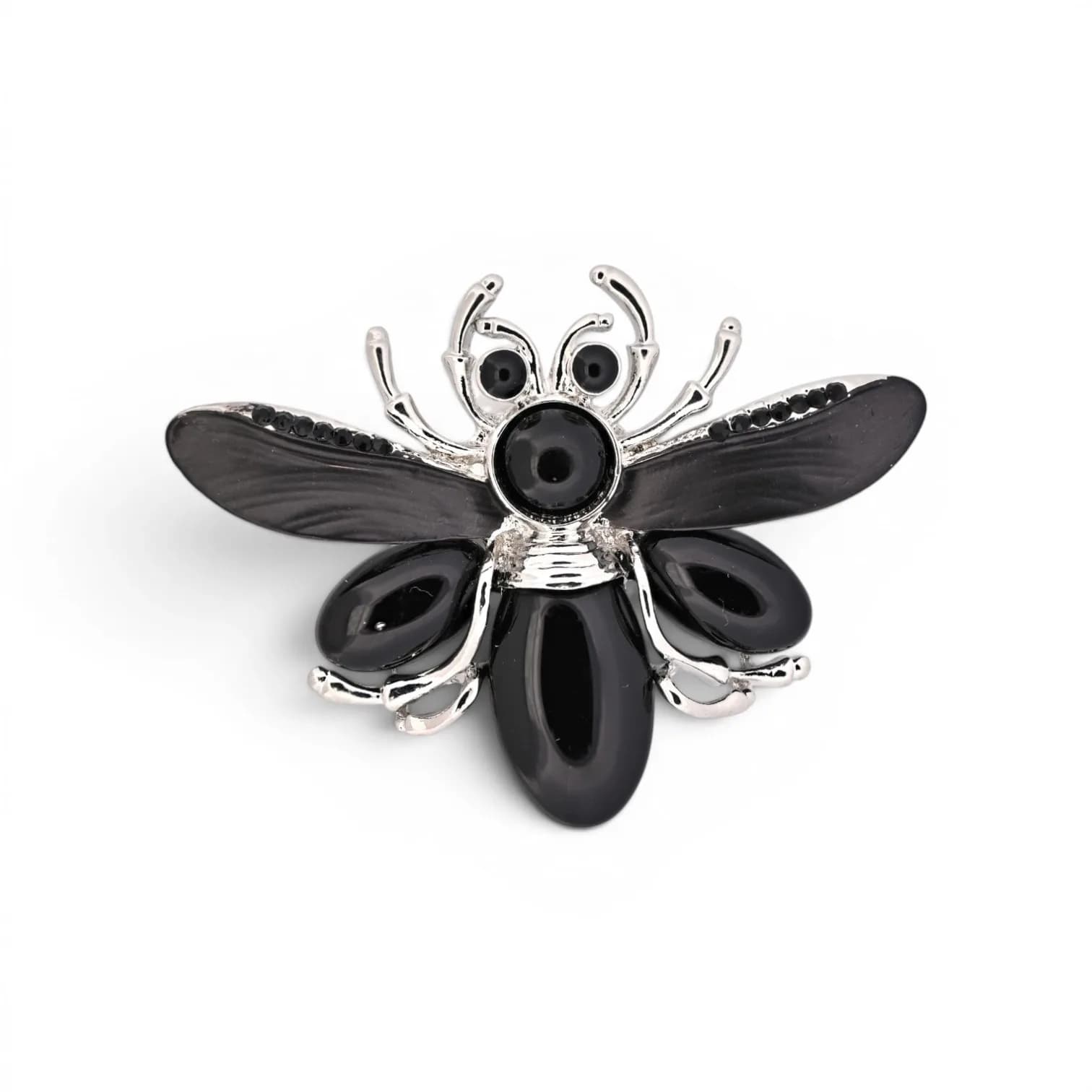
Among our beetle brooches, this design plays on contrast: an outline in silver-coloured steel that traces six legs and two antennae, large dark grey panels with fine ridges, and glossy black sections. It fastens with a magnetic clasp. This scarab is more graphic than Egyptian: the meaning is yours to give it, a morning sun or simply a fondness for beautiful creatures.
It sits well on a jacket lapel, a coat or a stole. As for colours, black echoes its glossy sections, grey answers its ridged panels, ecru brings out its outline and burgundy gives it a warmer contrast.
The scarab is not alone in its family. Our insect brooches bring together other small creatures with a past. If the subject appeals to you, read about the old legends of the dragonfly or the story of the bee, from Manchester to Napoleon.
Scarab meaning at a glance
The symbolism of the scarab comes from ancient Egypt, where a very real insect became the image of the sun reborn. Each meaning rests on a specific observation or object:
| Starting point | Egyptian or modern reading | Meaning kept |
|---|---|---|
| The dung beetle rolls a ball in front of it | Khepri pushes the sun above the horizon | The rising sun |
| The verb kheper, “to come into being” | Khepri, he who comes into being | Becoming, transformation |
| A larva comes out of a buried ball | An image of renewal and resurrection | Rebirth |
| Small steatite amulets | An object worn on the body, also used as a seal | Protection |
| Heart scarabs on mummies | A text meant to protect the heart of the dead | The passage to the afterlife |
| The colossal scarab in the British Museum | Khepri, the sun at dawn, carved in stone | The sun cult of Heliopolis |
| A dung beetle guided by the Milky Way (2013 study) | A scientific discovery | An insect that reads the sky |
A ball, a sun, a morning that keeps coming back: the scarab’s whole story lies in that stubborn gesture.
Frequently asked questions
Where does the word “scarab” come from?▾
From the Latin scarabaeus, itself taken from the Greek kárabos. The French word carabe, the name of another family of beetles, shares the same origin.
Where does the sacred scarab live today?▾
The sacred scarab lives around the Mediterranean, across almost all of Africa, in Asia Minor and in some parts of South America.
What did the Egyptians call the sun at noon and at dusk?▾
Khepri was the rising sun. At its highest point the sun became Ra, and in the evening, as it set, Atum.
Is every beetle a scarab?▾
Not quite, and it depends on who you ask. In its broad sense, the word covers a whole group of beetles that includes dung beetles, but also cockchafers, rose chafers and rhinoceros beetles. Some authors keep it for dung beetles alone.
How many kinds of scarab are there?▾
A great many. On 23 June 2023, the Catalogue of Life listed 2,590 genera in the family Scarabaeidae alone, and each genus can include several species.