
Turtle symbolism: longevity, wisdom and legends
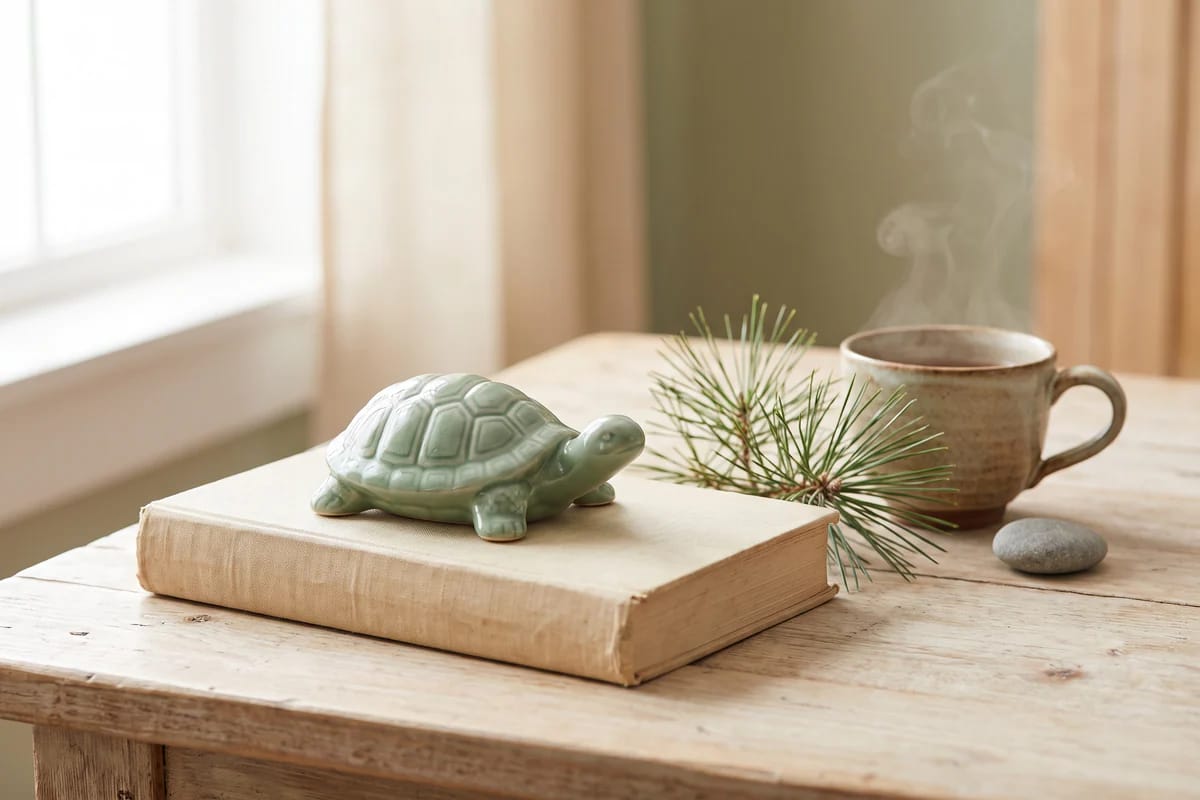
Why does the tortoise stand for long life, wisdom and protection? A journey from China and India to Turtle Island and Aesop’s fable, right up to today.
What does a turtle symbolise? Above all, longevity, wisdom, patience and protection. Slow, quiet and sheltered under its shell, it suggests almost everywhere a long stretch of time and a calm kind of strength. Yet turtle symbolism changes from one culture to the next: a celestial guardian in China, a divine avatar in India, the land that carries the world in North America, and a stubborn heroine in Aesop’s fable.
A quick word on names: in British English, a tortoise lives on land and a turtle lives in the sea, so you will meet both words below. Step by step, here is where each meaning comes from, and what the animal suggests today when you give one as a present or choose to wear it.
Turtle symbolism: a sign of longevity and wisdom
Watch a tortoise for a few minutes: it moves without hurrying, stops, then sets off again. It lives a long time and carries its shell, its ‘house’, wherever it goes. These three traits (slowness, long life and shelter) explain most of what people associate with it.
The first meaning is therefore about time. An animal that crosses the years unhurried easily becomes the image of someone who has seen it all and never gets carried away. That is where its reputation for wisdom comes from: it is a symbolic reading born of observation, not a measured quality.
The shell adds another idea: prudence. A tortoise withdraws into it at the first sign of danger, then comes out again once calm returns. Many people see in this a way of protecting yourself without running away.
Japan sums up this reputation in a saying explained by the Art Gallery of New South Wales in its education kit on Kamisaka Sekka’s cranes: ‘tsuru wa sennen, kame wa mannen’, or ‘the crane lives a thousand years, the tortoise ten thousand’. The crane is also a symbol of long life in Japan. The figures are symbolic: they simply say that the tortoise embodies long life even better than the crane.

The tortoise in Asia: guardian of the North and avatar of Vishnu
In Asia, the tortoise does more than illustrate long life. It holds a place in the order of the heavens as well as in great religious stories.
China: the Black Tortoise, the four spiritual animals and oracle bones
The Black Tortoise, called Xuanwu or ‘Black Warrior’, is one of the Four Symbols of the Chinese constellations. It shares the sky with the Azure Dragon of the East, the Vermilion Bird of the South and the White Tiger of the West. It guards the North and is linked to winter, water and the colour black.
It is often shown entwined with a snake, a striking image that joins two animals in a single figure. In Japan, it is known as Genbu.
The tortoise also appears among the four spiritual animals named in the Book of Rites (Liji), chapter ‘Li yun’, in James Legge’s translation: the qilin, the phoenix, the tortoise and the dragon. Legge notes that all of them except the tortoise are fabulous creatures.
Its shell was even used to question the future. Under the Shang dynasty (about 1600 to 1046 BC), questions were carved on the flat undersides of tortoise shells (plastrons) and on ox shoulder blades, which were then heated. The cracks were read as answers about harvests, weather, sacrifices or military campaigns.
According to Encyclopaedia Britannica, these oracle bones bear the oldest known Chinese inscriptions. Part of the story of Chinese writing therefore begins on the shell of a tortoise.
India: Kurma, the tortoise who holds up the mountain
In Hinduism, Kurma is the second avatar of Vishnu, and he takes the form of a tortoise. His story unfolds during the churning of the ocean of milk, when gods and demons seek the nectar of immortality.
To churn the ocean, they use Mount Mandara as the churning stick and the serpent Vasuki as the rope. But the mountain starts to sink. Vishnu then becomes a tortoise and supports it on his shell.
In this story, the tortoise’s spiritual meaning is very concrete: it is the stable base without which nothing holds. The Bibliothèque nationale de France keeps a painting of Kurma made in Madras in 1780.
Turtle Island: a continent on a turtle’s back
As The Canadian Encyclopedia’s article on Turtle Island explains, many Algonquian- and Iroquoian-speaking peoples, mainly in the north-east of North America, call the continent Turtle Island. In various Indigenous origin stories, the turtle supports the world and symbolises life itself. For some, it also embodies identity, culture, autonomy and a deep respect for the environment.
The Ojibwe version begins after a flood. Nanabush asks the animals to dive down and bring back a little earth from the bottom of the water. They all fail except the muskrat, who comes back up with some damp earth but loses his life.
Nanabush places this earth on the back of a turtle who volunteers, and Turtle Island is born. The story brings together the sacrifice of the smallest animal and the generosity of the one who agrees to carry the world.
Among the Haudenosaunee, the versions tell of Sky Woman, who is pregnant and falls through a hole towards the Earth. Birds guide her down and set her on a turtle’s back, and the world forms around her.
These stories vary from one community to another, so it is best not to blend them into one. Nor do all Indigenous creation stories feature a turtle: in many Northwest Coast cultures, Raven is the central figure.
The Tortoise and the Hare: the moral of the race
This unlikely race is attributed to Aesop, the Greek fabulist. Centuries later, La Fontaine retold it in French (Fables, book VI, fable 10, 1668). For many readers, it is the very first place they meet the tortoise.
The plot fits in a few lines. The hare, sure of winning, dawdles, rests and plays. The tortoise keeps going without stopping. By the time the hare sets off, it is too late, and the tortoise arrives first.
La Fontaine adds a cheeky ending. His tortoise asks the hare what good all that speed did him, and teases him: what would it have been like if he had had to carry a house? If you fancy rereading the English version, the Library of Congress hosts ‘The Hare & the Tortoise’ from The Aesop for Children; it takes a couple of minutes.
In English, the moral is usually summed up as ‘slow and steady wins the race’. Behind the idiom lie two ideas. Steady effort beats flashes of brilliance, and overconfidence makes even the gifted lose. No wonder the tortoise became the emblem of perseverance.
The fable tradition, from Aesop to La Fontaine, gives a voice to a whole bestiary, where you also meet the cat, the mouse and the cockerel. You will find those three among other animals to wear as a brooch.
What does a turtle symbolise today?
So what does a turtle symbolise today? Modern readings borrow from all these traditions and blend them. They are beliefs and interpretations, and everyone brings a little of their own story to them.
Here are the meanings most often given to it:
- patience, for those who can wait for the right moment
- perseverance, inherited from the fable
- protection, because of the shell
- wisdom and long life, which come from Asia
- the right to move at your own pace, without comparing yourself to others
The lucky-charm turtle is also a widespread belief: some people like to keep a small turtle close by as a talisman. Nothing proves it attracts luck, but the intention behind it is what gives it its value.
The turtle is not alone in this family of animals credited with kindly powers. If the subject interests you, read about the meaning of the lucky cat and its legends, another companion surrounded by beliefs.
In the end, the meaning also depends on you. The same tortoise may suggest calm to one person and the courage to keep going to another.
Giving a turtle or tortoise as a gift
Giving a tortoise is a way of slipping in a message without having to spell it out. It fits particularly well at these moments:
- a graduation, after years of steady work
- a fresh start (a house move, a new job, a career change)
- a birthday, to wish someone many long years
- a recovery, when healing takes time
- someone who moves at their own pace and whom you want to encourage
It suits a friend as well as a mother, a sister or a colleague. The key is to link the gift to what the person is going through: that link is what gives it meaning. For more ideas, here is how to choose a brooch as a gift.
A few words on the card are enough to make the symbol clear. You could borrow the moral of the fable: ‘Slow and steady wins the race. You’ve set off, you’re moving forward, and that already counts for a lot.’ Or, more simply: ‘At your own pace, but always forward.’
Wearing the turtle symbol every day
Wearing a turtle on a coat or jacket means taking its symbol with you wherever you go. For you, it can be a reminder not to rush; for others, it can start a conversation about what it means.
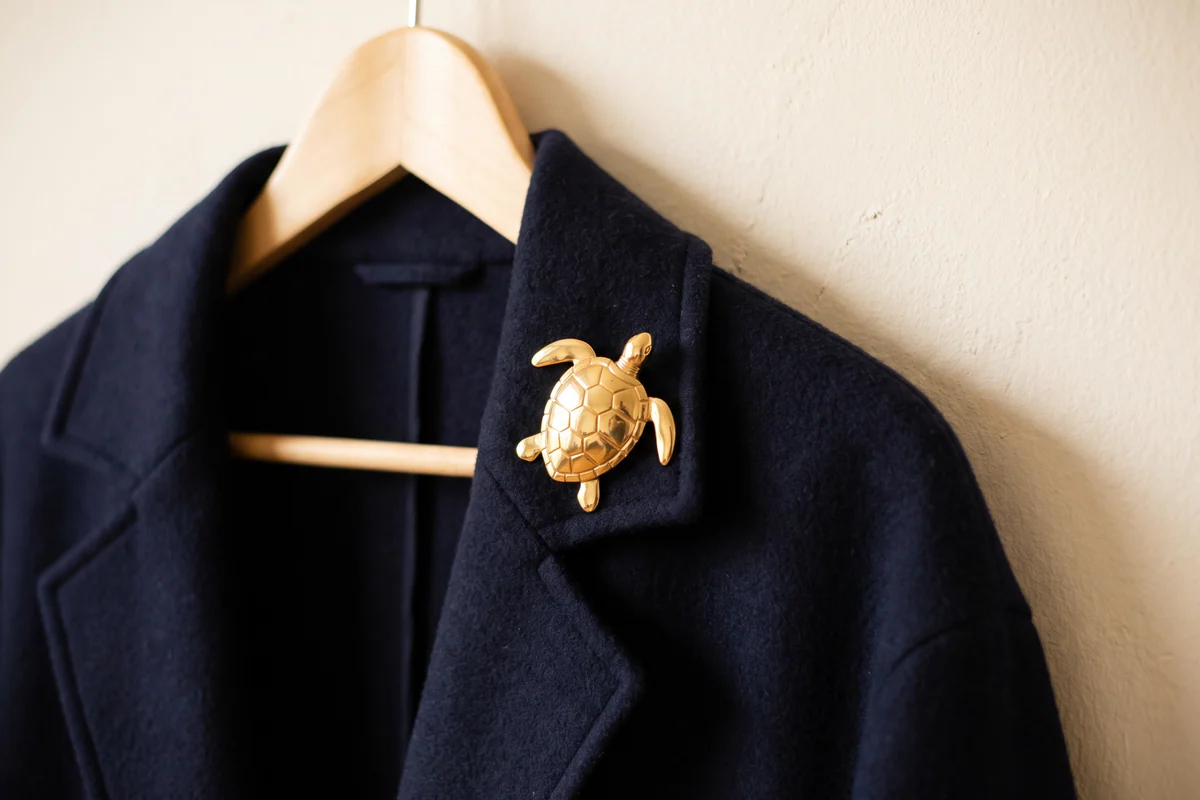
At Ma Broche, most brooches are costume jewellery in gold-tone, rose gold-tone or silver-tone steel, with a magnetic fastening: one magnet on each side of the fabric, without piercing the garment. That is a real plus on a coat or jacket you care about.
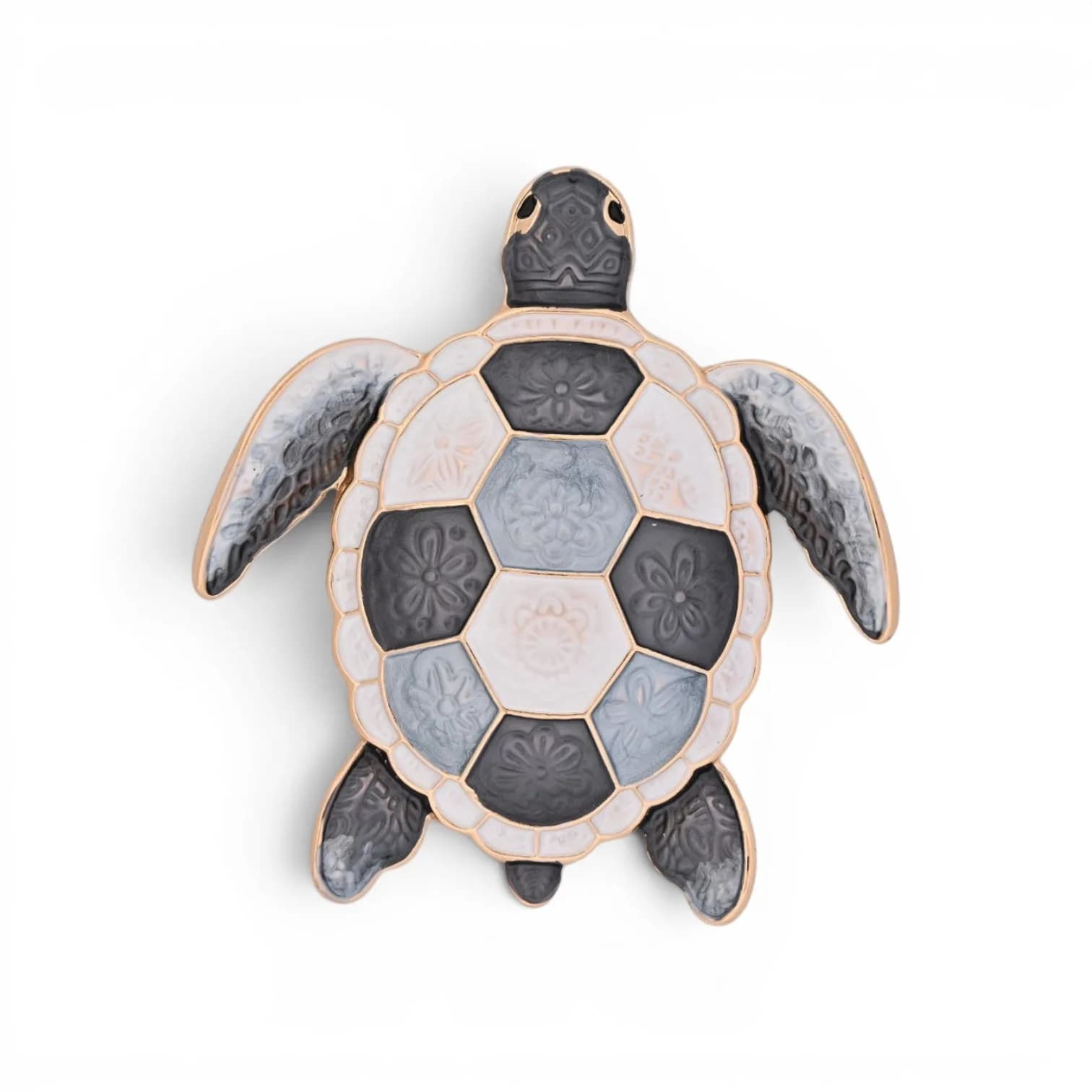
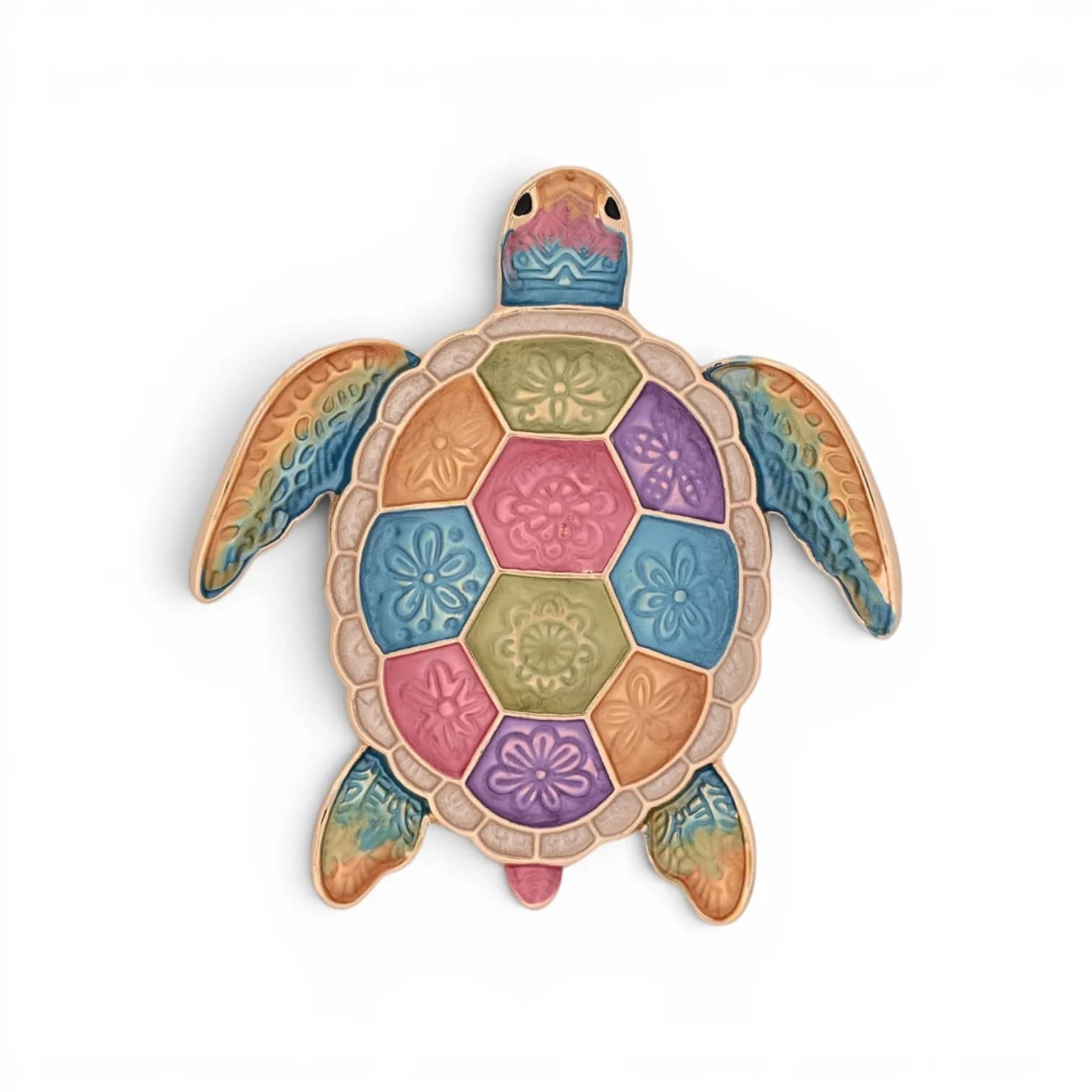
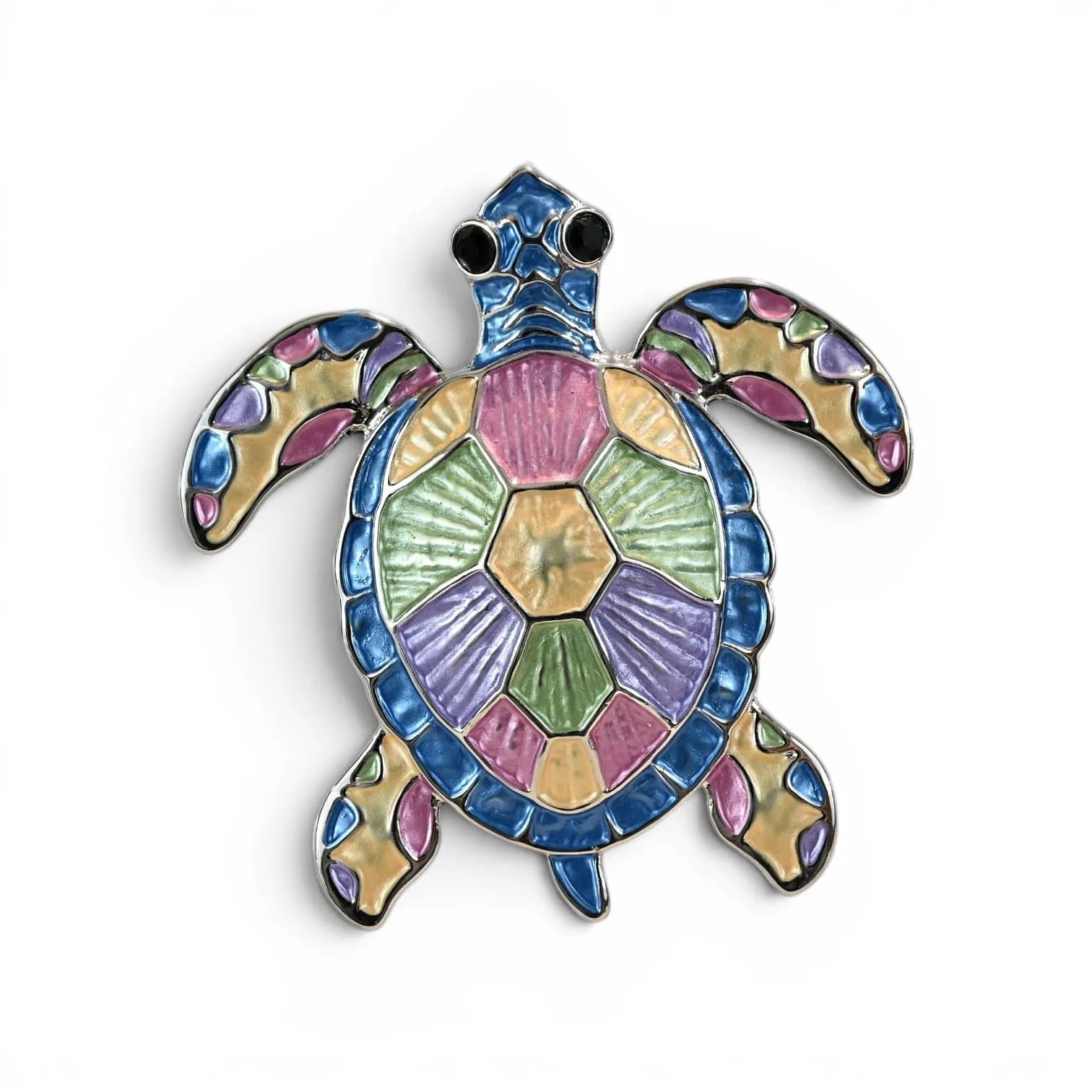
If you fancy it, you can browse our turtle-shaped brooches, in gold-tone or silver-tone, in soft or multicoloured tones. It is up to you to choose the one that best matches what the turtle means to you.
In short
The turtle or tortoise stands above all for longevity, wisdom, patience and protection. Its meaning still shifts from one culture to another.
| Culture or story | What the turtle or tortoise represents |
|---|---|
| Japan | Long life: ‘ten thousand years’ |
| China | Guardian of the North, spiritual animal, divination |
| India | Kurma, the base that holds up the mountain |
| Indigenous North America | Carries the world on its back |
| Aesop’s fable | Perseverance: slow and steady wins the race |
Frequently asked questions
Where should you place a turtle at home according to feng shui?▾
Feng shui is a belief system. In it, the Black Tortoise stands for the back of a place: the solid support, such as a hill or a wall, that sits behind you. Its followers therefore often advise placing a turtle behind you or at the back of the house, as a symbol of support and stability.
How long does a tortoise live?▾
It depends greatly on the species. Galápagos giant tortoises are among the longest-lived animals: according to Encyclopaedia Britannica, they can live up to 150 years. Other species live much shorter lives.
What does the hexagonal tortoiseshell pattern mean in Japan?▾
It is called kikkō: a pattern of hexagons inspired by the plates of a tortoise’s shell. In Japan, it stands for long life. According to the Textile Society of America, the crane and the tortoise are often paired on wedding textiles, to wish the couple many long years of happiness together.
What links the tortoise to music?▾
The link goes back to Greek mythology. According to Encyclopaedia Britannica, Hermes invented the lyre on the very day he was born, by stretching strings of gut over a tortoise shell. A humble shell therefore lies at the origin of one of the best-known instruments of the ancient world.
Where does the phrase ‘make haste slowly’ come from?▾
It translates the Latin adage festina lente, which pairs speed with care, rather like the tortoise of the fable. The Roman historian Suetonius reports, in his Life of Augustus (25.4), that Emperor Augustus often repeated it, and in Greek rather than Latin. It is a neat way of saying that speed and care can go together.