
Snake Symbolism: The Animal That Heals and Deceives
Three native snakes in Britain, and one snake on the emblem of British medicine: what the snake symbolises, from shed skin to Asclepius, Eden and the ouroboros.
Britain has only three native snakes, and just one of them, the adder, is venomous. Yet a snake turns up in a far more familiar place: at the heart of British medicine. The same sign, a single snake coiled round a staff, appears in the emblems of the British Medical Association, the Royal Society of Medicine and British emergency medical services.
So what does a snake symbolise? Almost everything, and its opposite. Snake symbolism lives in that contradiction. Because it sheds its skin, the snake stands for rebirth. Coiled round a staff, it became the emblem of healing. Biting its own tail, it speaks of eternity. But it is also the tempter of Genesis and the Egyptian monster that tries to swallow the sun. Across these traditions, the snake remains deeply ambivalent, both positive and negative.
Let’s start with the snake on that staff: of all the snakes in this story, it is the one you are most likely to have seen.
A snake on the doctor’s badge
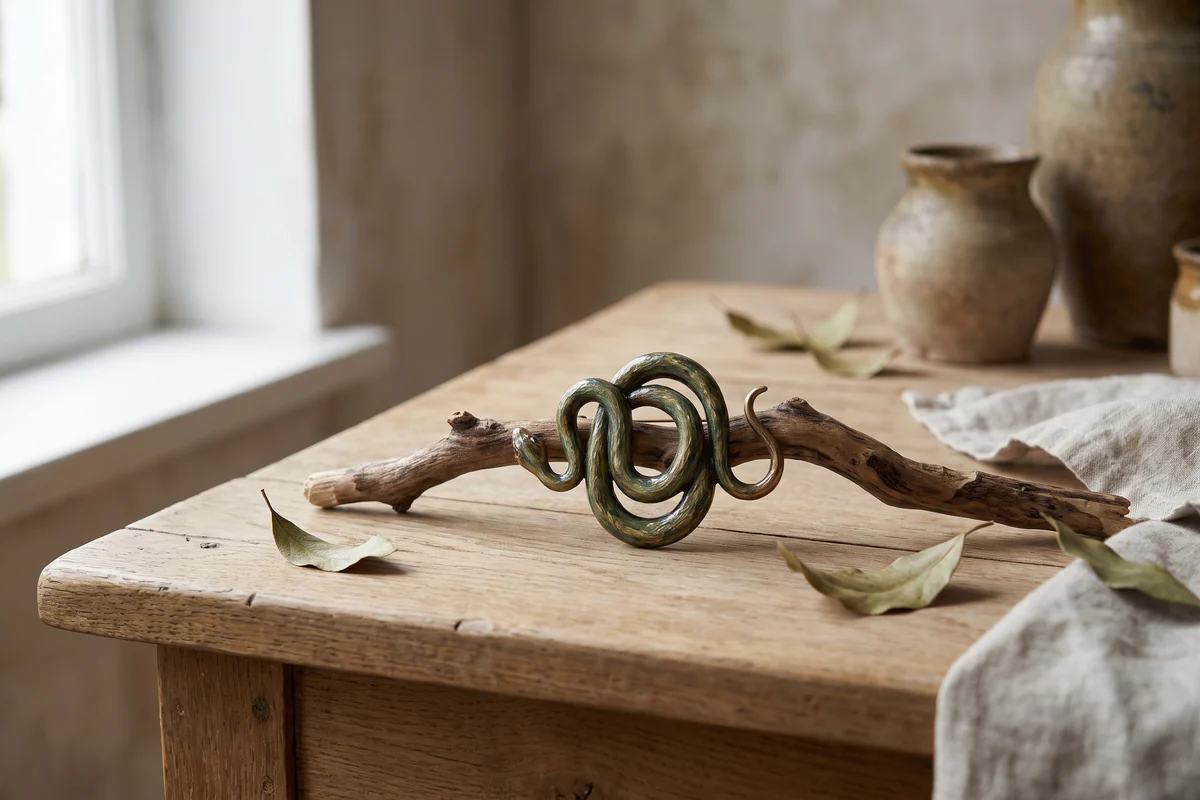
Asclepius was the Greek god of healing. In images of him, a snake keeps him company, coiled round his staff or curled beneath his throne. The rod of Asclepius, one snake round a plain staff, became the symbol of medicine in many countries. The World Health Organization flies it on its flag, and in the United States it sits at the centre of the Star of Life, the emblem of ambulances and emergency services.
Some of his sanctuaries offered a surprising sight: the sick came to sleep there in the hope of a cure, and tame snakes moved about among them.
Rod or caduceus?
The two signs are easy to mix up, so here is the difference:
- The rod of Asclepius carries a single snake and no wings.
- The caduceus of Hermes is a wand topped with two wings, with two snakes twined round it.
- In North America, the caduceus has often taken the place of the rod as a medical sign, by mistake.
One snake and no wings: Asclepius. Two snakes and wings: Hermes.
Moses and the copper serpent
The Bible has its own healing snake. In the Book of Numbers, the Israelites in the desert are bitten by snakes. In one English translation: “Moses made a copper serpent and mounted it on a standard; and when bitten by a serpent, anyone who looked at the copper serpent would recover.” Centuries later, King Hezekiah had it broken up, because it had become an object of worship.
Three snakes in Britain, thousands in the world
The adder shares Britain with two harmless neighbours, the barred grass snake and the smooth snake. The Wikipedia article on the adder puts it simply: three native species, only one venomous. Across the world, more than 3,500 species of snake are known, and, according to the French-language Wikipedia, about 515 of them are venomous.
Snakes are reptiles with very long bodies and no visible legs. About 100 million years ago, as they adapted to life underground, their ancestors lost their legs, after a series of mutations in a gene with an unlikely name: Sonic Hedgehog.
A new skin in a few minutes
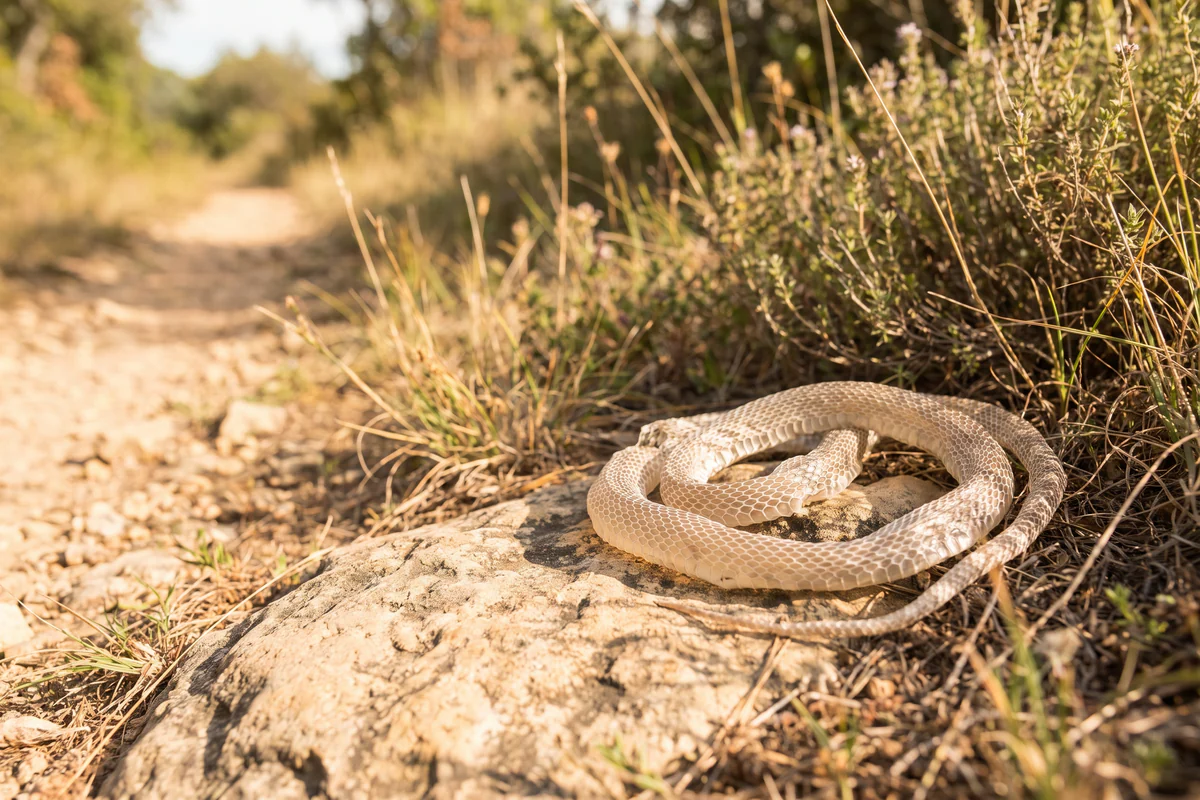
A snake sheds its skin several times a year, and young snakes do it more often than adults. Before shedding, it looks for a damp spot, which makes shedding easier. Then it rubs the tip of its snout against something rough. The skin splits there, and the snake slips out of its old skin in a few minutes. In a healthy animal, the skin comes away in one piece: an empty copy of the snake, left behind on the ground.
Eyes that never close, a tongue that smells
A snake has no eyelids: its eyes are always open. Its forked tongue picks up particles from the air and carries them to the Jacobson’s organ, which analyses them. Some species can even sense the warmth of their prey, through small pits sensitive to infrared.
A gaze that never blinks, a tongue that searches the air, a body that renews itself: no wonder people have watched the snake with a mix of fear and fascination.
A skin left behind: the snake and rebirth
Ancient peoples did not need biology to notice the empty skin. To many of them, the snake seemed to be reborn each time it left its skin behind. In some ancient religions it was even thought to be immortal: it could shed its skin again and again and look young for ever.
India: a new birth
In India, shedding stands for a new birth, and the snake carries rebirth, death and mortality all at once. The nāgas, snake beings of Indian tradition, guard the waters and hidden treasures.
Gilgamesh and the stolen plant
An ancient story from Mesopotamia ties the snake to youth. The Epic of Gilgamesh, whose first known version was written in Akkadian between the 18th and 17th centuries BC, preserves it. Its hero, Gilgamesh, gets hold of a plant of youth. Then, during a stop on his journey, a snake steals it. The man goes home mortal; the snake leaves with the plant.
The snake that bites its own tail
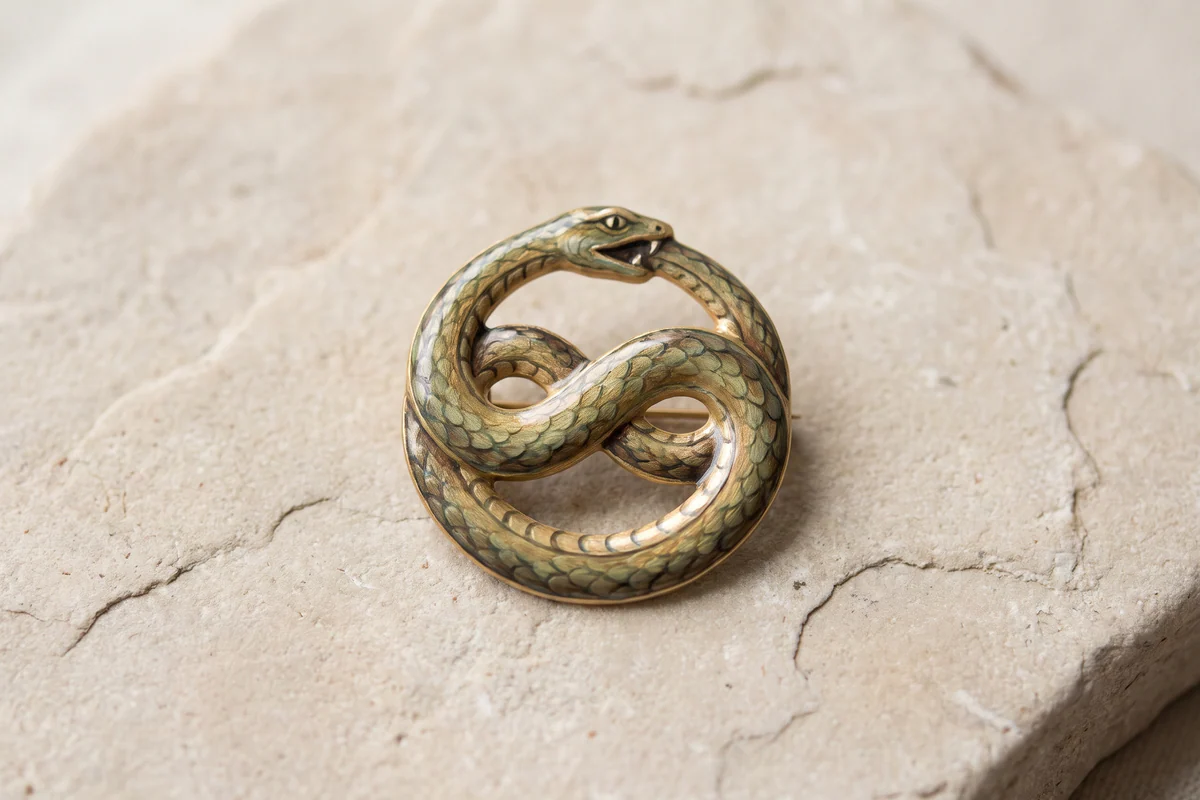
From shed skin to circle is a short step. The ouroboros is a snake, or a dragon, that bites its own tail. Its Greek name combines the words for “tail” and “devouring”. The French-language Wikipedia dates the oldest known depiction, probably Egyptian, to the 16th century BC; another one appears on a shrine of Tutankhamun. For the Egyptians, it stood for the cycle of time and for eternity.
Much later, around AD 300, the alchemist Zosimos of Panopolis turned it into a formula: one is the All, through it the All, and to it the All returns. An end that meets its beginning: the idea of shedding, drawn as a circle.
Other animals carry the idea of long life too, starting with the turtle: read about the turtle and its legends of long life.
Tempter, chaos and a giant: the darker side
The same animal that heals can also kill, and its bad name runs just as deep as its good one.
The serpent of Eden
In Genesis, a snake deceives Adam and Eve and leads them to disobey God. Tradition later identified it with Satan. It is probably the best-known image in the West: the cunning snake, the one that whispers. Yet some Gnostic groups did the opposite and praised it for bringing knowledge to humankind.
Egypt: threat and shield
Ancient Egypt shows both faces. On one side, Apophis (Apep), the serpent of chaos, tries to swallow the boat of the sun, and is defeated every time. On the other, the uraeus, a rearing cobra, sits on the pharaoh’s brow to protect him from his enemies. It embodies the goddess Wadjet.
Further north, a giant
In Norse mythology, Jörmungandr is a snake of enormous size. No cunning and no cure here: only its sheer bulk.
Wise as serpents
Even cunning can turn into a virtue. In the King James Bible, Matthew’s Gospel reads: “Behold, I send you forth as sheep in the midst of wolves: be ye therefore wise as serpents, and harmless as doves.” Where the King James says wise, the French text quoted by Wikipedia says prudent. Either way, the tempter’s cunning becomes good sense.
Feathered, kindly and wise: the snake as a god
In other traditions, the snake is given protective or generous roles:
- In Mesoamerica, Quetzalcoatl, the “feathered serpent”, is linked with the wind, the dawn and the planet Venus; he stands for renewal, wisdom and the union of earth and sky.
- In Dahomey, in West Africa, Danh-gbi is a benevolent snake god of wisdom and happiness.
- In many local beliefs, snakes are spirits of the earth.
- Much closer to our time, Carl Jung saw the snake as an image of the unconscious and of personal transformation.
From one culture to the next, the snake has been both worshipped and feared: a symbol of duality.
Snake spiritual meaning: what is known and what is believed
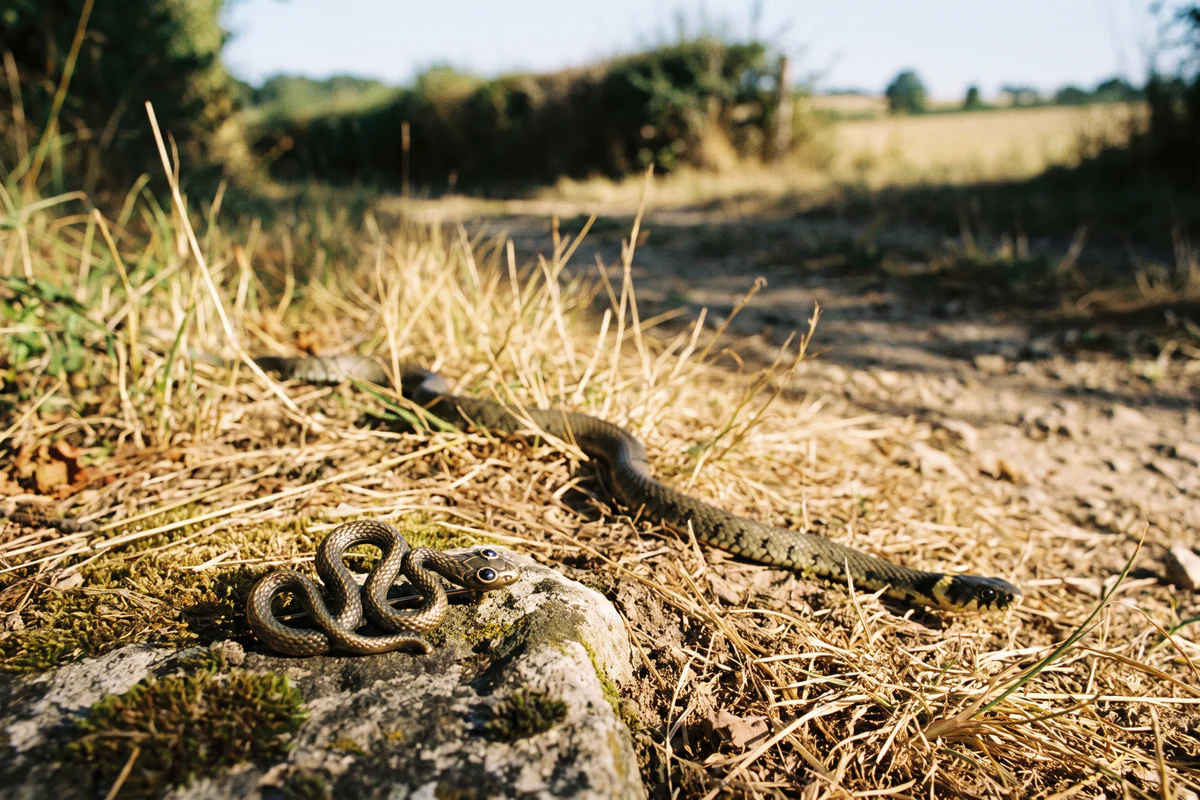
People who look up a snake’s spiritual meaning often have something specific in mind: a snake on a path, a shed skin in the garden, a dream that keeps coming back.
Two things are worth keeping apart:
- what is documented: a snake sheds its skin several times a year, never closes its eyes and smells with its tongue. if one crosses your path, it is above all a carnivore out hunting, or an animal looking for a damp spot to shed;
- what belongs to belief: depending on the tradition, the same snake stands for rebirth (India, the ouroboros), healing (Asclepius), cunning (Genesis), good sense (the Gospel) or wisdom (Quetzalcoatl).
So the snake has no single spiritual meaning. No source settles which reading is right: each one says more about what a people hoped for or feared. If a shed skin makes you think of change, of turning over a new leaf or of a fresh start, that reading is yours.
Giving an animal brooch: who to give it to and what to write
Who to give it to
With these stories in mind, an animal worn as jewellery becomes a small message. A few ideas:
- someone starting a new chapter: a house move, a new job, a change of career, for the skin that renews itself;
- a nurse, a care assistant or a medical student, for the snake of Asclepius;
- a friend getting back on their feet after a hard time;
- a careful person who thinks before acting;
- an animal lover with a soft spot for creatures that divide opinion.
A few words for the card
- “For a new skin and a fresh start.”
- “May this new skin fit you like a glove.”
- “A little good sense, and lots of colour.”
A stylised animal to wear
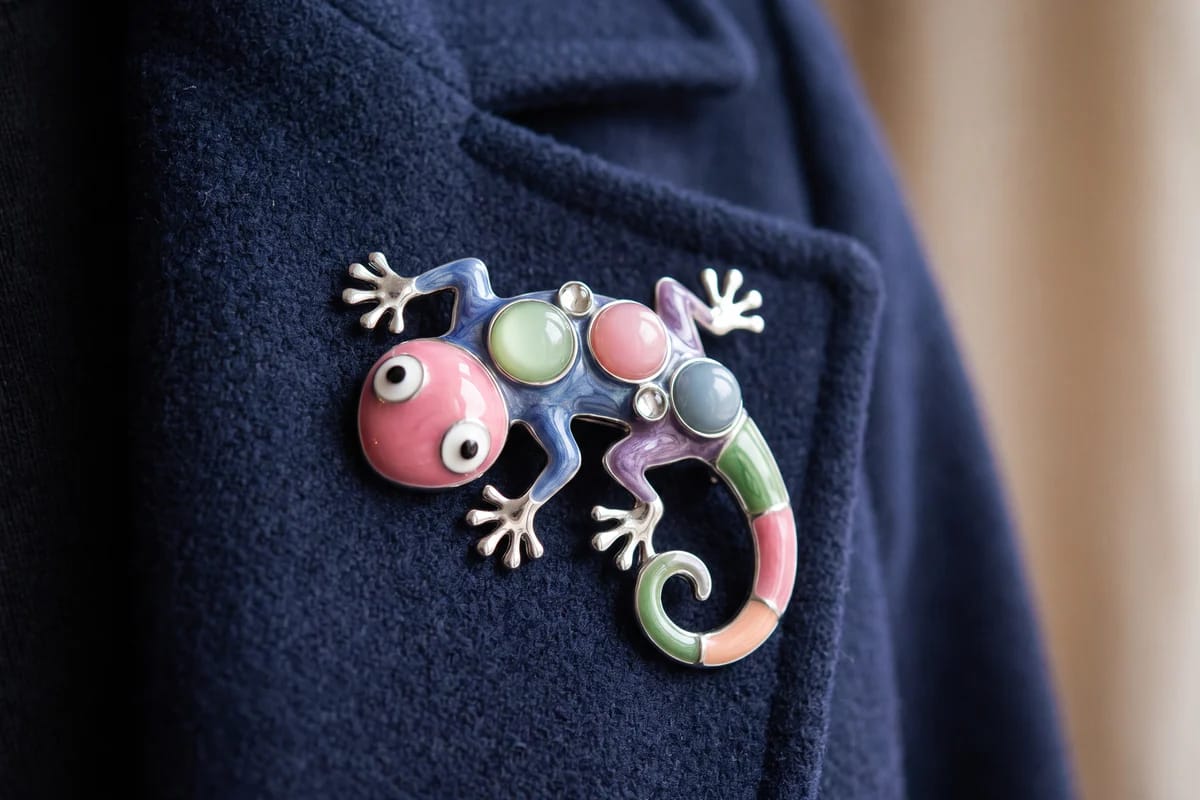
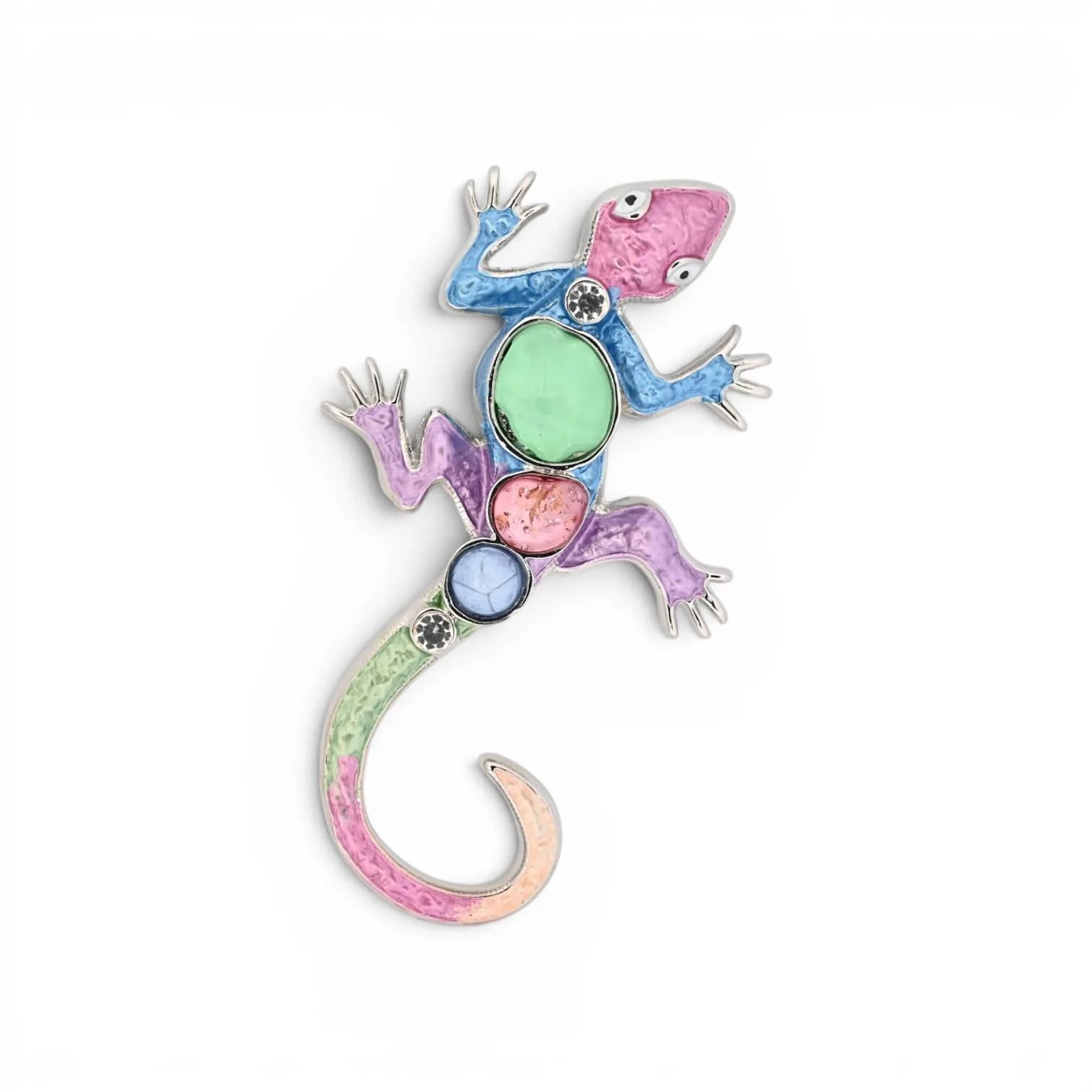
Let’s be clear: you won’t find a snake in our shop. The stylised animal waiting among our costume jewellery brooches has four legs with splayed toes and a long curled tail. Its outline may bring to mind a lizard or a gecko, though it is not any particular species.
It has a large pink head with white and black eyes, a blue and purple body and a tail in green, pink and peach. Along its back run three domed pieces (pale green, pink and blue-grey) and two small clear round ones. It is made of silver-coloured steel and fastens with a magnetic clasp. On a black coat, a denim jacket or an ecru jumper, its colours stand out clearly.
You will find it in our reptile brooch collection. And if other creatures are more your thing, you’ll find cats, dogs, birds and turtles among all our animal brooches.
Snake symbolism at a glance
Snake symbolism is not universal: each tradition ties a specific story to a specific meaning.
| Tradition or source | Story or figure | What the snake stands for |
|---|---|---|
| Britain today | The adder, one of three native snakes; the rod on medical emblems | A wild animal, and the sign of medicine |
| Biology | Shedding, the tongue, eyes without eyelids | An animal that renews itself |
| India | Shedding, the nāgas | Rebirth, death, guardians of the waters |
| Mesopotamia | Gilgamesh and the plant of youth | The one who carries off youth |
| Egypt, then alchemy | The ouroboros | The cycle of time, eternity |
| Greece | The rod of Asclepius | Healing, medicine |
| Bible (Numbers) | The copper serpent | Healing |
| Bible (Genesis) | The tempter | Cunning, disobedience |
| Egypt | Apophis and the uraeus | Chaos, and the king’s protection |
| Gospel of Matthew | “Wise as serpents” | Good sense |
| Mesoamerica | Quetzalcoatl | Renewal, wisdom |
| Carl Jung | The archetype | The unconscious, transformation |
Frequently asked questions
Where does the word “serpent” come from?▾
From the Latin serpens, “a creature that crawls”, the present participle of the verb serpere, “to crawl”.
Is it legal to harm an adder in Britain?▾
No. In Great Britain, it is illegal to intentionally kill or injure an adder, or to sell one, under the Wildlife and Countryside Act 1981.
What is the bowl of Hygieia?▾
It is a bowl with a single snake coiled round it, the emblem of pharmacists in France. It should not be confused with the rod of Asclepius, the symbol of medicine, or with the caduceus of Hermes.
What links the ouroboros to chemistry?▾
The German chemist August Kekulé said that the image of a snake biting its own tail, the ouroboros, inspired his discovery of the ring structure of benzene.
What is Nag Panchami?▾
It is a major Hindu festival devoted to snakes. Worshippers offer milk and incense to statues of snakes.