
Evil Eye Meaning: What the Blue Nazar Bead Stands For
A blue glass bead with a dark centre, hung on doors and given to babies: what the evil eye is, why the nazar is blue and what it means when it cracks.
The evil eye is the belief in a curse sent by a jealous glare, and the nazar, also called the Greek eye or Turkish eye, is the blue glass bead made to turn that glare back. English Wikipedia describes the belief as a “curse brought about by a malevolent glare, usually inspired by envy”. Picture a maternity ward in Turkey: on the door of a newborn's room hangs a small blue bead with a dark centre, staring back at everyone who walks in.
The nazar is an eye-shaped glass amulet, made of circles around a dark dot. It is hung on doors, given at births and worn as jewellery. Its name comes from Arabic, and it is especially common in Turkey today. And if it cracks, tradition sees a good sign rather than a bad one.
The nazar in six points
- a name: nazar, a word from Arabic linked to sight, and boncuk, “bead” in Turkish;
- a look: circles in dark blue, white, light blue and black, or a teardrop;
- a traditional material: handmade glass;
- a belief: it is said to draw the evil eye onto itself;
- where it is made: the province of Izmir, in Turkey;
- a modern sign: the 🧿 emoji stands for the nazar and joined the Unicode standard in 2018.
What is the evil eye? A look that harms
Before the amulet comes the fear it answers. According to the French-language Wikipedia, the belief gives a look, words of praise or a simple compliment the power to harm the person it is aimed at. The danger does not have to come from a spiteful person. English Wikipedia says of Greece that the evil eye “is not necessarily given by someone wishing you ill, but it stems from admiration”. A little too much praise for a baby or a new house is enough.
Habits that go with the belief
The same English article describes some of the ways people guard against it. In Greece, you may say “I spit so that I won't give you the evil eye” after a compliment. Among Muslims, it is customary to say Masha'Allah when admiring something. The nazar is the object version of those words: instead of speaking, you hang a bead.
From Sumer to Rome
The idea is old. According to the French-language Wikipedia, the evil eye appears in texts from Sumer, Babylon and Assyria, and the Romans had talismans against it too. Eye-shaped amulets remained common around the Mediterranean: the same encyclopedia lists them in Turkey, Greece, Armenia, Bulgaria, Malta, Tunisia and Algeria. Greeks say mati, “eye”; in Arabic, the evil eye is al-ʽayn.
The nazar has a cousin, the hand of Fatima (or khamsa, from the Arabic word for “five”), which does the same job in North Africa and the Middle East. “Hand of Fatima” is the name Europeans made popular in colonial North Africa, which is why you will often see both names side by side.
How a glass bead looks back at you
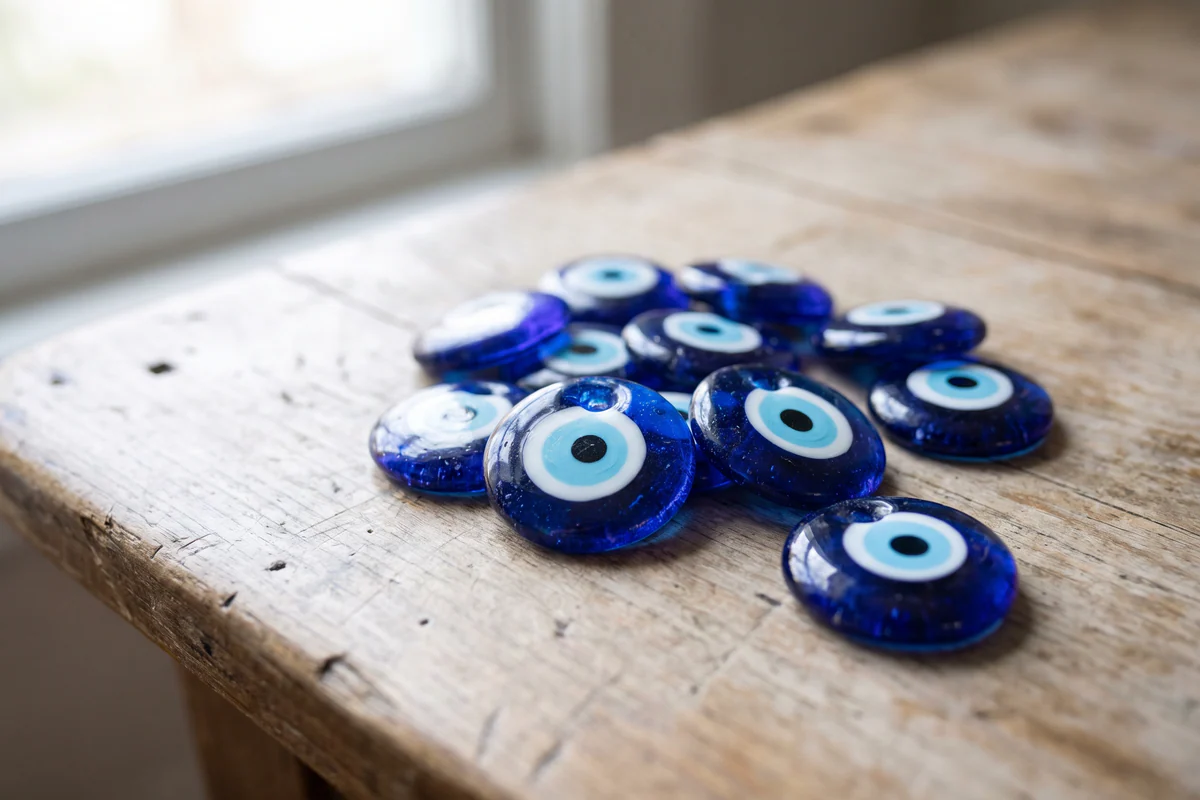
The idea fits in one line: answer an eye with an eye. The bead “looks” on your behalf and draws the hostile gaze onto itself. At least, that is what tradition says.
What the name means
Le Petit Journal d'Istanbul, a French-language magazine, explains that the nazar boncuğu is an amulet made by hand from glass. “Nazar” comes from Arabic, where it means “look” or “eye”, and “boncuk” is the Turkish word for “bead”. Put together, it literally means “bead of the gaze”. English Wikipedia gives the Arabic meanings as “sight”, “surveillance” and “attention”.
What it is made of
According to English Wikipedia's article on the nazar, the bead is made from a mix of molten glass, iron, copper, water and salt. The design follows nearly the same order every time: concentric circles, or a teardrop, in dark blue, white, light blue and black. The dark dot in the middle is the pupil, and it is what makes you feel watched.
How old is the nazar? Sources disagree

Ask how old it is and the answers differ:
- according to Le Petit Journal d'Istanbul, the first amulets of this kind date back to 3300 BC;
- according to English Wikipedia, the oldest written records and surviving beads date from the 16th century BC;
- both tie its story to glassmaking, from Mesopotamia and Egypt to the Aegean islands and Asia Minor.
Today most nazars are made in Turkey. Le Petit Journal says most nazar production is concentrated in Kemalpaşa, in the province of Izmir. In the same province, the village of Görece registered its nazar bead as a geographical indication: number 70 in the Turkish register, entered on 23 June 2005, for a round bead in blue, white and black made by traditional methods.
Why the nazar is blue
There are two explanations, and they are very different kinds of story.
The glassmaker's answer
Le Petit Journal says the deep blue comes from firing the glass with copper and cobalt. It is the colour that comes out of the kiln, and it became the amulet's signature.
The legend's answer
The same article passes on a legend: people with blue eyes were thought the most likely to cast the evil eye, so the amulet gives them back their own colour, like a mirror. There is no way to check this. It is a story people tell, not a fact.
| Subject | What is documented | What the belief says |
|---|---|---|
| The evil eye | A fear recorded from Sumer to Rome, still alive around the Mediterranean | A look or a compliment could harm |
| The nazar | A handmade glass bead, mostly from the province of Izmir | It draws the hostile gaze onto itself |
| The blue | Obtained with copper and cobalt | Blue eyes are the most dangerous |
| A broken bead | A reading reported by Le Petit Journal and Wikipedia | It has turned away an evil eye |
Where do people put a nazar?
In Turkey you meet it in several places, each with its own use:
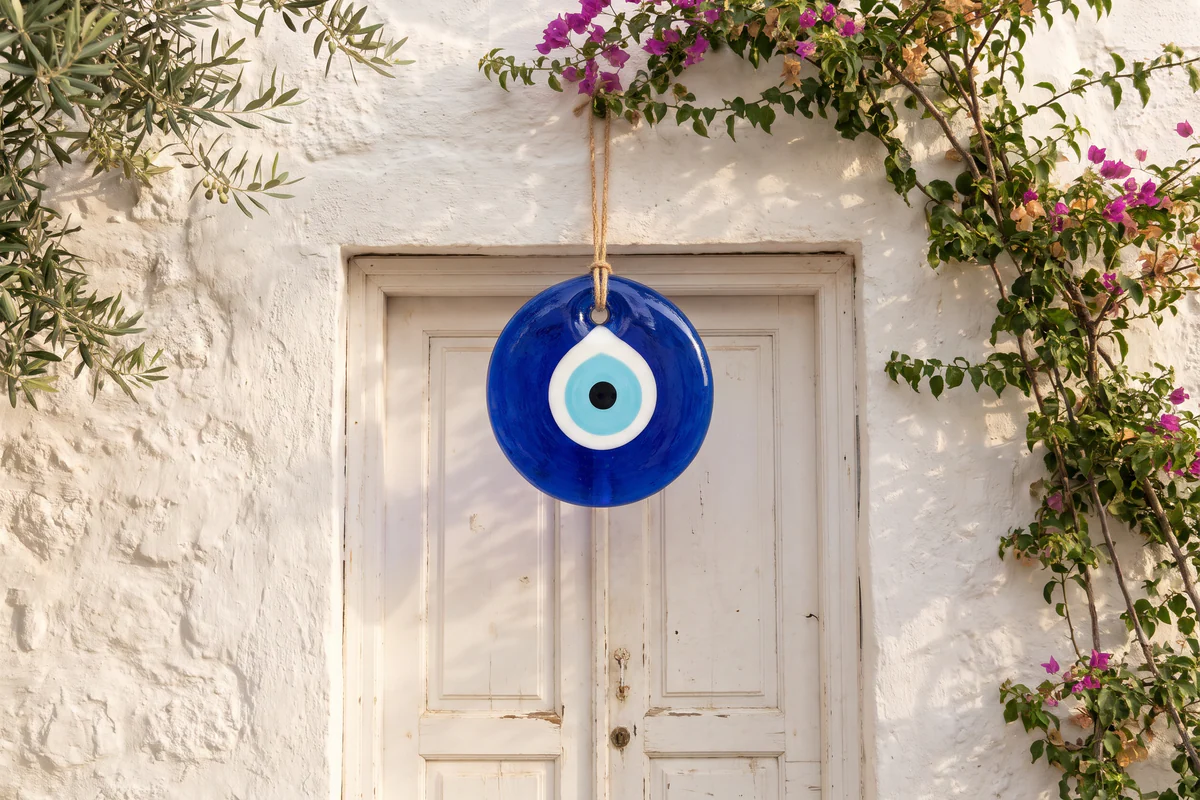
- near a newborn: Le Petit Journal reports that a miniature one is given at a birth, and English Wikipedia shows a nazar on the door of a newborn's hospital room in Turkey;
- at home: it hangs above the front door, the threshold where visitors and their glances pass;
- in the car: according to the French-language Wikipedia article on the evil eye, it is often hung from the rear-view mirror;
- on yourself: as a bead, pendant, bracelet or brooch, it goes where the wearer goes.
The gesture matters as much as the object. Giving a nazar to a baby means wishing that people look at the child kindly. Turks even have a phrase for when misfortune seems to follow too much admiration: “Nazar değdi”, meaning the evil eye has struck.
What if a nazar cracks?
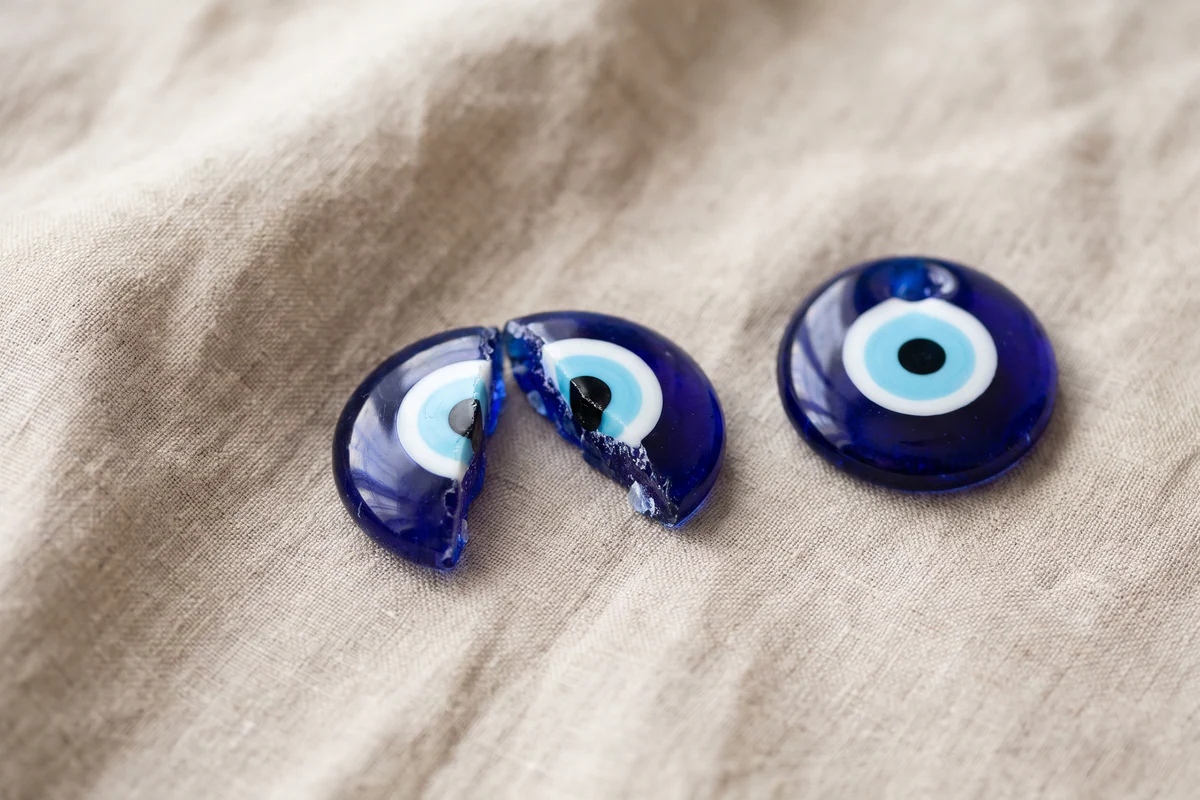
Glass beads do crack in the end. According to tradition, a broken nazar is not a sign of bad luck, quite the opposite. Le Petit Journal says that if an eye breaks or cracks, it has done its job and “pushed back the harm”. English Wikipedia reads it much the same way: a broken bead means that a very strong evil eye has struck the person wearing it. What next? Le Petit Journal's answer is simple: replace it with a new one.
Wearing a nazar as a brooch
You can also wear a nazar for a plainer reason: it looks good. It can bring back a trip, a family, a summer by the sea. Its circles stand out from across a room, and its blues go with almost anything.
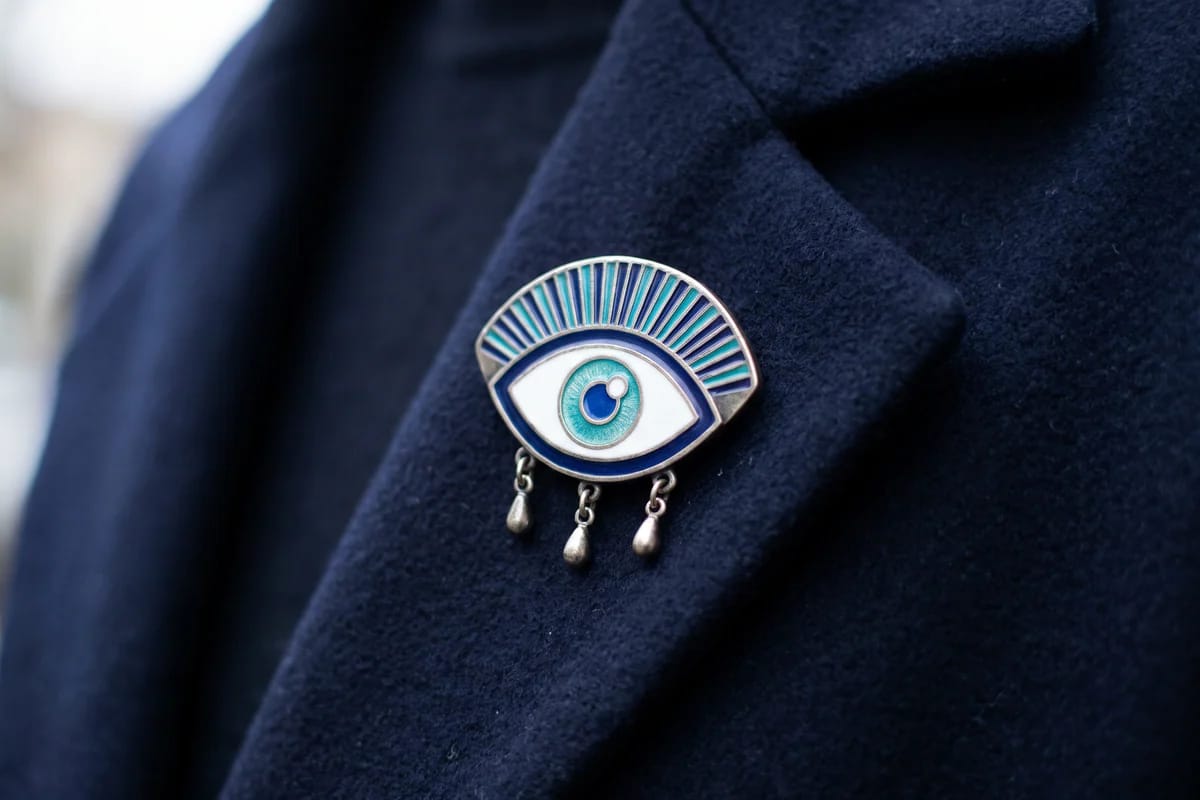
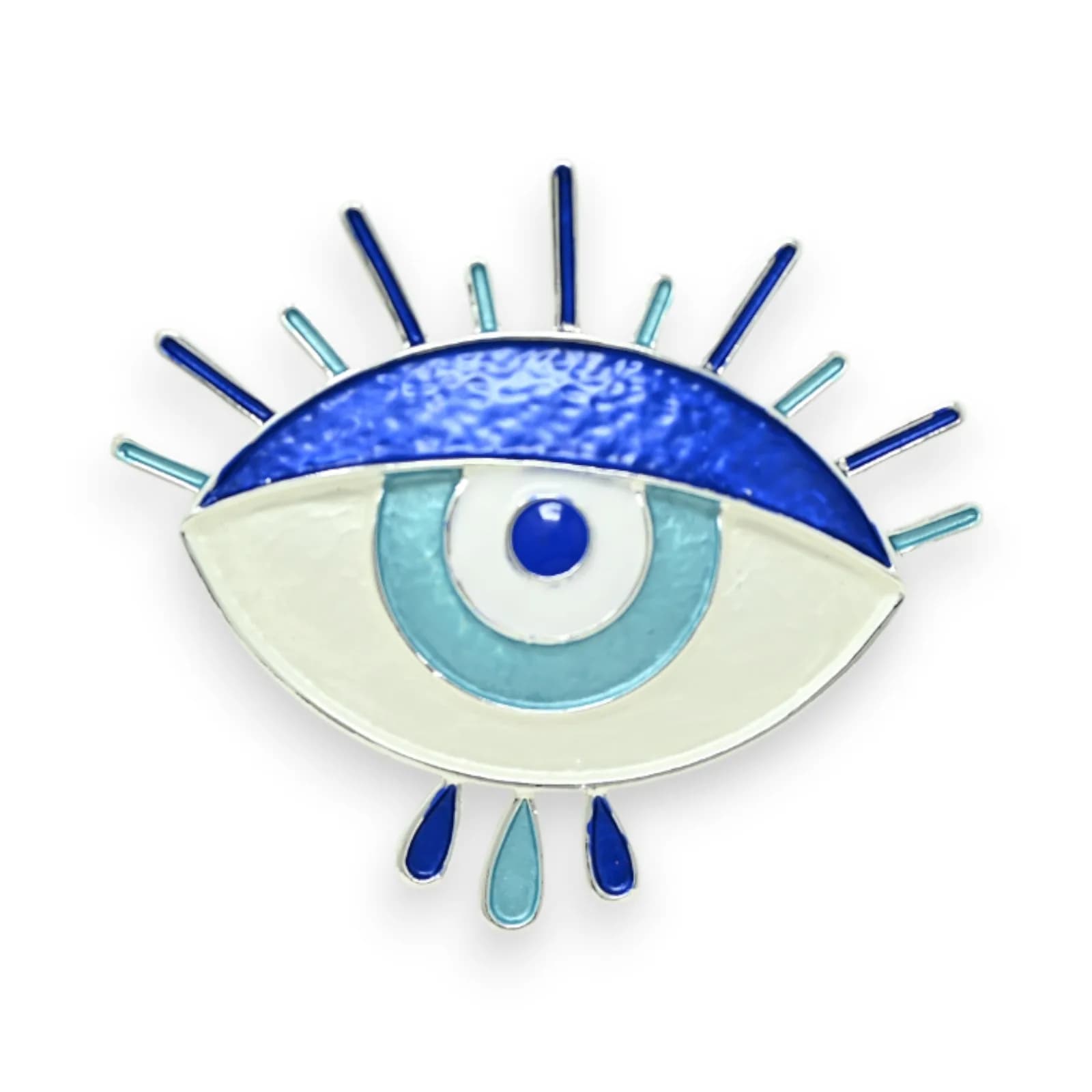
Our nazar brooch turns the motif into a piece of fashion jewellery, and it is the only model of its kind in the shop. A white eye edged in dark blue, a turquoise and white iris around a blue pupil, lines radiating above and three drops hanging below. It measures 6 cm. Made of silver-tone steel, it fastens with a magnet, without piercing the fabric, like every piece in our range of magnet-fastened brooches. It is part of our original brooches, alongside other motifs with a story to tell.
On a navy coat, a white jumper or a denim jacket, its white and turquoise stand out effortlessly. To choose where to place it, our guide to where a brooch sits best goes through every option. A soft, dry cloth is all it takes to keep the colours bright; just avoid water and perfume.
Giving a nazar
A nazar makes a good gift because it comes with its own message: “may the looks you get stay kind”. The tradition Le Petit Journal reports goes the same way: a nazar is best received from someone with pure intentions rather than bought for yourself. A few ideas:
- for new parents, echoing the bead given to babies in Turkey;
- for a friend back from Greece or Turkey, as a souvenir;
- for someone moving house, like the eye hung over the door;
- for a person starting a new job who likes good-luck charms;
- for anyone who loves blues and graphic motifs, just because.
If the person collects lucky charms, the nazar is in good company: the cat raising its paw in Japan, the Egyptian scarab or the elephant and its legendary memory. For more ideas, browse our whole range of brooches.
The nazar at a glance
| Question | Answer | Detail |
|---|---|---|
| What is it? | An eye-shaped glass amulet | Nazar boncuğu, literally “bead of the gaze” |
| What is it believed to do? | Turning away the evil eye | Envious look, over-warm compliment |
| How old is the belief? | Very old | Texts from Sumer, Babylon, Assyria; Rome |
| How old is the bead? | Disputed | 3300 BC or 16th century BC, depending on the source |
| Where is it made? | In Turkey | Kemalpaşa and Görece, province of Izmir |
| Why blue? | Copper and cobalt | Plus the legend of blue eyes |
| Where is it hung or worn? | By a baby, at the door, on yourself | Miniature given at a birth |
| What if it cracks? | It has “done its job” | It has warded off harm |
| A similar amulet? | The hand of Fatima | Khamsa, from the Arabic for “five” |
One small blue circle, and behind it centuries of anxious looks and kind wishes. Whether you believe in it or not, wearing a nazar means keeping close to you a very old way of wishing someone well.
Frequently asked questions
Are the nazar, the Greek eye and the Turkish eye the same thing?▾
Yes, these names describe the same amulet: a glass bead, most often blue, drawn in circles around a dark dot. Its Turkish name is nazar boncuğu; in Greece it is called mati, “the eye”. Which name people use often depends on the country where they first saw it.
Does the nazar really protect against the evil eye?▾
Nothing proves it: protection from the evil eye is a matter of belief. The nazar is above all a very old cultural symbol, worn for what it stands for: a wish for kindness, a souvenir, a family tradition.
What does the 🧿 emoji mean?▾
It is the nazar. It was added to the Unicode standard in 2018 as “nazar amulet”, code U+1F9FF. People often send it in a message to wish good luck or, playfully, to keep envious looks away.
What is the difference between the nazar and the hand of Fatima?▾
Both are amulets against the evil eye, but they look different. The nazar is an eye-shaped bead, very common in Turkey and Greece. The hand of Fatima, or khamsa, is shaped like a hand; its name comes from the Arabic word for “five” and it is found in North Africa and the Middle East.
Can you wear a nazar as a brooch?▾
Yes. The nazar is worn as a bead, pendant, bracelet or brooch. As a brooch, it sits on a jacket lapel, a coat or a scarf; its blues stand out well against plain fabric in white, beige or navy.