
Bear Symbolism: Why It Inspires Awe and Comfort
The Plough, Norse berserkers, the bears of Bern, spring festivals in the Pyrenees and the first teddy bears: what the bear stands for, where each meaning comes from, and which meanings come from older sources rather than modern belief.
On a clear night anywhere in Britain, look north. Seven bright stars draw a shape that people here call the Plough, known elsewhere as the Big Dipper. Yet those stars belong to a much larger figure: a great she-bear, placed in the sky by the ancient Greeks. Down on earth, the same animal has been a feared creature of the forest and the softest toy in the nursery.
Bear symbolism lives in that contrast. Across cultures, the bear stands above all for strength, for renewal with the seasons, and for the comfort we now find in a teddy bear. Its strength belongs to the warrior who wore its skin and to the city that put it on its coat of arms. Its renewal comes from its rhythm: it disappears in winter and comes back in spring. Along the way, it was even king of the animals in Europe. Here is where each meaning comes from, and which ones stand on firm ground.
What does a bear symbolise?
There is no single meaning. Depending on the period and the story, the bear speaks of power, of a new season or of tenderness. These are the meanings that texts and traditions actually support:
- strength and courage, among Norse warriors and in heraldry;
- renewal, with the bear that wakes from its long winter sleep;
- kingship, since it long ruled the animal world in Europe;
- guidance, with the Great Bear that points the way north;
- comfort, ever since the teddy bear moved into children’s bedrooms.
To see how one animal came to carry all of this, you have to go back a very long way, into the caves.
A neighbour since the Stone Age
People have hunted bears since prehistoric times for their meat and fur, and bears have left a deep mark on myths, folk traditions and art. The Latin word ursus (ursa for a female) lives on in the scientific name of the family, the Ursidae. The relationship is old, and it has never been neutral.
In the Chauvet Cave, in the Ardèche region of southern France, bear skulls were found that were probably placed there on purpose. That ‘probably’ matters: nobody knows what the gesture meant. But the idea that a bear deserved special treatment runs through the centuries. In Japan, the Ainu people dedicated an elaborate religious ceremony to the bear, the Iyomante.
The king who lost his crown
Ask who the king of the animals is and most people will say the lion. In Europe, it was not always so. The French historian Michel Pastoureau tells the story in L’Ours, histoire d’un roi déchu (2007), whose title translates as ‘The Bear: History of a Fallen King’. His argument: the lion did not always wear the crown; it took it from the bear. Until around the end of the 12th century, the bear reigned over the bestiary.
According to Pastoureau, the Church fought the bear for close to a thousand years. It turned an animal that people admired too much into an unsettling creature, and put the lion on the throne instead. The book holds a surprise at the end: it also tells the story of the teddy bear, which its publisher presents as the last echo of a passionate relationship between people and bears.
Strength: warriors in bearskin and a city of bears
Think of a bear and you think first of its power. You find it in the Norse sagas and on the coat of arms of a Swiss city.
Berserkers, the bear-shirts
In the Scandinavian sagas, berserkers are warriors who go into battle in a sacred fury. Their name can be read two ways. The more widely accepted reading, as Wikipedia’s article on berserkers explains, is ‘bear-shirt’: someone who wears a coat made of a bear’s skin. The other, ‘bare shirt’, meaning a man who fought without armour, has largely been abandoned. The French scholar Régis Boyer favoured the first: the warrior took on the power of the bear whose skin he wore as armour. To wear the bear was to borrow its strength.
Bern, the city of the bear
The Swiss city of Bern has a black bear on its coat of arms. Legend says its founder, Berthold V of Zähringen, named it in 1191 after a bear he had killed or captured (Bär in German). The likelier explanation is quite different: an old Celtic river name, berna, which may mean ‘ditch’ or ‘cleft’. Either way, the people of Bern adopted the animal, and their bear pit became famous. The first name Urs, from ursus, is still common there.
Another animal protects us on a more everyday scale, right by our side: our article on dog symbolism tells the story of that faithful companion.
The bear in winter: asleep, then back in spring

This may be the bear’s most striking habit. As winter approaches, most species withdraw into a period of winter dormancy, a sleep that can last around a hundred days. Then, as the days grow longer, the bear comes out of its den. For mountain villages, the message was obvious: winter is over.
That meaning is still alive. Every winter, five villages in the Pyrenees, in France and Andorra, hold bear festivals: Arles-sur-Tech, Prats-de-Mollo-la-Preste and Saint-Laurent-de-Cerdans in the Haut-Vallespir, and Encamp and Ordino in Andorra. Young men dress up as bears and run through the streets trying to catch the people taking part, amid dancing, music and speeches in Catalan.
UNESCO added these festivals to the Intangible Cultural Heritage of Humanity in 2022. According to UNESCO, they stand for the end of winter, the rebirth of spring (with the bear waking from hibernation) and the relationship between people and nature. If you find yourself in the Vallespir in February, that is when the bear comes down from the mountain.
The bear in the sky: from the Plough to the Great Bear
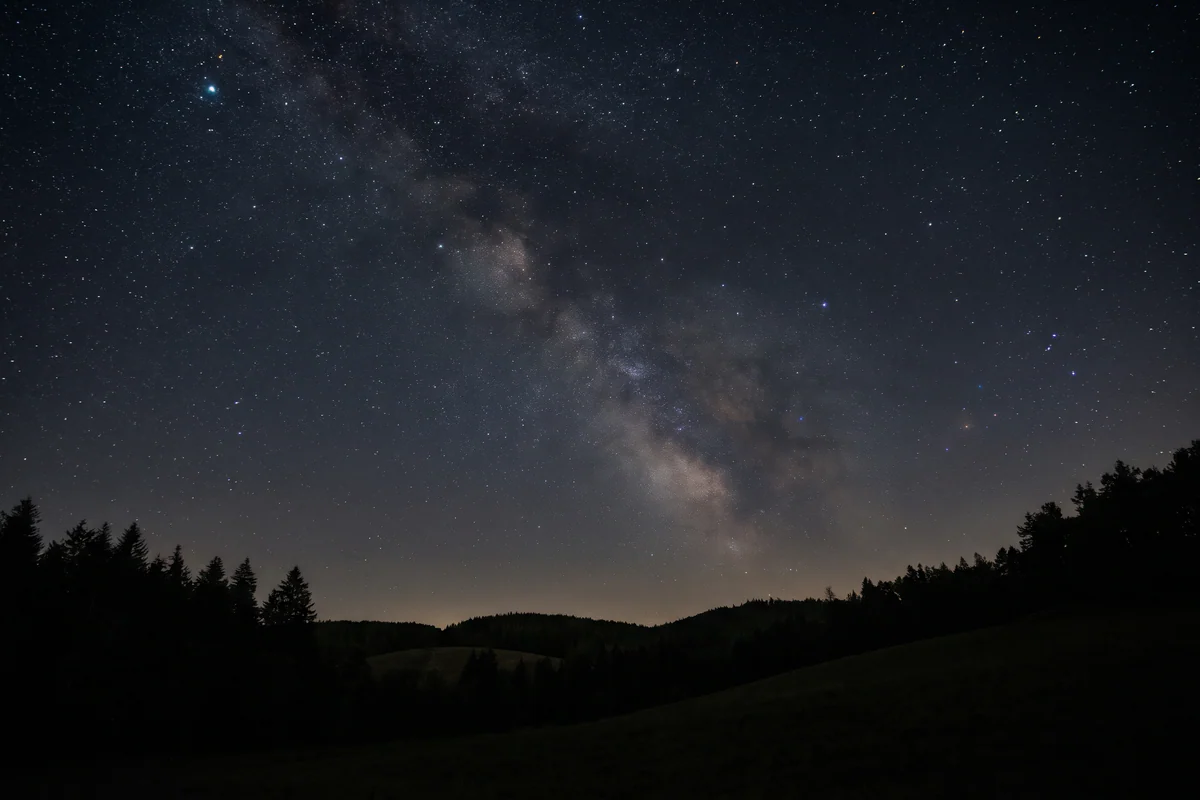
Back to those seven stars. The Plough is only the brightest part of the constellation the Greeks called the Great Bear, and they told a story about it. The nymph Callisto, daughter of Lycaon, king of Arcadia, was loved by Zeus. Zeus eventually turned her into a constellation, the Great Bear, and her son Arcas into the Little Bear.
The bear even gave its name to the far north. In Greek, a bear is arktos, which gave us the word Arctic. The Plough also works as a compass. Take the two stars at the far end of the Plough, from Merak to Dubhe, and extend that line about five times the distance between them: you reach the Pole Star, which marks north. A she-bear that guides travellers home is not a bad image to carry with you.
Teddy bear origin: a president, a cartoon and a toy fair
November 1902, in Mississippi. President Theodore Roosevelt had joined a bear hunt. According to a story that became famous, an injured bear was tied to a tree so that the president could shoot it. Roosevelt refused to kill it. On 16 November, the cartoonist Clifford Berryman published a drawing in the Washington Post of the president sparing the bear. Morris Michtom, who ran a sweet and toy shop, spotted it. With his wife Rosa, who sewed rag dolls, he was selling a plush bear named Teddy by 1903.
The Steiff teddy bear in Germany
On the other side of the Atlantic, Richard Steiff came back from Stuttgart Zoo with sketches of bears. He persuaded his aunt, Margarete Steiff, to make a jointed bear in mohair plush, the PB 55. She showed it at the Leipzig toy fair in 1903, and an American buyer, Hermann Berg, ordered 3,000 of them. So the teddy bear appeared almost at the same time in the United States, with Morris and Rosa Michtom, and in Germany, with Richard and Margarete Steiff.
A very British bear
Britain soon had a bear of its own. A young Christopher Robin called his toy bear Edward, then Winnie, after a Canadian black bear he often visited at London Zoo. That bear had been bought by a Canadian lieutenant, Harry Colebourn, on his way to England during the First World War, and named after his home town, Winnipeg. On 14 October 1926, A. A. Milne’s Winnie-the-Pooh was published in England. A Canadian bear had inspired one of the best-known toy bears in children’s books.
A bear that comforts
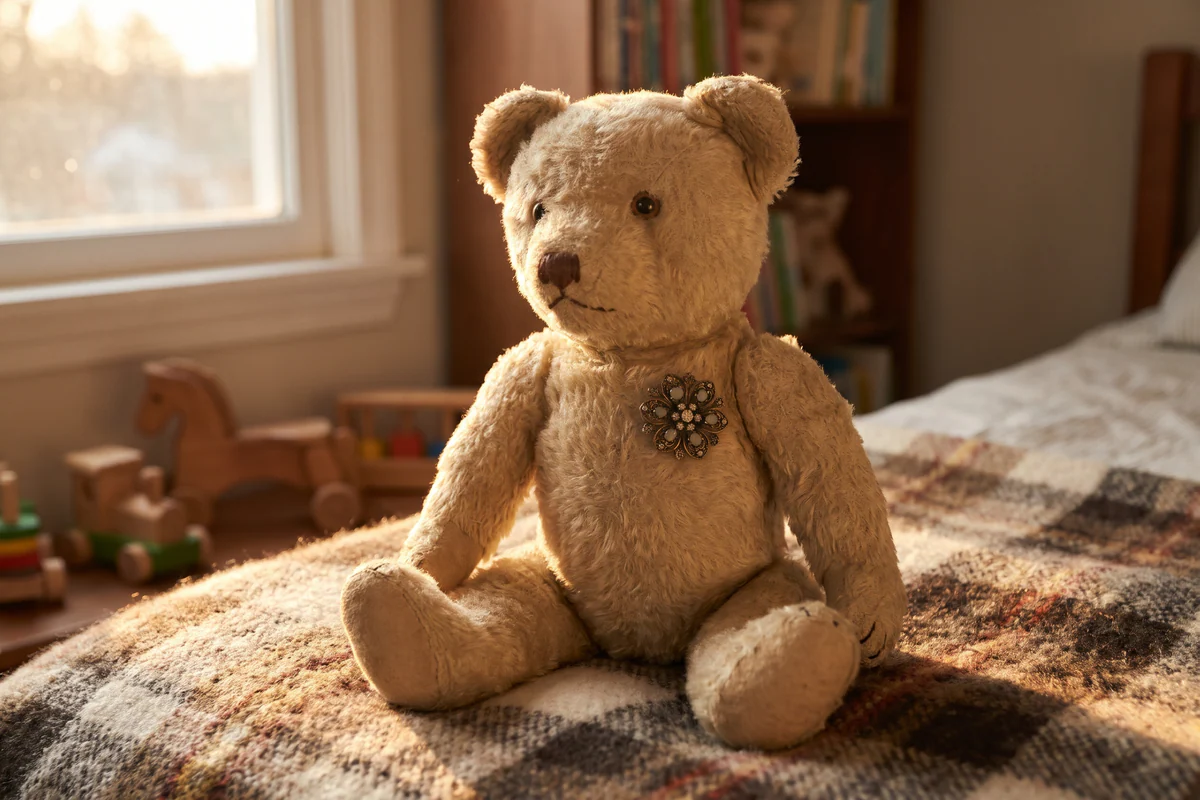
Since then, the teddy bear has held a special place: it consoles. Peter Bull, one of the first to talk about a ‘therapy bear’, fixed simple arms to a soft toy to help a little boy understand the condition he had been born with, caused by thalidomide, and to comfort him. Russell McLean, nicknamed the ‘Teddy Bear Man’, gave a bear to every child in hospital. And the world’s first museum devoted to teddy bears opened in 1984 in Petersfield, Hampshire. The old king of the animals ended up in our arms.
Spiritual meaning of a bear: history or belief?
Search for the spiritual meaning of a bear or a bear totem and you will find pages about the bear as a spirit animal, a healer or an inner guide, and about what it means to dream of one. These readings are modern interpretations. They do not appear in the older traditions examined for this article. Here, ‘documented’ means that a story, a text or an identifiable tradition ties the meaning to a source. The table below tells the two apart:
| Idea | Where it comes from | Status |
|---|---|---|
| The bear as the warrior’s strength | Berserkers of the Norse sagas | Literature, documented (etymology debated) |
| The bear as king of the animals | Europe until the 12th century, according to Pastoureau | History, documented |
| The bear of spring | Pyrenean festivals listed by UNESCO in 2022 | Living tradition, documented |
| The bear in the sky | Greek myth of Callisto | Mythology, documented |
| The bear that comforts | Teddy bear, since 1903 | Recent history, documented |
| The bear as totem or healer | Present-day spirituality websites | Modern interpretation, not attested in the sources examined |
| Dreaming of a bear | Dream books and websites | Personal interpretation |
You can sort the meanings of any animal the same way. Our article on animal symbolism explains how these meanings take shape, from ancient stories to recent beliefs.
Wearing a bear brooch
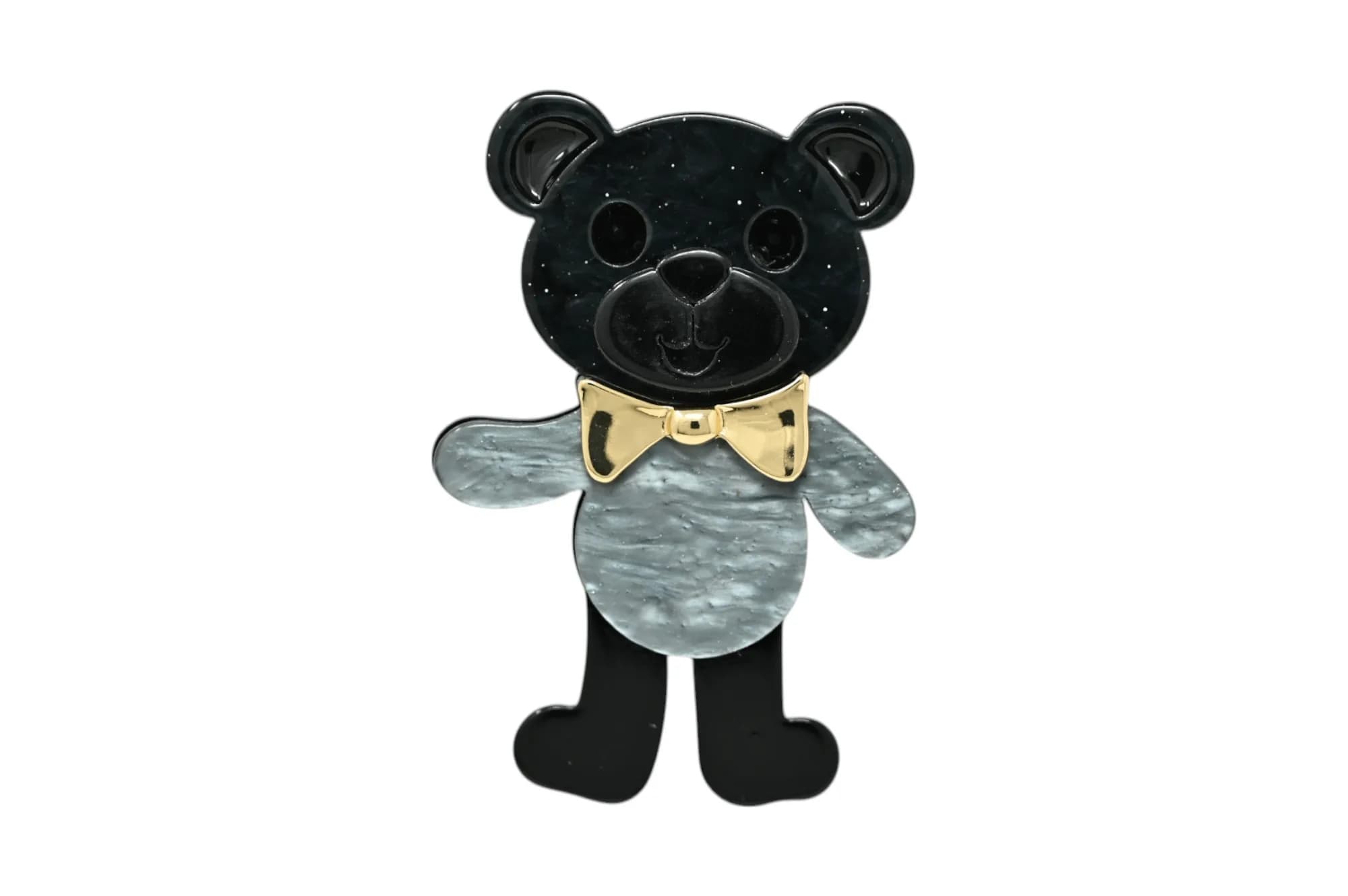
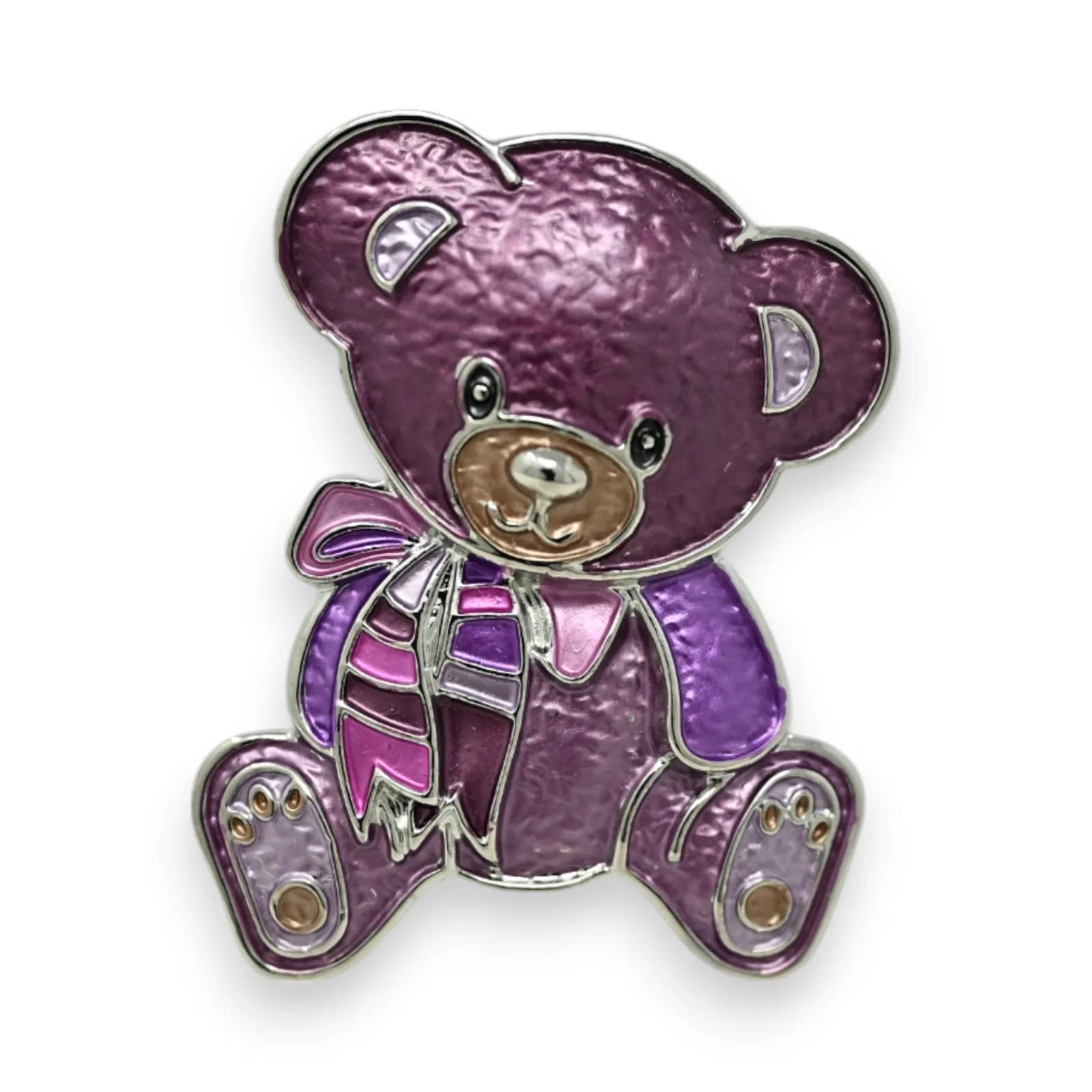
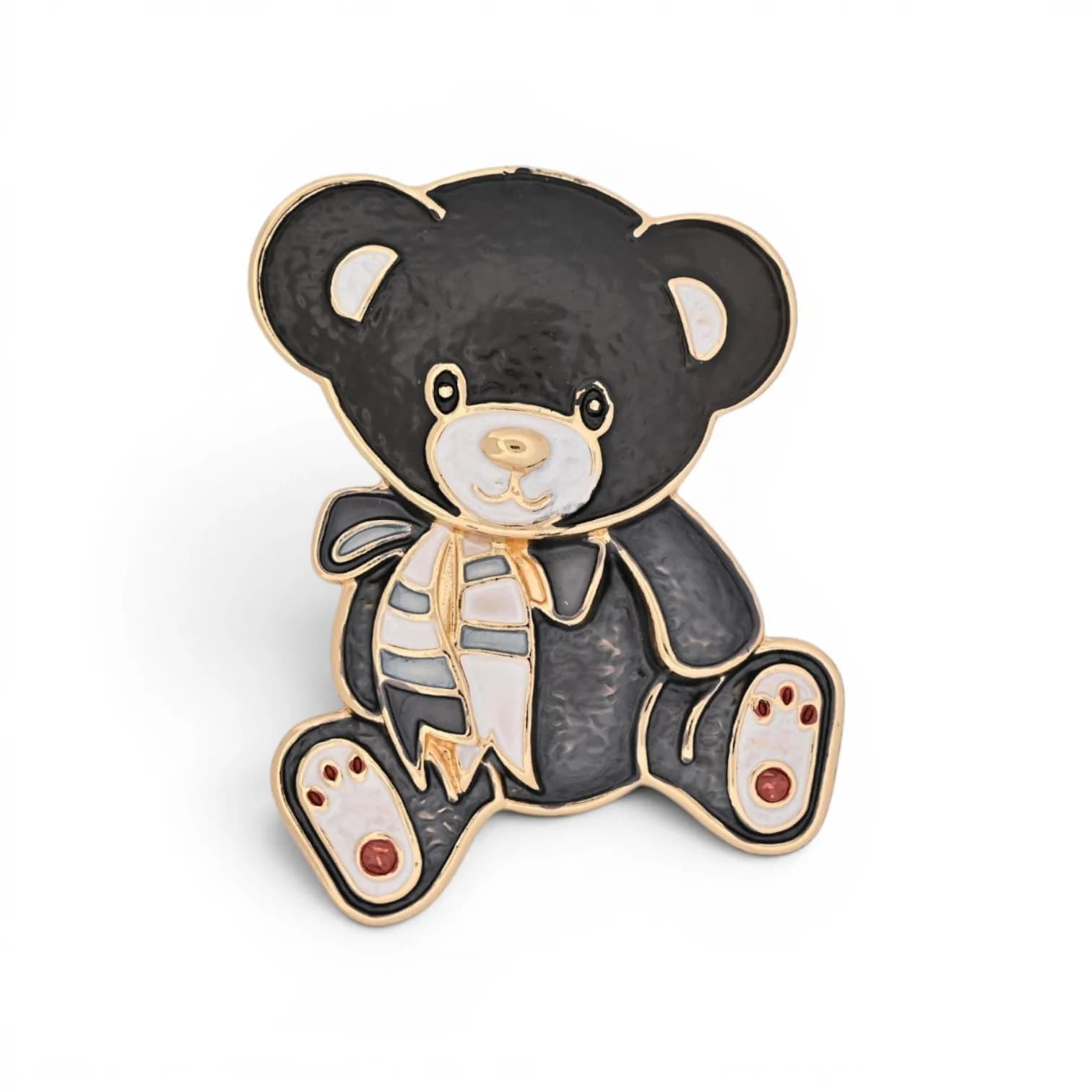
Between the king of the forest and the teddy, our bear brooches come down on the gentle side. There are four designs:
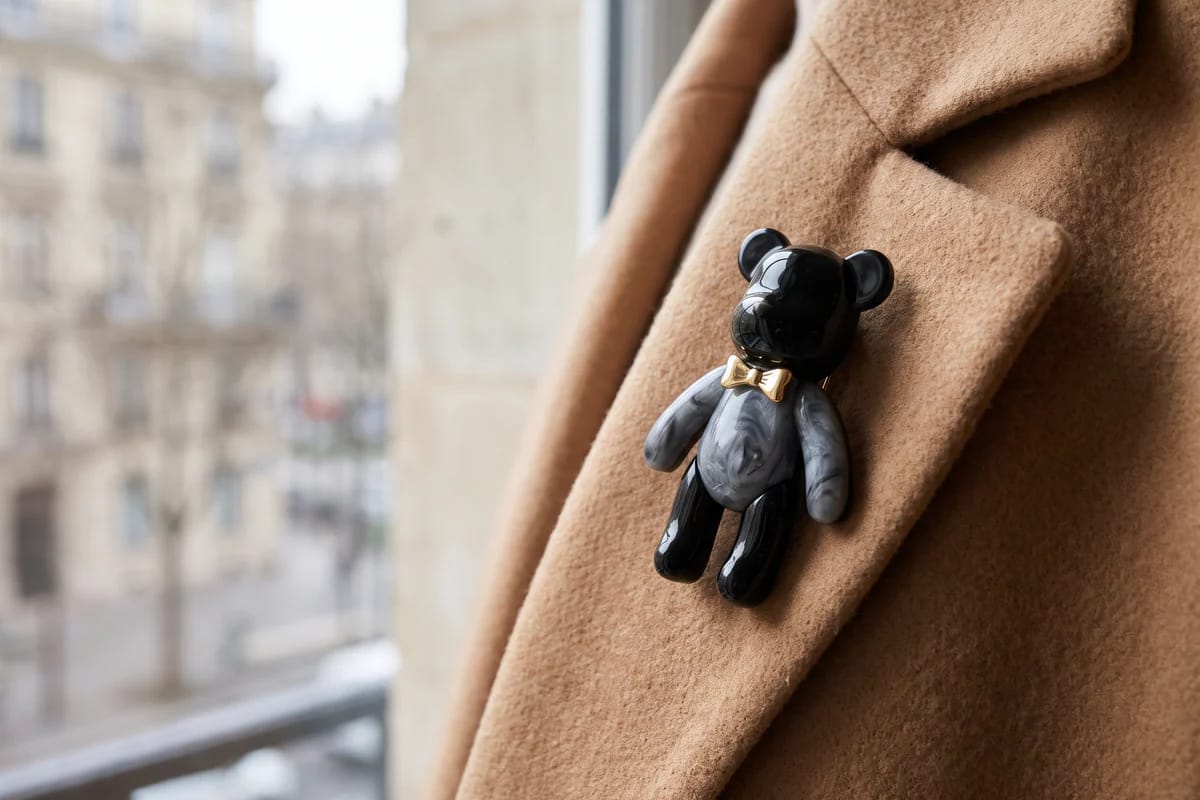
- a standing bear in glossy black resin, with a marbled grey belly and a gold-tone bow tie;
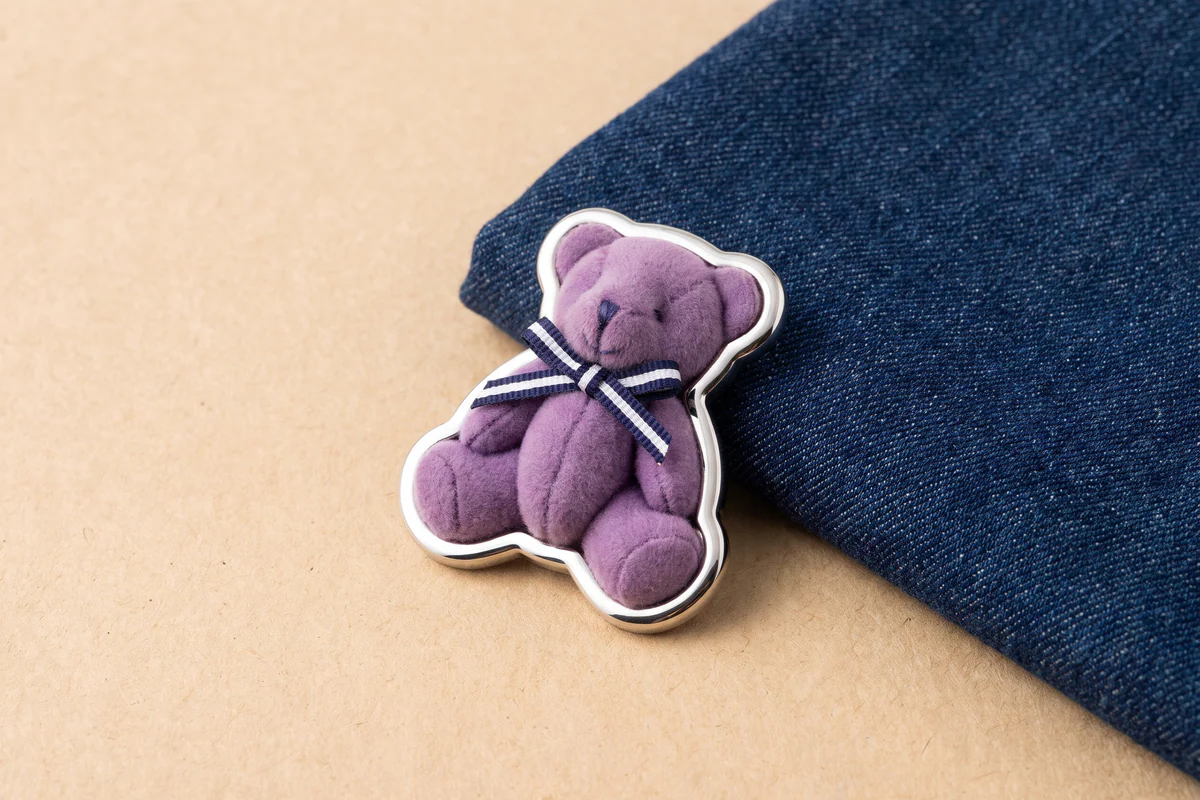
- a seated purple teddy with a striped ribbon, framed by a silver-tone steel outline;
- a teddy in black enamel edged with gold-tone steel;
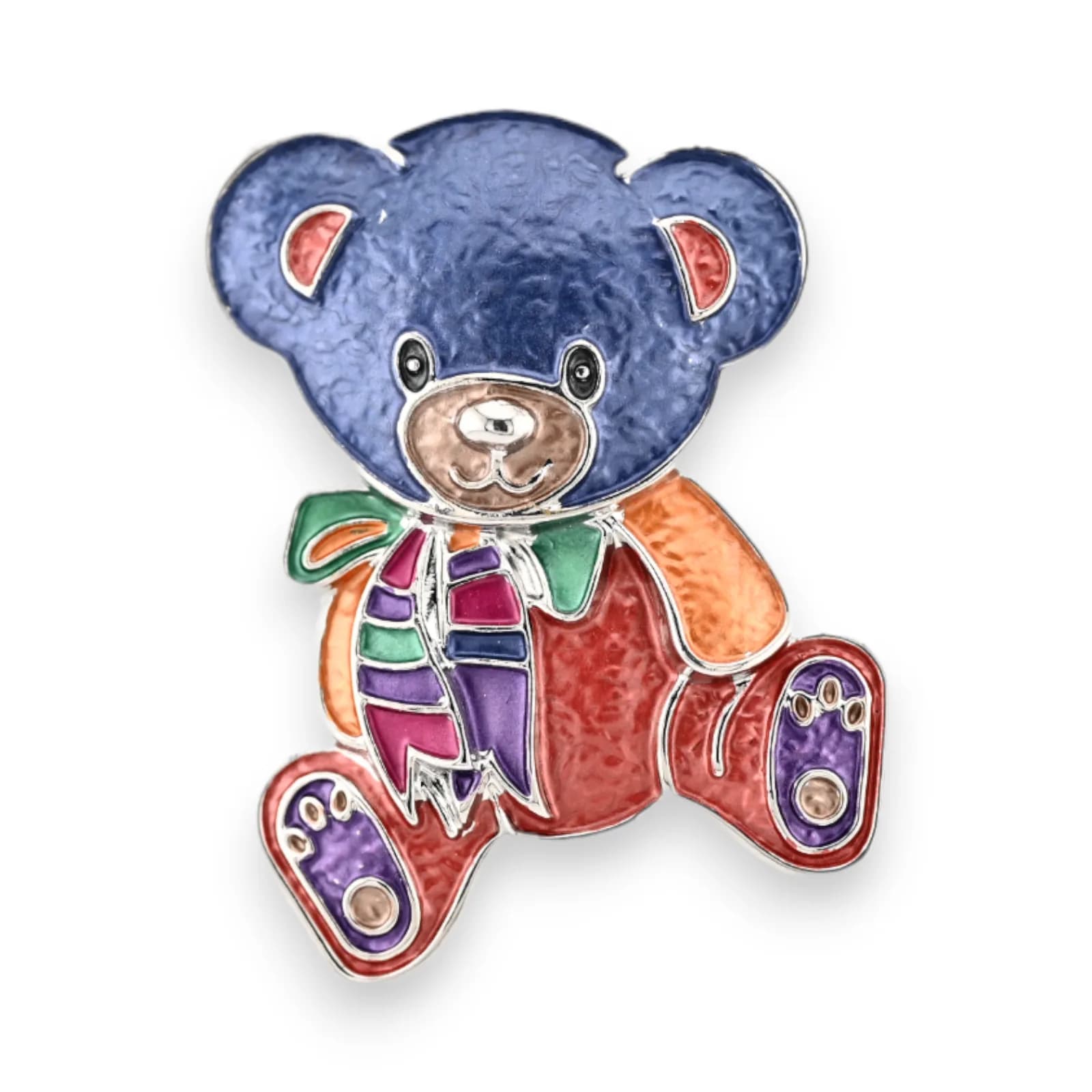
- a multicoloured teddy with a blue head and a red body, wearing a scarf striped in green, purple and fuchsia.
To match them with the rest of your jewellery, have a look at our gold-tone designs and our silver-tone brooches. All four bears fasten with a magnet, the backing plate sitting inside the garment, like the rest of our brooches that hold without a pin.
For a clear contrast, try wearing a bear against a plain background: a blazer lapel, a coat collar, the shoulder of a jumper, the flat panel of a canvas bag. Black stands out on camel or ecru, purple on beige or denim. Our guide on where to pin a brooch goes through the other spots, garment by garment.
A bear brooch as a gift
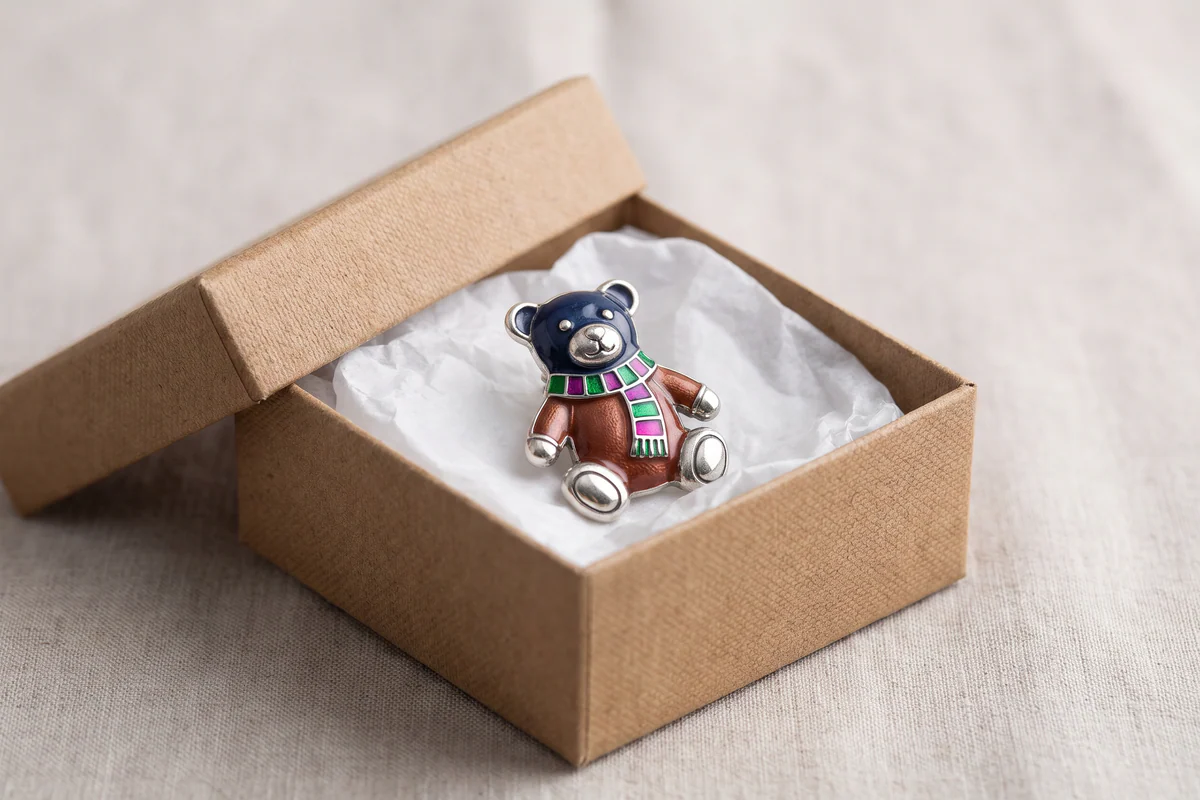
A bear speaks to many people: someone who has kept their childhood teddy, someone who loves the mountains, a friend who collects animal motifs, a grown-up who still knows Pooh by heart. Its story also gives you something to write on the card:
- for someone going through a hard time, as a reminder of the teddy that comforts;
- for a person who needs courage, with the bear of warriors and coats of arms;
- at the end of winter, as a nod to the bear that wakes up in spring;
- for a stargazer, with the Plough that leads to the Pole Star.
The mouse made the same journey from fables to the nursery: we tell its story in our article on mouse symbolism. For other creatures, browse our animal designs, or the whole range of fashion brooches.
Bear symbolism at a glance
| Tradition | Where you find the bear | What it says |
|---|---|---|
| Prehistory | Bear skulls in the Chauvet Cave | An animal set apart, very early |
| Medieval Europe | King of the animals, dethroned by the lion | Lost kingship |
| Scandinavia | Berserkers of the sagas | The warrior’s strength |
| Switzerland | Coat of arms of Bern | The emblem of a city |
| Pyrenees | Bear festivals, listed by UNESCO in 2022 | The end of winter, renewal |
| Ancient Greece | Callisto, the Great Bear and the Plough | The bear in the sky that points north |
| 20th century | Roosevelt in 1902, Teddy and Steiff in 1903, Pooh in 1926 | Comfort |
Feared, revered, dethroned, then hugged at bedtime: the bear has been through it all. Perhaps that is the truest thing it tells us: real strength also knows how to be gentle.
Frequently asked questions
What does a bear symbolise?▾
Above all, strength, the renewal of spring after its winter sleep, and the comfort linked to the teddy bear. In Europe, the bear was also long seen as the king of the animals, before the lion took its place.
What is the spiritual meaning of a bear?▾
Readings of the bear as a totem, healer or inner guide are modern spiritual interpretations. They do not appear in the older traditions examined here, which link the bear to the strength of warriors, to the end of winter and to the sky through the Great Bear.
What is the origin of the teddy bear?▾
The name comes from Theodore ‘Teddy’ Roosevelt. According to a story from November 1902, the American president refused to kill an injured bear tied to a tree. Clifford Berryman’s cartoon inspired Morris and Rosa Michtom, who were selling a plush bear called Teddy by 1903. In Germany, Steiff showed its own bear at the Leipzig toy fair the same year.
Why is the Plough part of the Great Bear?▾
The seven stars of the Plough are the brightest part of the Great Bear. In Greek myth, Zeus turned the nymph Callisto into that constellation and her son Arcas into the Little Bear. The Greek word for bear, arktos, gave us the word Arctic.
Why is the bear linked to spring?▾
Because it spends the winter dormant, sometimes for around a hundred days, then leaves its den. The bear festivals of the Pyrenees, listed by UNESCO in 2022, celebrate that awakening as the end of winter and the rebirth of spring.