
Apple Symbolism: From Eden to Snow White and Newton
The apple of my eye, the fruit Genesis never named, the apple thrown to the fairest, Avalon and Snow White's red half: what the apple has been saying for centuries.
Apple symbolism has no single meaning: depending on the story, the fruit can stand for knowledge, rivalry, youth, temptation or discovery. English also got a few of its best-known sayings out of it. “You are the apple of my eye”: most of us have said it, or heard it, without wondering what an apple is doing in an eye.
Let's follow the apple through its biggest stories, one by one, keeping what is documented apart from what is legend.
Apple symbolism at a glance
- a phrase: “the apple of my eye”, the thing you cherish most, found in English as early as the ninth century;
- a Bible story: the fruit of the tree of knowledge of good and evil, which the text never names;
- a Greek myth: an apple marked “for the fairest” sets off the dispute that leads to the Trojan War;
- legendary apples: Idunn’s, which keep the Norse gods young, and the Isle of Avalon of the Arthurian tales;
- a fairy tale: Snow White, collected by the Brothers Grimm at the end of 1812;
- an anecdote: Newton and the falling apple, which Larousse calls probably invented.
In short, the apple has no single meaning. It stands for knowledge in the Christian reading of the forbidden fruit, for rivalry in the Judgement of Paris, for youth among the Norse gods and for the trap in Snow White.
The apple of my eye: an old English phrase
Start with the one apple that belongs to English. According to English Wikipedia, the phrase first meant the pupil of the eye, the round opening at its centre. The earliest known use is in a ninth-century Old English translation of a Latin text, which the page attributes to Alfred the Great. Later, the King James Bible of 1611 used it in Deuteronomy (“he kept him as the apple of his eye”) and in the Psalms.
The “apple” is an English choice: the same page says the original Hebrew simply speaks of the pupil. From there the phrase slid from the eye to whatever you hold most dear, a child, a friend, a favourite place.
The forbidden fruit that the Bible never called an apple
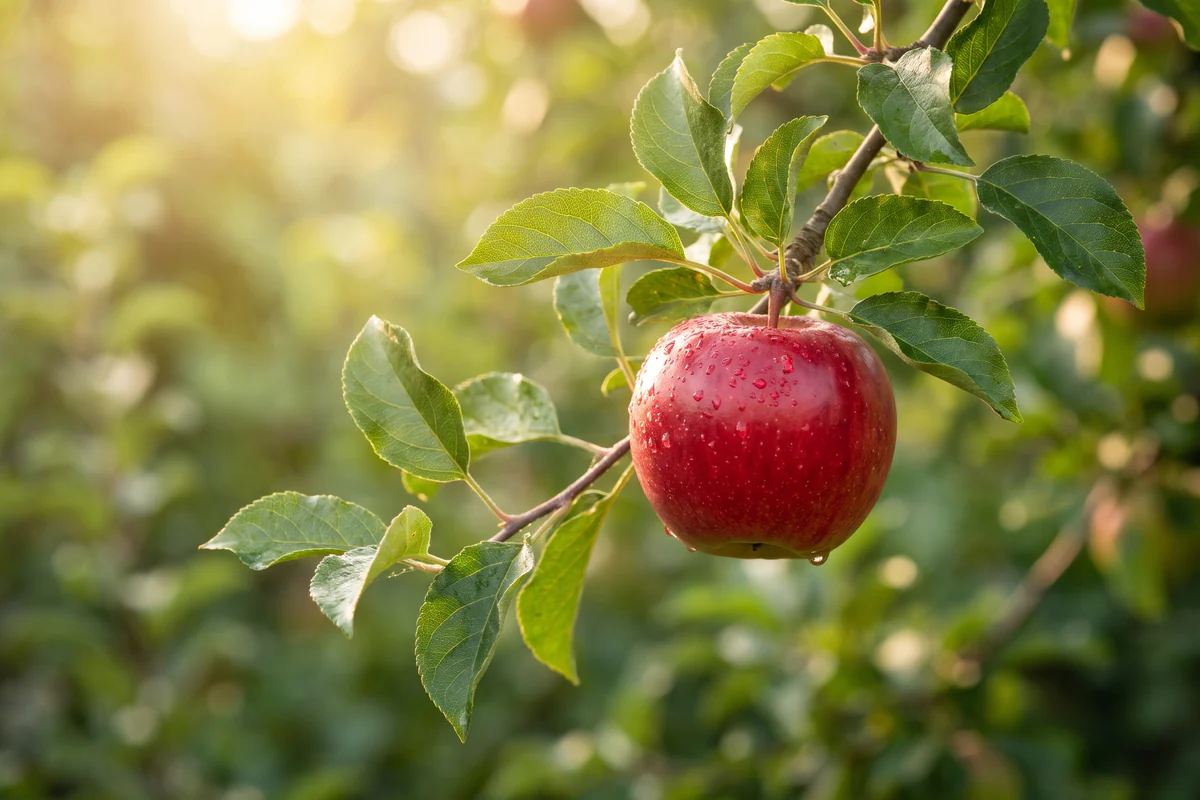
Back to the garden of Eden. God forbids Adam and Eve from eating the fruit of one tree, the serpent urges them on, they eat, and they are driven out of Eden.
What Genesis actually says
The text speaks of the fruit of the tree of knowledge of good and evil, and nothing more. English Wikipedia’s article on the forbidden fruit lists the candidates put forward over the centuries: grapes, a pomegranate, a fig, a pear, a quince and many more. Some rabbis argued for the fig, since Adam and Eve make their first clothes from fig leaves.
That garden holds another famous tree, the tree of life, whose story we tell in our guide to the tree of life. As for the tempter, he has his own legend: the snake that sheds its skin.
Why the apple won
Two reasons come up again and again. The first is simple: the apple tree is common in Europe, and European painters chose the fruit they saw every day. The second is a pun. In Latin, the word for evil and the word for apple can both be written malum, and it is often said that this pun nudged the apple into the role of the forbidden fruit. Treat it as an interpretation, not a certainty: the same English Wikipedia article cites a scholar, Azzan Yadin-Israel, who notes that Latin writers rarely used that word for the forbidden fruit. He points to another shift: the Latin pomum simply meant “fruit”, and the French pomme, like the English “apple”, once meant any fruit before narrowing to the one we know.
The Adam’s apple
The story even left a mark on the body. The Adam’s apple is the bump at the front of the neck formed by the thyroid cartilage around the larynx, usually more prominent in men. English Wikipedia notes that the name copies the Latin pomum Adami. The legend says a piece of the fruit stuck in Adam’s throat. It is a lovely image, but anatomy does not back it up.
Golden apples of the Greeks: discord, Troy and the Hesperides
For the Greeks, the apple is not about guilt. It is about desire, rivalry and winning.
The apple of discord
Picture a wedding attended by the gods: the marriage of Peleus and Thetis. One goddess is left off the guest list: Eris, the goddess of discord. Offended, she throws an apple into the middle of the party. In later tellings it carries the words “for the fairest”. Hera, Athena and Aphrodite each claim it, and Zeus leaves the verdict to a Trojan prince, Paris.
Aphrodite promises him the love of the most beautiful woman in the world, and Paris hands her the apple. But that woman, Helen, is already married to King Menelaus. Her abduction starts the Trojan War. According to French Wikipedia’s article on Aphrodite, this is why the apple became the symbol of the goddess of love, which puts it alongside the heart, the other great sign of love.
English kept the story in an idiom. English Wikipedia’s article on the apple of discord says that in everyday speech the phrase means the core of an argument, or a small matter that could grow into a bigger dispute.
The golden apples of the Hesperides
Another shining apple appears in Greek myth. According to French Wikipedia’s article on the garden of the Hesperides, Gaia, the Earth, gives Hera golden apples that grow in a garden at the end of the world, on the slopes of the Atlas. A hundred-headed dragon, Ladon, stands guard. Picking them is the eleventh labour of Heracles. The giant Atlas agrees to fetch three apples if Heracles holds up the sky in his place. On his return, the hero tricks him into taking the burden back and leaves with the fruit.
The same fruit turns up in the tale of Atalanta. During their race, Hippomenes drops apples he had received from Aphrodite, and that is how he wins. Once again the apple is bait.
Idunn’s apples and the Isle of Avalon

Norse mythology connects apples with renewed youth, while Arthurian tradition connects Avalon with apples and healing. In both, the apple no longer tempts.
In Norse mythology, the goddess Idunn keeps the apples of youth. According to French Wikipedia’s article on Idunn, the Norse gods are mortal: when they feel old age creeping up, they eat one of these apples and become young again, and so it goes until Ragnarök. Without the fruit, they would grow old like humans.
In the medieval Arthurian tradition, a whole island carries the apple in its name. Avalon is said to come from a Brittonic word, aval or afal, meaning apple in Breton and Welsh. Between 1135 and 1138, Geoffrey of Monmouth mentions it in his History of the Kings of Britain, and he later calls it the “island of apples”, insula pomorum. That is where King Arthur, mortally wounded at the battle of Camlann, is taken to be healed by Morgan, one of nine sisters living on the island. At the end of the twelfth century, the monks of Glastonbury, in England, would claim that Avalon was on their doorstep.
An orchard where wounds heal, fruit that holds back old age: here the apple is a promise of youth and care.
Snow White and the red half
The best-known fairy tale brings the two faces of the apple together. In the Brothers Grimm version, whose collection was first published at the end of 1812, the queen prepares a poisoned apple. But she poisons only the red half, the more tempting one, and keeps the white half for herself. Snow White bites, and drops as if dead.
What follows is less well known. She does not wake with a kiss. In the most widespread version, one of the men carrying the coffin trips over a root, and the piece of apple lodged in the girl’s throat comes loose. In the very first edition, it is a servant of the prince, tired of carrying the coffin, who strikes her on the back. In 1937, Disney turned it into its first animated feature, and the red apple became an image known the world over.
The legend of William Tell also puts an apple at the heart of danger: the bailiff Gessler forces him to shoot an arrow at an apple placed on his son’s head.
Newton: an anecdote that refuses to fall
Isaac Newton sits under a tree, an apple drops, and the idea of gravity springs to mind. The story is so memorable that schools still tell it. But how much of it is true?
According to the French encyclopaedia Larousse, tradition says Newton came up with universal gravitation by watching an apple fall and wondering why the Moon does not. Larousse says the anecdote was passed to Voltaire by one of Newton’s nieces, and considers it probably invented. English Wikipedia adds a nuance: people who knew Newton attributed the story to him. His friend William Stukeley recorded him telling it in a Kensington garden in April 1726, with no apple landing on his head. What is certain is the setting: the plague was raging in London, and Newton had gone back to Woolsthorpe, where he probably made his main discoveries. English Wikipedia says the same of those two years of work at Woolsthorpe on calculus, optics and gravitation.
True or not, the story made the apple a symbol of discovery. After the fruit of knowledge in Eden, here is the fruit of science.
| Story | What is documented | What is legend |
|---|---|---|
| The forbidden fruit | Genesis does not name the fruit | The apple, chosen by painters and perhaps helped by a Latin pun |
| The Adam’s apple | The bump formed by the thyroid cartilage | A piece of fruit stuck in Adam’s throat |
| Avalon | A name linked to the apple, cited by Geoffrey of Monmouth around 1135 | The island where Arthur was supposedly healed |
| Newton | His stay at Woolsthorpe during the plague | The falling-apple anecdote, considered probably invented by Larousse |
| The Big Apple | The nickname used in 1921 by a racing journalist | An origin that is still debated |
From the apple of discord to the Big Apple: apples in the English language and in New York
English is full of apples. Three of them have already turned up in this story:
- “the apple of my eye”: the person or thing you cherish most;
- “the apple of discord”: the heart of a quarrel, as Paris learned;
- “Adam’s apple”: the bump in the throat, with the forbidden fruit behind it.
Across the Atlantic, a whole city was nicknamed “the Big Apple”. According to English Wikipedia, the sportswriter John J. Fitz Gerald popularised the name for New York in his horse-racing columns, with a first mention on 3 May 1921. He said he had heard it from African American stable hands at the New Orleans Fair Grounds. In the 1930s, jazz musicians spread it further, and a tourism campaign revived it in the 1970s. Its exact origin is still argued over.
Red, golden or bitten: what the colours say
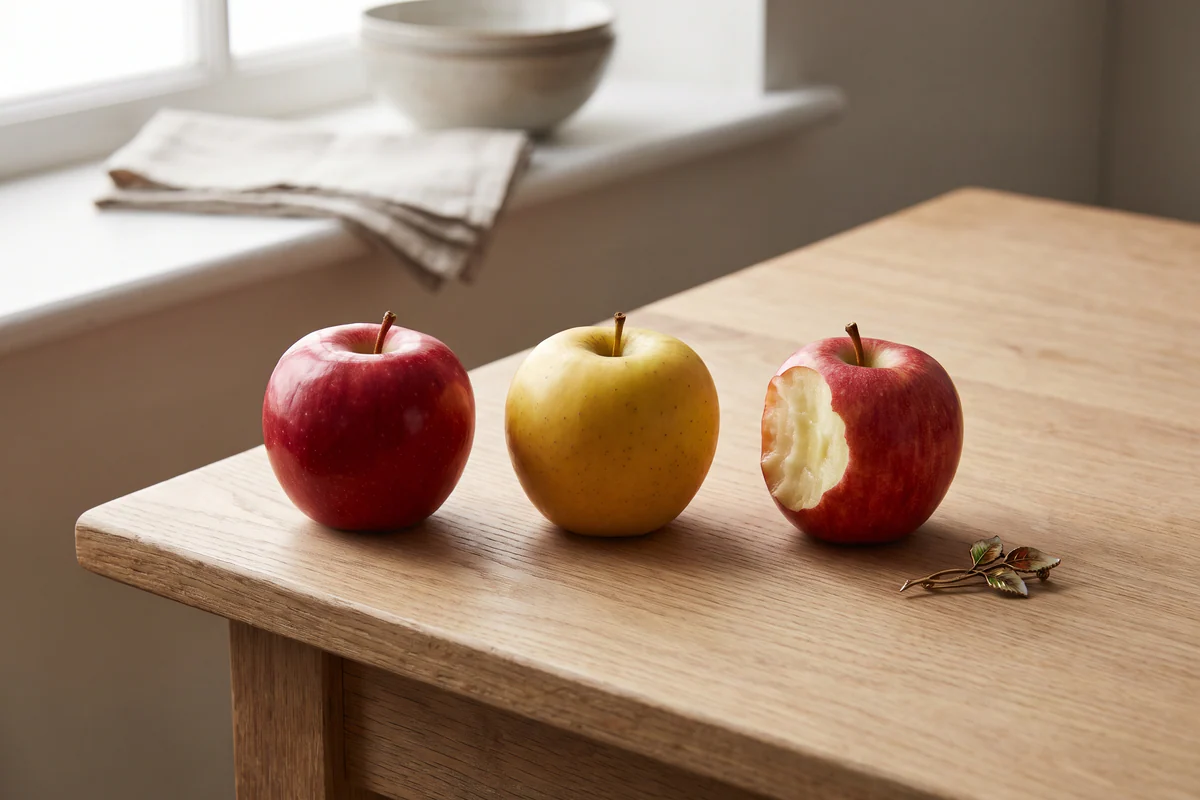
The colours of the apple follow no fixed code: each one borrows its meaning from a story.
- the red apple is the apple of temptation: it is the red half, the more beautiful one, that the queen poisons in Snow White;
- the golden apple belongs to the Greek gods, a treasure guarded by a dragon at the end of the world;
- the bitten apple recalls Eve’s gesture in the garden of Eden.
And the green apple? We found no reliable source that gives it a meaning of its own, and we would rather not make one up.
Wearing an apple today
An apple motif can recall several of these stories: the Garden of Eden, childhood fairy tales, Newton’s anecdote or simply the colour and shape of the fruit.
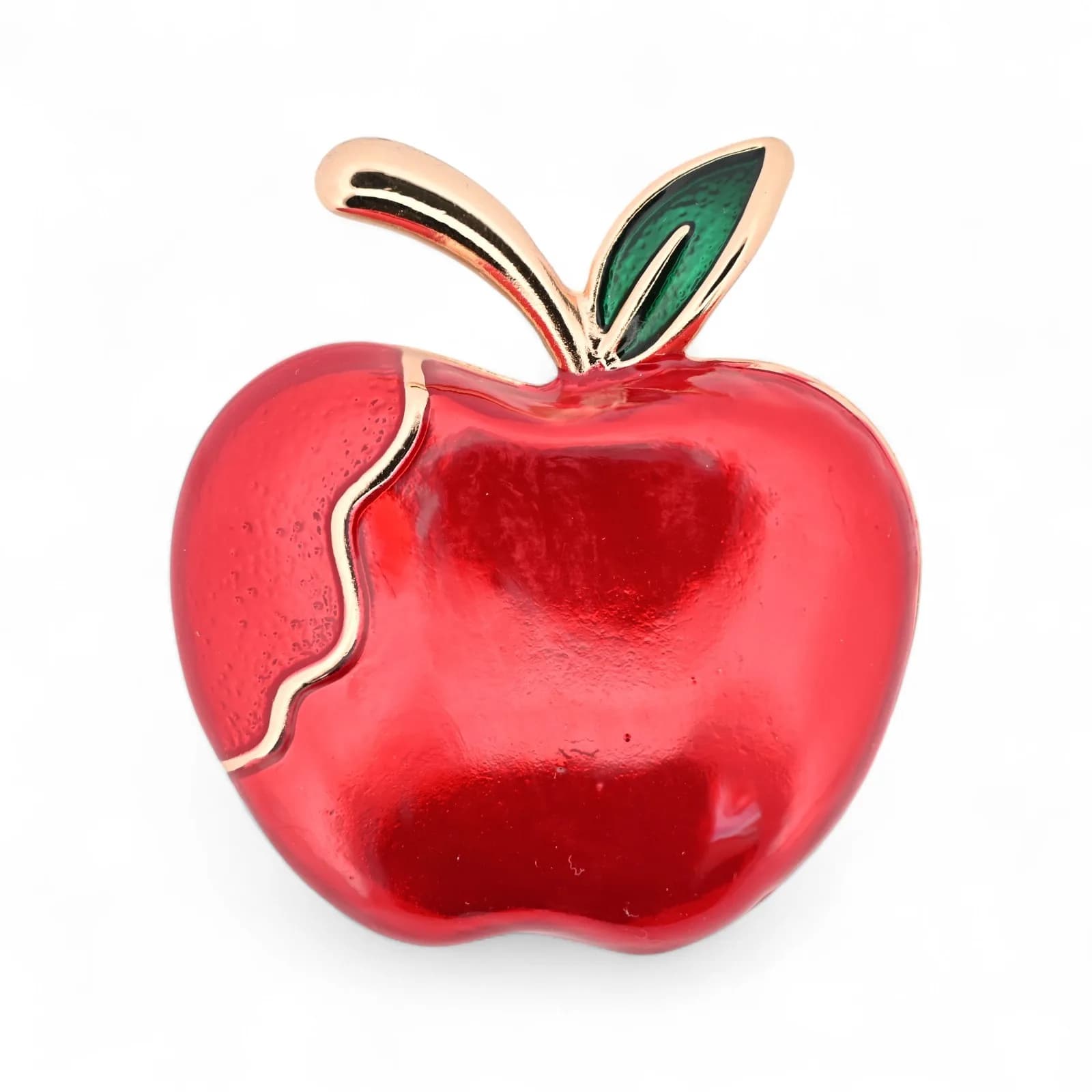
Our red apple brooch is the only apple-shaped model in the shop. It measures 5 cm. A wavy gold-coloured line separates its large glossy red surface from a more matt red area. Above it, a curved stem carries a green leaf with a gold-tone edge. Made of gold-coloured steel, it also belongs with our warm-toned brooches. It fastens with a magnet, so there is no need to pierce the fabric. On a beige coat, a denim jacket or a grey jumper, the red stands out clearly.
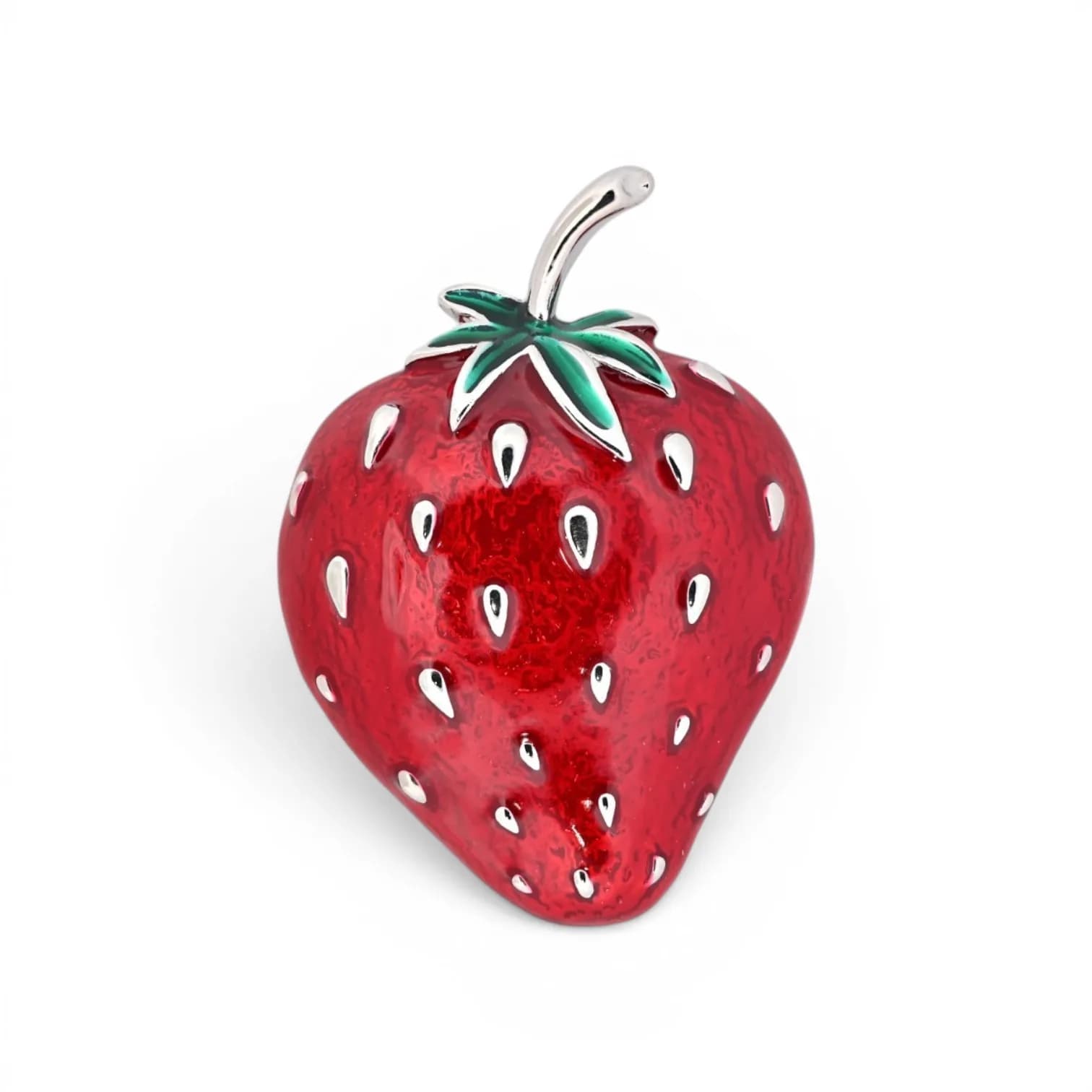
It has company in our small selection of fruit-shaped brooches: a red strawberry measuring 5 × 3.5 cm, in silver-tone steel, with raised teardrop details and green leaves. If you are wondering where to pin either of them, our guide covers the lapel, the collar and the other places to wear one.
Giving an apple, and the story that comes with it
An apple rarely arrives alone: it brings a story, which makes it a gift people talk about. A few ideas:
- for a friend who loves fairy tales, as a nod to Snow White;
- for a science student or someone curious about everything, with Newton’s anecdote;
- for someone moving to New York, or just back from it, with the Big Apple in mind;
- for a fan of Arthurian legends, as a little piece of Avalon;
- for someone you love, since the apple was Aphrodite’s fruit.
For more motifs with something to say, browse our brooches.
Apple symbolism in a nutshell
| Story | What the apple stands for | Landmark |
|---|---|---|
| Apple of my eye | What you cherish most | Ninth-century Old English, King James Bible 1611 |
| Genesis | Temptation, knowledge | A fruit never named; the Latin pun on apple and evil |
| The apple of discord | Beauty, rivalry | Paris, Aphrodite, the Trojan War |
| The Hesperides | A treasure of the gods | Eleventh labour of Heracles |
| Idunn | Youth preserved | Apples kept by the goddess |
| Avalon | Healing in Arthurian tales | Geoffrey of Monmouth, between 1135 and 1138 |
| Snow White | The trap, temptation | Brothers Grimm, 1812; Disney, 1937 |
| Newton | Discovery | Probably an invented anecdote |
| The Big Apple | New York | John J. Fitz Gerald, 1921 |
A fruit we eat without a second thought, and behind it a serpent, three goddesses, an island in the mist and a jealous queen. Next time you bite into an apple, you will know all the stories it has already told.
Frequently asked questions
Does the Bible really say the forbidden fruit was an apple?▾
No. Genesis speaks of the fruit of the tree of knowledge of good and evil and does not say which tree it was. The apple came later, in European painting and perhaps thanks to a Latin pun, since the words for apple and evil can both be written malum. Figs and grapes have also been suggested.
What does the apple mean in love?▾
In Greek mythology the apple is Aphrodite’s fruit, the goddess of love: Paris gives it to her in return for the promise of Helen’s love. In English, “the apple of my eye” also names the person you cherish most. The apple evokes desire, but also affection.
Why is New York called the Big Apple?▾
The sportswriter John J. Fitz Gerald used the nickname in his horse-racing columns, with a first mention in 1921, and said he had heard it from stable hands in New Orleans. Jazz musicians spread it, and a tourism campaign revived it in the 1970s. Its exact origin is still debated.
Is the story of Newton and the apple true?▾
There is no proof. Newton himself told the story late in life, as his friend William Stukeley recorded in 1726, but Larousse reports that it reached Voltaire through one of Newton’s nieces and considers it probably invented. Either way, it made the apple a symbol of scientific discovery.
Where does the phrase “the apple of my eye” come from?▾
It first meant the pupil of the eye. English Wikipedia traces the earliest known use to a ninth-century Old English translation attributed to Alfred the Great, and the phrase appears in the King James Bible of 1611. It now means the person or thing you cherish most.