
Flower Meanings: A Friendly Guide to the Language of Flowers
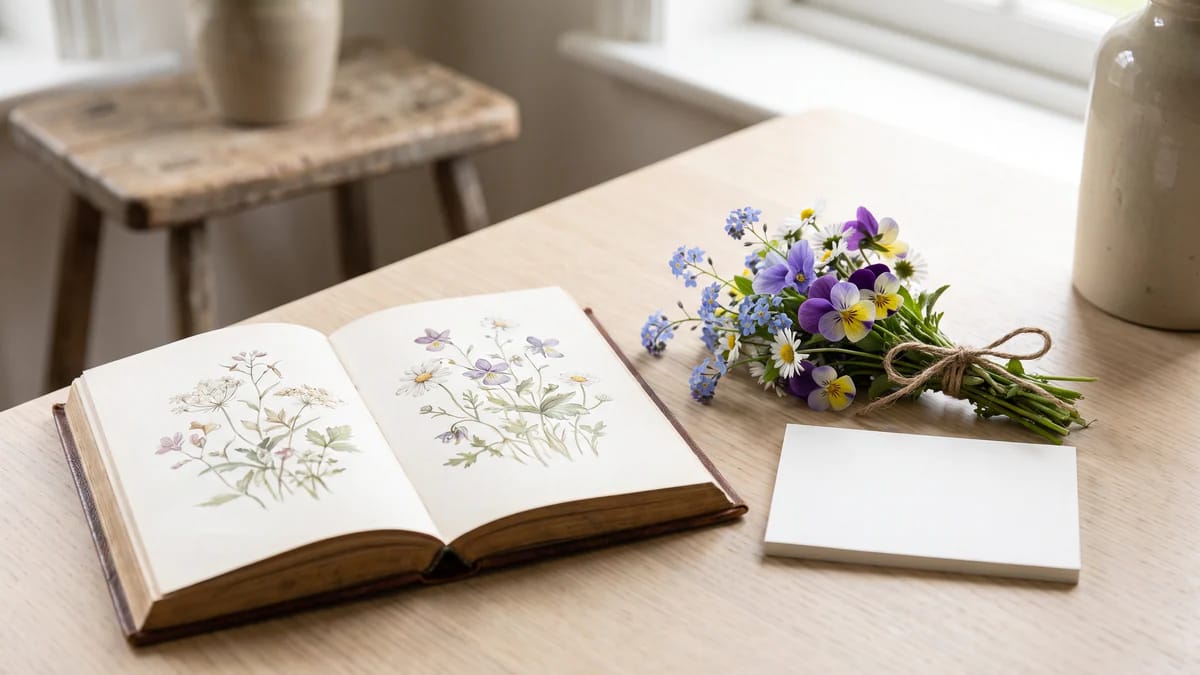
Red roses, pansies, lily of the valley and poppies: what the most loved flowers and colours mean, where the Victorian language of flowers came from and the British customs to know before you give a bouquet.
Flower meanings are the feelings people have attached to each bloom and each colour: red roses for love, pansies for thoughts, lily of the valley for the return of happiness. Most of these meanings come from the language of flowers, a craze that swept Victorian Britain, and the little dictionaries of the time rarely agreed with one another. So the best way to use them is simple: decide what you want to say, pick a flower whose meaning is widely shared, then let the colour and a few handwritten words do the rest. Below you will find a quick guide to the flowers we give most often, what the colours say, and the British customs worth knowing before you send a bouquet.
Where the language of flowers comes from
The selam, a game from Constantinople
The idea that a posy can carry a message is old, but the language of flowers as we know it is a fairly recent invention. In 1718, Lady Mary Wortley Montagu wrote home from Constantinople describing the selam, a game of coded messages in which a flower, a fruit, a spice or even a feather stood for a line of verse. Her Turkish Embassy Letters were published in 1763 and fired the European imagination, even though the Ottoman code was never only about flowers.
From Paris to the Victorian drawing room
The book that set the fashion appeared in Paris in 1819: Le Langage des Fleurs, signed Charlotte de La Tour, a pen name whose owner is still debated. Cornell University Library's online exhibition Written in Petals presents it as one of the first books devoted entirely to the subject. English adaptations followed quickly, and by the middle of the century floriography was a genuine pastime. Young women exchanged small posies called tussie-mussies, and flower dictionaries sat on drawing room tables beside the poetry.
The best loved of them all is Kate Greenaway's Language of Flowers, published in London by George Routledge and Sons in 1884 and still in print today. Britain had its own head start, too: In Hamlet (Act 4, Scene 5), Ophelia hands out "rosemary, that's for remembrance" and "pansies, that's for thoughts". Japan has a separate tradition, hanakotoba, with quite different meanings, which is the clearest proof that there has never been one single code.
Flower meanings at a glance
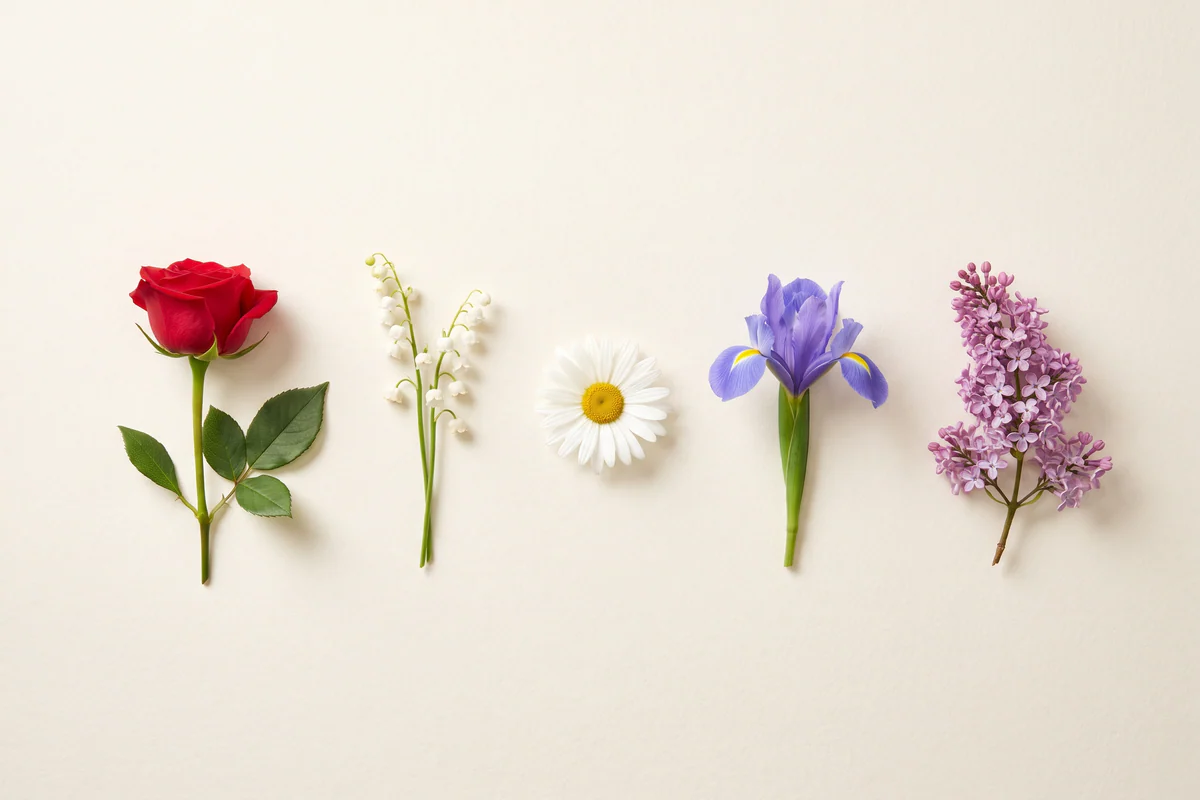
This table gathers the meanings you will come across most often today, with a note on where they come from or how to use them.
| Flower | What it says | Worth knowing |
|---|---|---|
| Rose | Love, in every shade | Red for passion, white for purity, pink for gratitude |
| Tulip | A declaration, spring energy | The colour changes the message a lot |
| Daisy | Innocence, simplicity | The flower of "he loves me, he loves me not" |
| Lily of the valley | The return of happiness | A favourite in royal wedding bouquets |
| Forget-me-not | True, lasting remembrance | The name says it all |
| Pansy | "You are in my thoughts" | From the French pensée, meaning thought |
| Violet | Modesty, faithfulness | A classic of Victorian posies |
| Rosemary | Remembrance | Straight from Ophelia's speech in Hamlet |
| Iris | A message, good news | Named after the messenger of the Greek gods |
| Lilac | The first stirrings of love | Purple lilac is the romantic one |
| Sunflower | Adoration, loyalty | Linked to Clytie, who never took her eyes off the sun |
| Sweet pea | Thank you, a fond goodbye | A cottage garden favourite |
| Poppy | Remembrance, consolation | Worn in November across the UK |
| Peony | Prosperity, a happy marriage | Highly prized in China |
| Carnation | Admiration, a mother's love | Yellow carnations meant disdain in old dictionaries |
| Chrysanthemum | Friendship, long life | A funeral flower in France and Italy |
The rose, the most codified flower
The rose deserves a closer look, because it is the most codified flower of all: the colour matters, and so does the number of stems. If you are torn between two shades, our guide to what red and white roses mean explains the nuances and how many to give.
The sunflower and the legend of Clytie
A word on the sunflower: the legend of Clytie comes from Book IV of Ovid's Metamorphoses, centuries before our sunflower arrived in Europe from the Americas in the sixteenth century. The story was borrowed later, because young sunflower heads really do follow the sun across the sky.
What flower colours mean
When you do not know the meaning of a particular flower, its colour already gives you a good clue. These are the readings most people in Britain would recognise:
- Red: love, passion, courage. The most explicit colour, best kept for messages you fully mean.
- Pink: gratitude, tenderness, admiration. Ideal for a thank you or a congratulations.
- White: purity, respect, new beginnings. Also the traditional colour of sympathy flowers.
- Yellow: friendship and joy today, although Victorian books linked yellow roses with jealousy.
- Orange: enthusiasm, warmth, energy.
- Purple: admiration, dignity, sometimes remembrance.
- Blue: calm and trust. Rare in nature, which makes it feel special.
Same flower, different message
The same flower can therefore change its tone completely. Tulips are the perfect example: red declares, pink thanks, yellow cheers. Every shade is covered in our guide to tulip meanings by colour.
A mixed bouquet blurs the message on purpose, and that is often a good thing. Soft pinks and whites together simply say "thinking of you", without asking anything in return.
British customs and superstitions
Some rules have nothing to do with the old dictionaries, yet they matter far more on the day you hand over flowers.
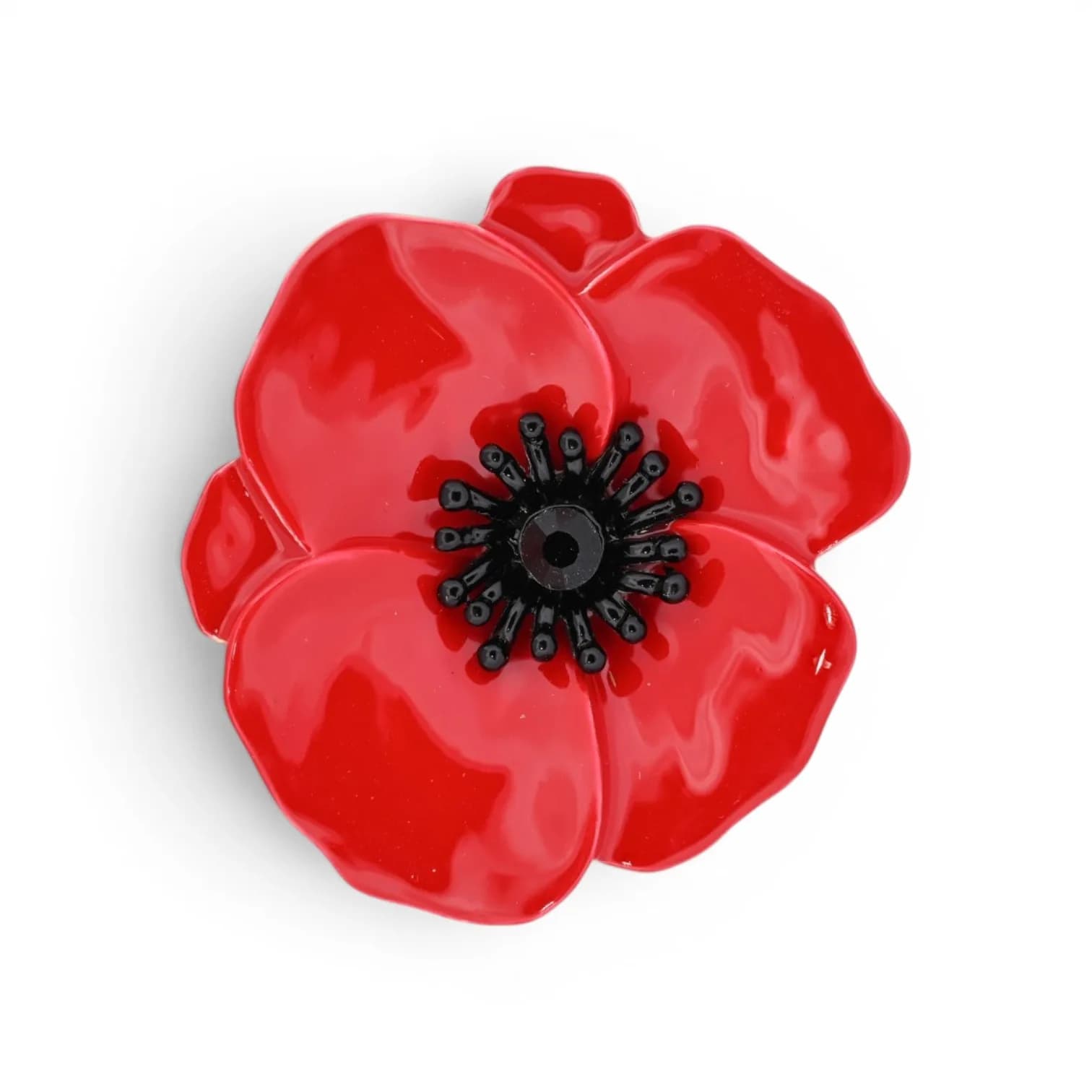
The poppy belongs to November. Since the Royal British Legion's first Poppy Appeal in 1921, inspired by John McCrae's poem In Flanders Fields (first published in Punch in December 1915), the red poppy has honoured those who died in war. Outside that season it is also a flower of summer meadows and fleeting beauty, as our article on poppy meaning and symbolism tells in more detail.
Red and white together can raise eyebrows on a hospital ward. An old nursing superstition links the pairing with blood and bandages. Few people still believe it, but a softer mix is an easy way to avoid any awkward moment.
White lilies are strongly tied to funerals in Britain, so think twice before choosing them for a birthday. Chrysanthemums, on the other hand, are perfectly cheerful here, even though they are kept for graves in France and Italy.
Royal brides carry myrtle. The tradition dates back to the wedding of Queen Victoria's eldest daughter, Princess Victoria, in 1858, and sprigs from the myrtle at Osborne House have appeared in many royal bouquets since, as a symbol of love and marriage.
Birth flowers are a lovely shortcut for birthdays. British lists vary a little from one florist to the next, but the most common pairings are carnation or snowdrop for January, violet or primrose for February, daffodil for March, daisy or sweet pea for April, lily of the valley or hawthorn for May, rose or honeysuckle for June, larkspur or water lily for July, gladiolus or poppy for August, aster for September, marigold for October, chrysanthemum for November and holly or narcissus for December. Choosing someone's birth flower is a quiet way of saying you remembered, even if they have never opened a flower dictionary.
How to say something with flowers
You do not need to learn the whole dictionary to choose a bouquet that means something. Three steps are enough.
- Put your message into one sentence: "thank you", "I'm here for you", "I love you", "well done".
- Choose one main flower whose meaning is widely shared, then a colour that points the same way.
- Write it on the card. Nobody is expected to know floriography, and a few words clear up any doubt, especially with yellow flowers or carnations.
| You want to say | Flowers often chosen | Colours |
|---|---|---|
| I love you | Rose, tulip | Red |
| Thank you | Sweet pea, pink rose | Pink, peach |
| Thinking of you | Forget-me-not, pansy, lilac | Blue, mauve |
| Congratulations | Iris, sunflower | Yellow, blue, orange |
| With sympathy | White rose, lily | White, soft tones |
| We're friends | Daisy, yellow rose | Yellow, pink |
Often the kindest choice is simply the person's favourite flower, whatever the books say. The language of flowers is there to spark an idea, not to set a test for whoever receives the bouquet.
A meaning you can keep
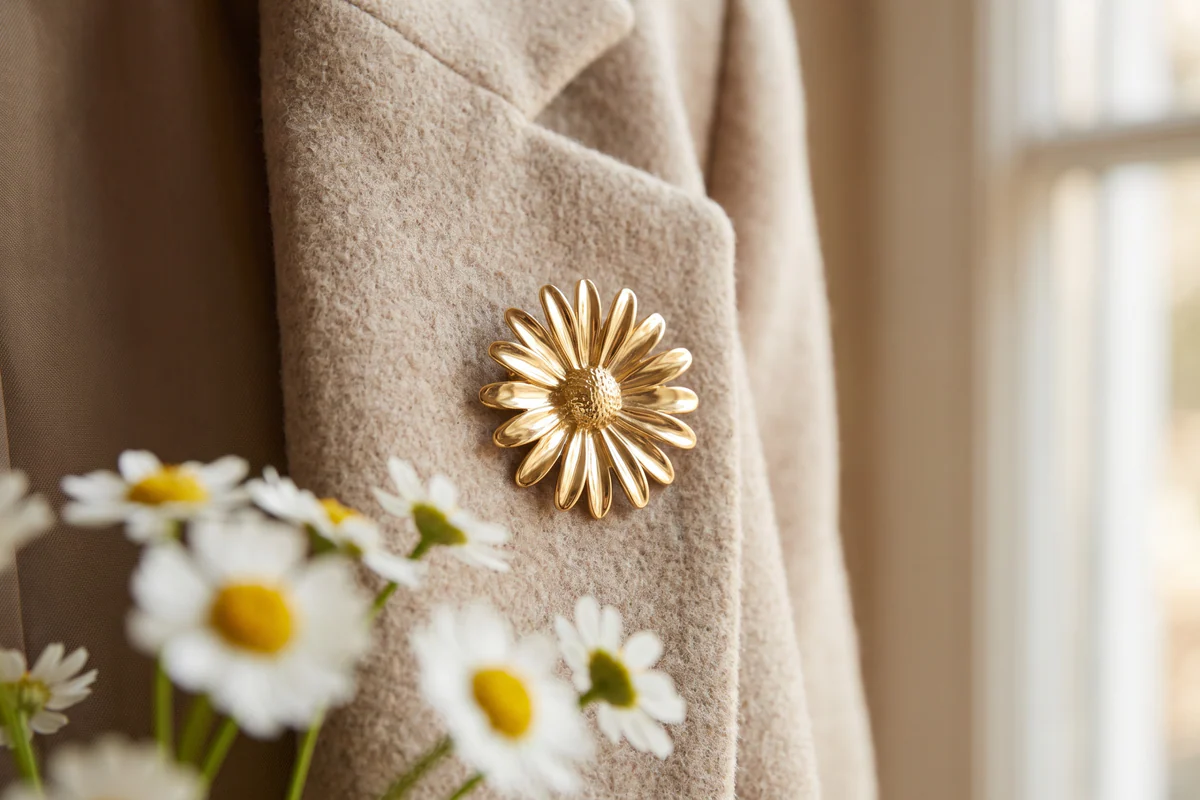
A bouquet lasts a week, but a symbol can stay with you far longer. There is nothing to stop you choosing a flower for what it says and keeping it close: a daisy for simplicity, a sunflower for joy, a poppy for summer.
That is the whole idea behind our floral brooch designs: daisies, little bouquets and bright blooms that sit on a coat lapel, a jacket collar or a scarf, and keep their message without ever wilting.
Flowers are not the only motifs with a story, either. The tree of life speaks of family and roots, and the butterfly of change and new beginnings.
In short
The language of flowers is a poetic inheritance, mostly Victorian and partly French, rather than an official code. Remember the meanings most people share: red roses for love, forget-me-nots and pansies for remembrance, lily of the valley for happiness. Keep poppies for their November meaning, go gently with red and white on a hospital visit, and always let a handwritten note say what a flower can only hint at.
And if one flower has been with you for years, you may well find it among the designs created by Ma Broche, ready to wear all year round.
Frequently asked questions
Which flower means love in the language of flowers?▾
The red rose is still the clearest symbol of passionate love. A red tulip reads more like a declaration, and purple lilac hints at the first stirrings of love. For a tender or new relationship, pink roses are often the gentler choice.
Which flower symbolises friendship?▾
Yellow roses are the usual answer today, having long lost their Victorian link with jealousy, along with daisies for their simplicity. A cheerful mixed bouquet with a personal note works just as well.
Which flowers should you avoid giving in the UK?▾
White lilies are closely associated with funerals, so they are best avoided for happy occasions. On a hospital visit, some people still avoid red and white together because of an old nursing superstition. Poppies carry a strong remembrance meaning in November.
Is the language of flowers the same everywhere?▾
No. The nineteenth century dictionaries did not always agree, and Japan has its own system, hanakotoba. Chrysanthemums, for instance, are a cheerful bouquet flower in Britain, a funeral flower in France and Italy, and the imperial emblem in Japan.
What flower says "I'm thinking of you"?▾
Forget-me-nots and pansies are the most explicit: the pansy even takes its name from the French word for thought. Rosemary, the herb of remembrance, and soft mauve lilac also suit an affectionate, discreet message.