
Cameo Meaning: The Story Carved in Relief
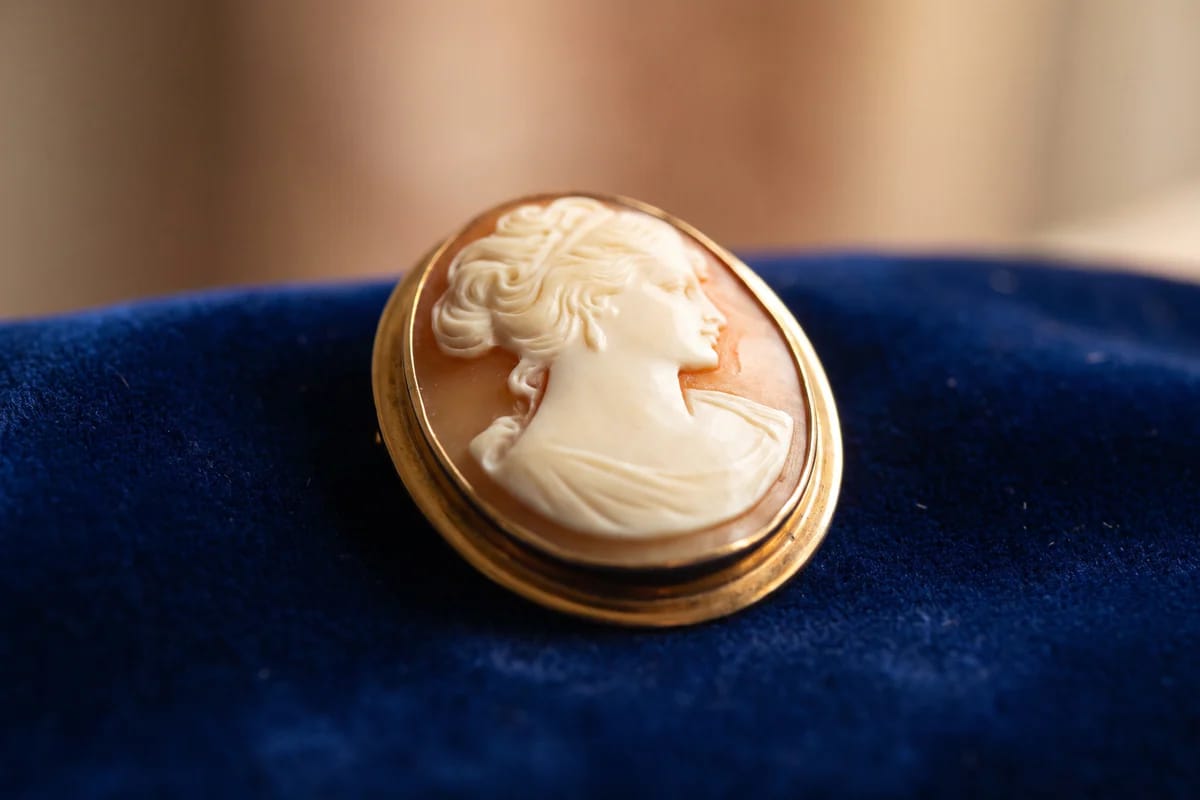
A pale face on a dark ground, carved from a single stone or shell: what a cameo is, what it shows, and the Roman masterpieces you can see in London.
Say “cameo” in Britain and many people will think of a film first: a famous face that turns up for a few seconds and steals the scene. Yet the word began in jewellery, where a cameo is a design carved in relief from a layered material. The screen meaning is younger than you might think: according to the Oxford English Dictionary, quoted by Wikipedia, a cameo role in the 1920s was a small character part that stood out from the other minor parts, a name borrowed from the carved jewel.
So what is a cameo in the original sense? It is a carving in relief, cut into a material with layers of different colours: a stone such as agate, or a seashell. The carver works the pale layer to bring out the design, and the darker layer becomes the background. In short, a cameo is defined by its raised design and contrasting layers, not by the subject it depicts. It is the opposite of an intaglio, which is cut into the stone to serve as a seal. Born in the Greek world and loved by Roman emperors, the cameo came back into fashion under Napoleon, then again in the Victorian age. Cameos mostly showed scenes from mythology and portraits of rulers. Today, Torre del Greco, near Naples, is still the great centre of shell carving.
The cameo: six things to know
- a technique: carving in low relief through layers of contrasting colour;
- the materials: layered stones (sardonyx, onyx, agate), shells, glass;
- its opposite: the intaglio, cut into the surface;
- the masterpieces, including the largest known ancient cameo, kept in Paris, and a Roman emperor's portrait in London;
- a town: Torre del Greco, known for its shell cameos since the 17th century;
- the subjects: mythology and portraits of rulers.
How a cameo is carved: stone, shell and layers
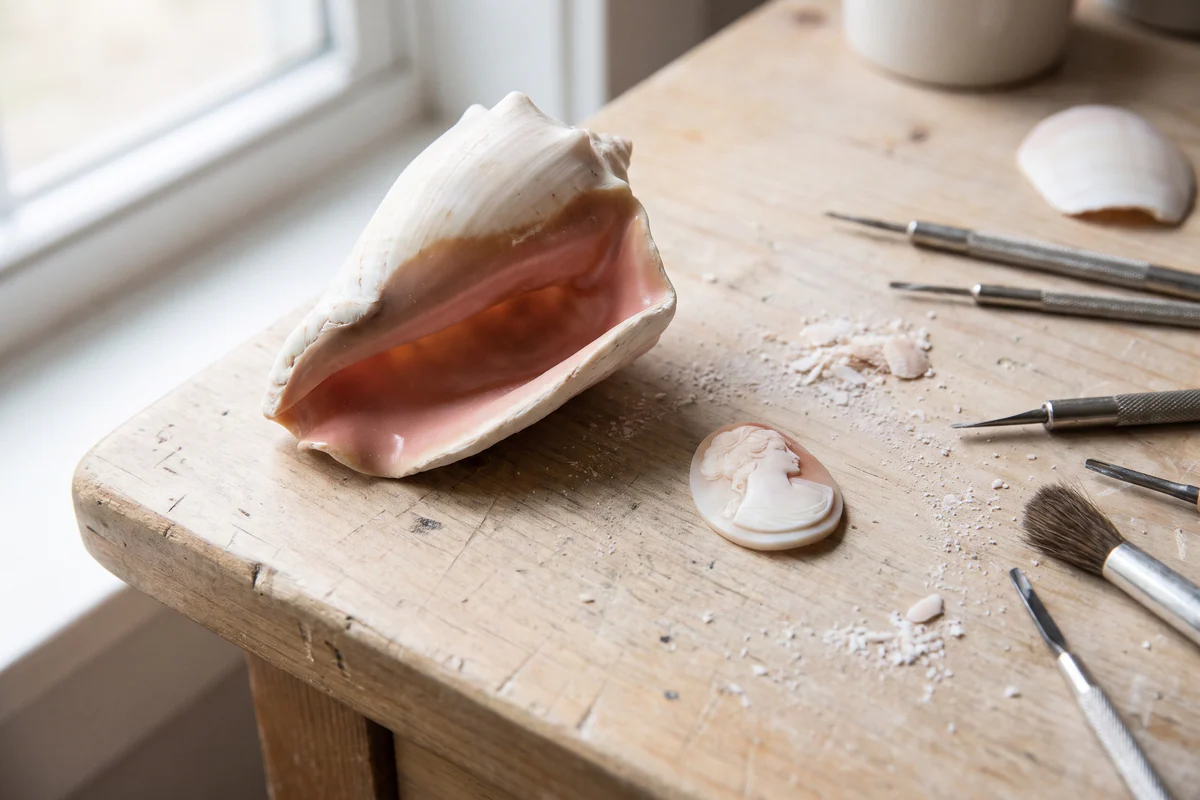
Everything starts with a material made up of distinct layers. Some stones, such as sardonyx or onyx, form in bands of different colours, a pale band lying on a darker one. Some large seashells also have two clearly separate layers. The carver uses them the way a painter uses two colours.
English Wikipedia describes the cameo as a “raised (positive) relief image”. The French-language Wikipedia files it under glyptics, the art of engraving stones, and describes it as worked on materials with contrasting layers of colour. The terminology bank of the Office québécois de la langue française adds that the design is usually carved in the lightest layer, and that a cameo most often takes the shape of a round or oval jewel, a brooch or a pendant.
So the work runs backwards compared with painting. Nothing is added; everything is taken away. Each stroke of the tool removes a little of the pale layer to reveal the ground beneath, until a profile, a fold of drapery or a whole scene stands free.
Cameo or intaglio: raised or sunk
The intaglio is the cameo's twin, working the other way round. It is a hard stone engraved into its surface to serve as a seal: pressed into wax, it leaves a raised image. The art of engraving stones goes back to the Mesopotamians, as early as the fourth millennium BC. Intaglios are small, usually 10 to 25 mm. A cameo prints nothing: it is there to be looked at. Raised for one, sunk for the other: the whole difference lies in the direction of the cut.
| Object | How it is made | Key visual clue | What it is for |
|---|---|---|---|
| Cameo | Carved in relief from a layered material | Raised pale design against a contrasting layer | Decoration: jewels, vases, ceremonial objects |
| Intaglio | Engraved into a hard stone | Design cut below the surface | Sealing: seals, signet rings |
| Moulded piece with a cameo effect | Cast or pressed in a mould (glass, ceramic, synthetic material) | Relief added or formed by a mould | Reproducing the look of a cameo |
Where the word comes from
“Cameo” comes from the Italian cameo. According to Le Robert's historical dictionary of French, quoted by the French-language Wikipedia, it is probably related to the French camaïeu, painting in shades of a single colour, and its origin remains uncertain. English later gave the word a second life on stage and screen, with the cameo role.



From Alexandria to Augustus: the great cameos of antiquity
The art is very old, and some of its finest pieces are kept in Paris and Vienna.
Two cups from the Hellenistic world
The oldest major piece surviving from the Hellenistic world, English Wikipedia says, is a cup: the Farnese Tazza. Paris holds another marvel from that age, the Cup of the Ptolemies, a two-handled cup carved from a single block of sardonyx, probably in Alexandria, between 50 BC and AD 50. In the Middle Ages it served as a chalice, including at the coronations of French kings. Stolen on 17 February 1804, it was found buried in a garden at Rozoy-sur-Serre on 14 November that year, stripped of its Carolingian mounts. It is now in the Cabinet des médailles of the Bibliothèque nationale de France.
Rome: cameos for the family of Augustus
In Rome, the cameo became an art of power, very much in fashion around the emperor Augustus. Around AD 10, a carver, perhaps Dioscurides or one of his pupils, cut the Gemma Augustea from a two-layered onyx, one layer white, the other a very dark blue. On this cameo, about 23 cm wide, Augustus sits enthroned like a god, beside Tiberius and the goddess Roma. It is in Vienna, at the Kunsthistorisches Museum.
The record, though, belongs to Paris. The Great Cameo of France measures 31 cm high by 26.5 cm wide and is carved from a stone with five layers: it is the largest known ancient cameo. Twenty-four figures are set out on three tiers: the gods, the court of Tiberius, the conquered peoples. It may have been acquired by Saint Louis, and it was kept at the Sainte-Chapelle. Stolen in 1804 and recovered in 1805, it too is in the Cabinet des médailles.
Roman cameos you can see in London
You do not need to cross the Channel to stand in front of a Roman cameo. The British Museum has held the Blacas Cameo since 1867. It shows the profile head of Augustus, carved in a sardonyx with four alternating layers of white and brown, probably soon after his death in AD 14, perhaps between AD 20 and 50. At 12.8 cm high, it is an unusually large Roman cameo.
The same museum holds the Portland Vase, a Roman vase of cameo glass made between AD 1 and 25: the same pale relief on a dark ground, this time in glass. It has been in the British Museum since 1810, and it has been through a lot: on 7 February 1845, at a quarter to four in the afternoon, it was shattered by a man named William Lloyd.
Wedgwood's copy in jasperware
The vase had a famous admirer. Josiah Wedgwood spent four years of painstaking trials copying it, not in glass but in black and white jasperware, and perfected his copy in 1790. Jasperware, a pottery he first developed in the 1770s, is best known in a pale “Wedgwood blue” with white reliefs that give a cameo effect, including fine portraits, mostly in profile. Look at the method, though: the reliefs are produced in moulds and applied to the piece. That is exactly what separates a moulded cameo effect from a carved cameo.
Napoleon, the Victorians and the Grand Tour
Around AD 300, cameos became rarer, but making them never quite stopped during the Middle Ages, and ancient stones were reused on reliquaries and church treasures. The big return came with Napoleon: according to English Wikipedia, the neoclassical revival began in France with his support of the glyptic arts. His coronation crown, made in 1804 by the craftsman Martin-Guillaume Biennais for the ceremony of 2 December, is decorated with shell cameos; Biennais also added cameos and stones taken from a reliquary in the treasury of Saint-Denis. It is now in the Louvre.
In the Victorian era, it was the shell cameo's turn to make a comeback. Carvers used large shells, such as helmet shells and conch shells from the Caribbean, whose two coloured layers suit relief work. After 1850, demand grew again: cameos became popular among the middle classes as souvenirs of the Grand Tour, that long cultural journey across Europe. A small carved face brought home from the trip, much as you might bring back a postcard today.
Torre del Greco: where shell cameos are still carved
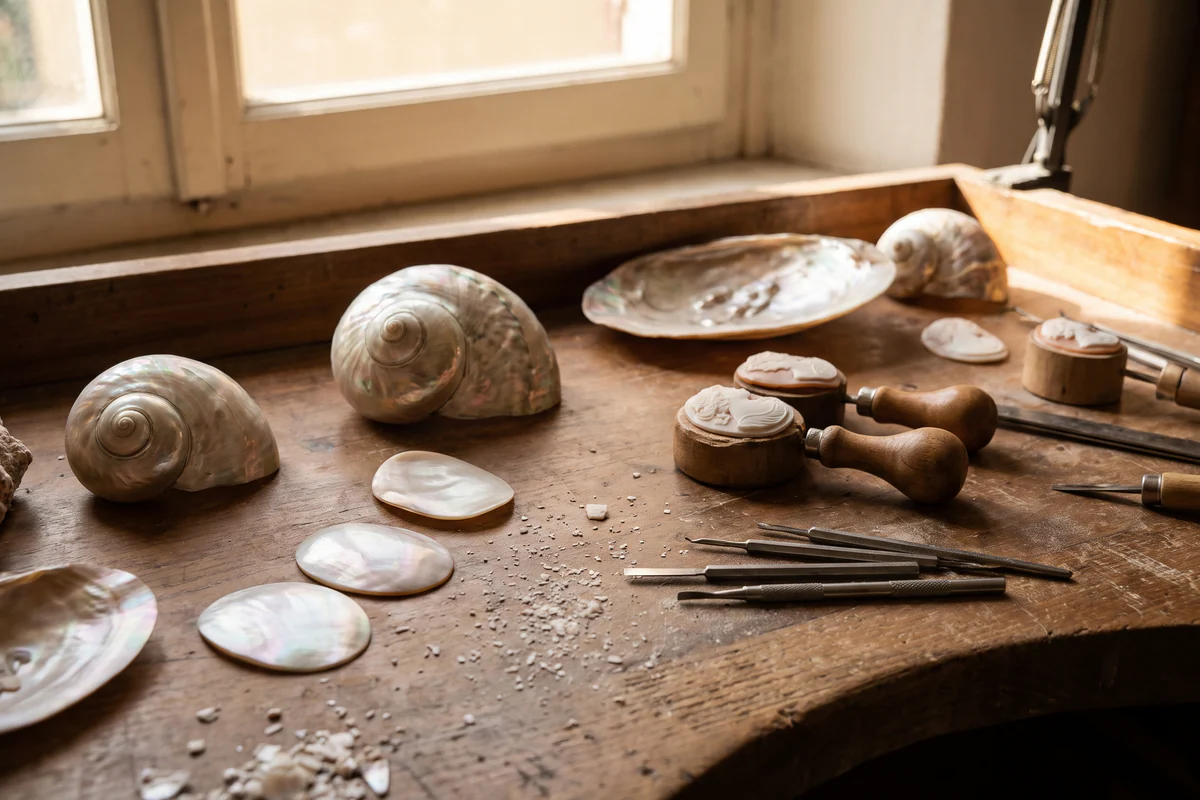
At the foot of Vesuvius, by the sea, the town of Torre del Greco has been known for its coral objects and shell cameos since the 17th century. English Wikipedia goes further and calls it the world centre of cameo carving in shell. The carvers there work mainly with a metal scraper called the bulino, whose invention is credited to the craftsman Antonio Cimeniello.
On a shell, the carver has only two layers to play with: the pale one for the face, the darker one for the ground. A curl of hair, a fold of fabric, the rim of an ear: everything has to come out of that thin pale layer without breaking through it.
What does a cameo represent?
Traditionally, cameos showed two main subjects:
- scenes from Greek or Roman mythology;
- portraits of rulers or important dignitaries.
The great Roman cameos mix the two. On the Gemma Augustea, the emperor poses as a god, and the woman seated beside him is Roma, the city of Rome pictured as a goddess. The Blacas Cameo in London keeps to the second subject: a ruler's profile, and nothing else. Either way, the cameo celebrates power.
And the woman in profile, the one most of us picture when we hear the word? The sources we consulted do not give her a single name. On an old piece she may be a goddess, an empress or a figure from mythology: only the piece itself, its attributes and its history can tell. What stays the same is the gesture: wearing a carved face close to you, the way you might keep a treasured picture.
Stone, shell or moulded: how to tell them apart
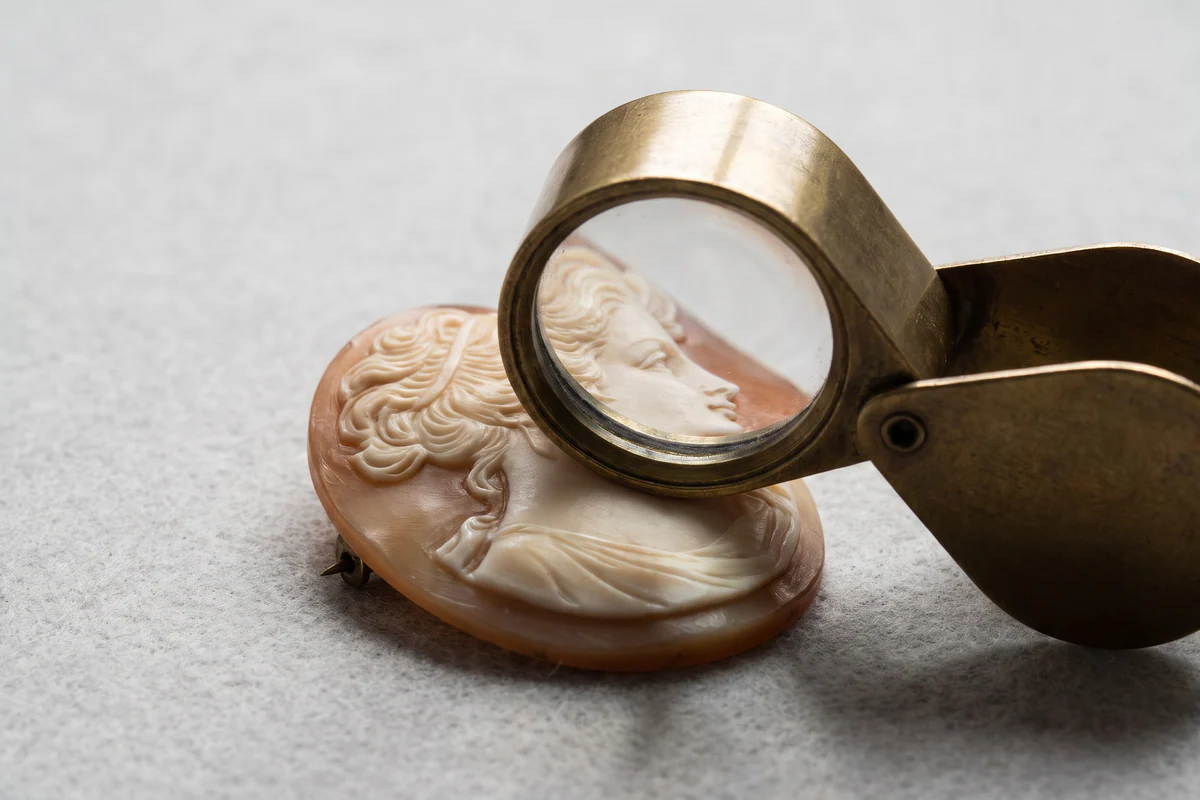
An old shell cameo, a modern agate cameo and a moulded piece can look alike from a distance. Up close, a few clues help you look properly:
- the layers: on a carved cameo, the design rises from the pale layer and the ground belongs to another layer of the same material;
- the material: layered stone (sardonyx, onyx, agate) or shell; specialists reserve the terms “stone cameo” or “authentic cameo” for pieces cut in stone, notes the Quebec terminology bank;
- imitations: the same entry lists pieces in shell, coral, glass, ceramic or synthetic material as imitations of the stone cameo; intaglios, too, were copied in moulded glass, and Wedgwood's moulded reliefs fall into the same category;
- the machine: according to English Wikipedia, most modern agate cameos are carved with the help of an ultrasonic mill; a regular texture and the lack of any undercutting (the hollows cut beneath the edge of the relief) are used by experts as signs of machine work.
These clues help you understand what you are holding. Dating a piece or putting a value on it is a job for an expert, loupe in hand.
Wearing a portrait brooch today

A cameo is worn as a brooch, at the collar of a blouse or on a jacket lapel, or as a pendant. Its strength is contrast: a pale face on a dark ground reads from across a room. So it likes plain fabrics that do not steal its thunder. Our guide to the spots where a brooch sits best goes through each one.
Our portrait brooches take a different path. They are fashion jewellery, more graphic and more colourful, and they keep the idea behind the cameo's charm: wearing a portrait. One shows a Parisian woman in black, white and red, 7.5 cm high by 3.8 cm wide, in silver-tone steel. Another, in steel, 5.2 × 7.5 cm, shows a face behind big black glasses, with a bun and a polka-dot top. A third, in resin, 7 × 5.5 cm, gives its portrait a pink cap, large round black glasses and a glittery turquoise top. All three fasten with a magnet, without piercing the fabric, like all our magnetic brooches.
A soft dry cloth is all they need to stay bright; keep them away from water and perfume. Our advice on looking after costume jewellery gives the details.
Giving a cameo or a portrait
A carved or drawn face speaks to many people, and the cameo's story gives you plenty to write in a card:
- for a museum lover: a word on the Blacas Cameo and the Portland Vase at the British Museum;
- for someone who loves Italy: Torre del Greco and the Grand Tour;
- for a history enthusiast: Napoleon's crown decorated with cameos;
- for someone who has inherited a family cameo: a modern portrait to wear beside it;
- for a friend with a bold style: a graphic portrait in big glasses.
For more ideas that suit the person, read our tips on picking a brooch for someone else, or browse our whole range of brooches.
Cameos at a glance
| Question | Answer | Example |
|---|---|---|
| What is it? | A carving in relief from a layered material | Design in the pale layer, dark background |
| Its opposite | The intaglio, cut into the surface | Seals, signet rings |
| Its origins | The Hellenistic world | Cup of the Ptolemies, probably Alexandria |
| Its Roman peak | The circle of Augustus | Gemma Augustea, Great Cameo of France |
| In London | The British Museum | Blacas Cameo, Portland Vase |
| Its revivals | Napoleon, then the Victorian era | Coronation crown, 1804; Grand Tour after 1850 |
| Its home town | Torre del Greco, near Naples | Shell cameos since the 17th century |
| What it shows | Mythology, rulers, faces | Roma on the Gemma Augustea |
| Telling it apart | Layers, material, signs of machine work | An expert's opinion to date it |
A cameo is not added to its material: it comes out of it. The carver only removes what was hiding the face. Perhaps that is why we like to keep one close.
Frequently asked questions
What is a cameo?▾
A cameo is a carving in relief cut into a material with several layers of colour: a stone such as sardonyx, onyx or agate, or a shell. The design is usually carved in the lightest layer and stands out against the darker background. It is most often worn as a round or oval brooch or pendant. The stage and film term “cameo role”, a small part that stands out, borrowed the word from these carvings.
What is the difference between a cameo and an intaglio?▾
A cameo is carved in relief and is meant to be looked at. An intaglio is engraved into a hard stone and was used as a seal: pressed into wax, it leaves a raised image.
Who is the woman on a cameo?▾
There is no single answer. Cameos traditionally showed scenes from mythology and portraits of rulers: on the Gemma Augustea, the woman seated beside Augustus is Roma, the city of Rome pictured as a goddess. On a later piece she may be a goddess, an empress or an idealised figure; only the piece and its history can tell.
How can you tell if a cameo is stone or shell?▾
Look at the material and the layers: layered stone (sardonyx, onyx, agate) or shell. Specialists reserve the terms “stone cameo” or “authentic cameo” for pieces cut in stone. A very regular texture and no hollows under the edge of the relief can point to machine carving. To date or value a piece, ask an expert.
Where can you see famous cameos in London?▾
The British Museum holds the Blacas Cameo, a profile of the emperor Augustus carved in a four-layered sardonyx, there since 1867, and the Portland Vase, a Roman vase of cameo glass, there since 1810. Across the Channel, the Cabinet des médailles in Paris keeps the Great Cameo of France, the largest known ancient cameo.