
Owl Spiritual Meaning: The Bird That Sees in the Dark
In 1843, Charles Waterton released little owls in Yorkshire. Athena’s wisdom, a Roman omen of death, a messenger of the gods: what the owl symbolises.
Walton Hall, Yorkshire, 1843. The naturalist Charles Waterton releases a few little owls brought over from Italy. They fail to settle. Decades later, Lord Lilford tries again at Lilford Hall, near Oundle in Northamptonshire, and this time the birds stay. By 1900, they are abundant.
The newcomer carries a famous name: Athene noctua, the owl of Athena. So what does an owl symbolise? There is no single answer: it can stand for wisdom, a bad omen or a divine message, depending on who is telling the story. In ancient Greece, the owl stands for wisdom and knowledge. In Roman folklore and in the Middle Ages, its cry in the night announces death or bad luck. In Japan, the tawny owl is a messenger of the gods and the barn owl a demon. Behind these opposite readings sits one simple trait: this bird sees clearly when everyone else is blind.
Let’s follow it from the English countryside back to Athens, through the Roman night, and on to the lapel of a coat.
Athena’s owl, a British bird since the 19th century
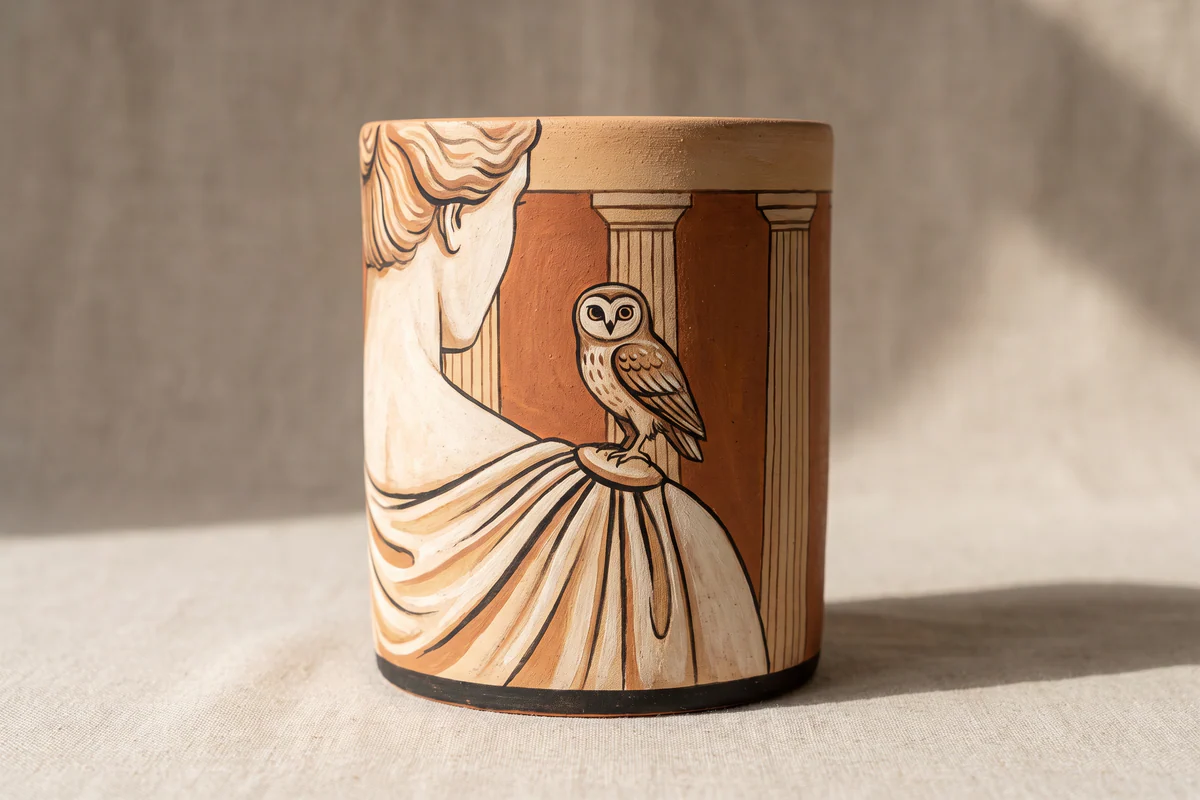
Athena’s owl is a small one. In antiquity, the little owl was the bird of Athena, goddess of wisdom, who carries one on her shoulder. Its scientific name still carries hers.
In Britain, the bird’s story is far more recent. Waterton’s attempt in Yorkshire came to nothing. The introductions that worked came later in the century, from Lord Lilford in Northamptonshire and from Edmund Meade-Waldo at Stonewall Park, near Edenbridge in Kent. From these two estates, the owls spread. Today the little owl lives across much of England and the whole of Wales, mostly in the lowlands. The Wikipedia article on the little owl follows the bird from those 19th-century estates to the fields of today.
So the bird of Athena now hunts over English farmland. Before it became a symbol, though, it was a hunter, and its body explains much of what came next.
Built for the night
A word on words first. English has one name for all these birds: owl. French splits them in two, and a pair of feathers decides which is which. A hibou has ear tufts, those raised feathers that look like ears; a chouette has none. The little owl, with its smooth round head, is a chouette. This is everyday language, not science: for zoologists, all owls belong to a single order of night hunters, the Strigiformes.
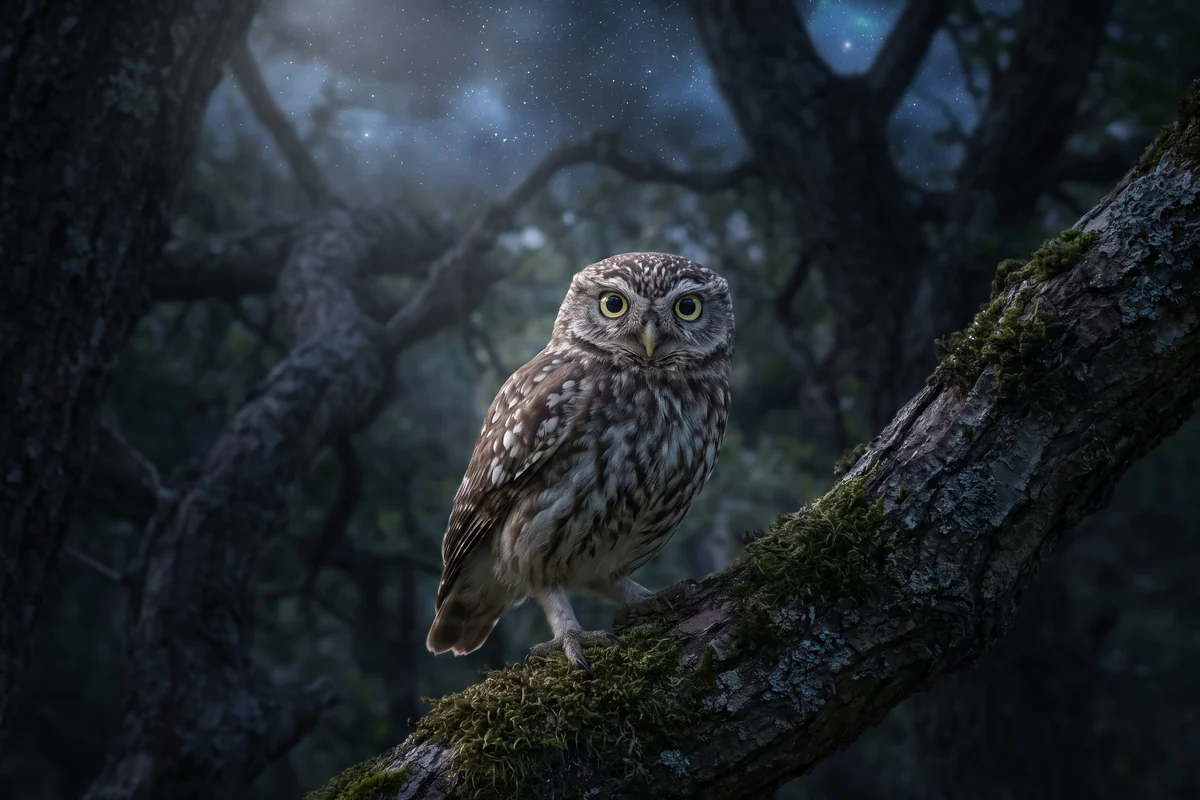
Owls have fascinated people since antiquity, above all because they are awake while we sleep. They are mainly nocturnal, and their whole body seems tuned to the dark.
Eyes that gather light
An owl has large eyes facing forward, like ours. They let in two to three times more light than the human eye. But they are fixed: set in a ring of bone, they cannot move in their sockets.
A head that turns 270 degrees
To look around, the owl turns its whole head. Its neck has fourteen vertebrae, twice as many as ours, which lets it swivel its head through 270 degrees.
Sharp ears and silent wings
Its hearing is keener than that of other birds. In some small owls, the ears sit at different heights on each side of the head: this lopsided layout helps the bird pinpoint its prey.
And it flies almost without a sound. The front edge of each wing carries a comb of stiff feathers that muffles the rush of air. The owl can reach its prey without being heard.
Seeing in the dark, hearing the invisible, arriving in silence: no wonder people turned the owl into a figure of wisdom in one age and a threat in another.
Coins, Minerva and Hegel: the owl as wisdom
Money with an owl on it
Athens seems to have adopted the owl as a sign of loyalty to its patron goddess. After 510 BC, the bird became common on the city’s coins. The Athenian tetradrachm was known as a glaux, a “little owl”, and in daily use the drachmas were simply called glaukes, “owls”. One coin now held in a museum was struck between about 480 and 420 BC.
From there grew an image that has crossed the centuries: the owl of Athena became a symbol of knowledge, wisdom, insight and learning. It shares that reputation with a giant of a very different kind, whose stories you can read in why the elephant never forgets.
From Minerva to Hegel
The Romans kept the symbol: Minerva, their counterpart to Athena, had her owl too. Much later, in 1820, the German philosopher Hegel gave it a place in a famous sentence from the preface to his Elements of the Philosophy of Right: “the owl of Minerva spreads its wings only with the falling of the dusk”. For Hegel, the owl is philosophy itself.
Long before him, in the Middle Ages, the owl already stood for the scholar, for learning and for solitary thought. It still appears today in the coats of arms of many schools and universities.
Harbinger of death: the owl’s other face
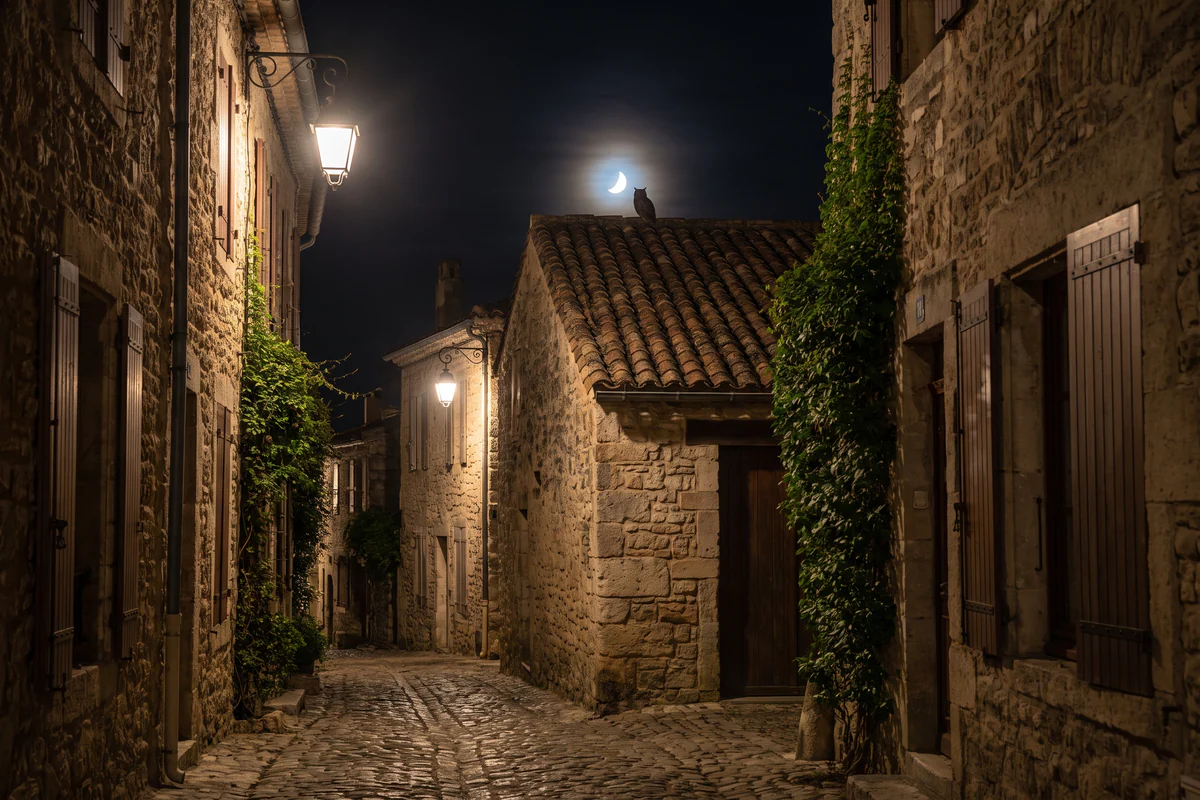
But the night that gives the owl its wisdom also gives it a bad name. What sees in the dark can also lurk there.
Rome: a hoot from the rooftop
In Roman folklore, an owl hooting from a rooftop announced a death to come, and the cry of an owl with ear tufts was no better an omen. Owls fly at night and nest in places that are hard to reach: that was enough to make them a symbol of death.
The Middle Ages: nailed to the door
In this period the owl was thought cunning and deceitful. The reason is simple: it hunts at night, when its prey is all but blind and it sees clearly. To ward off bad luck, people went as far as nailing an owl to their door. The same age linked it with death and saw it as the embodiment of evil, yet it remained the image of the scholar.
Around the world
- In ancient Egypt, owls with ear tufts stood for cold, night and death.
- For the Aztecs, the owl was the symbol of the god of the underworld.
- In China, night birds of prey were linked with lightning.
- In Japan, it depends on the species: barn owls are demonic, while tawny owls are messengers of the gods.
Japan sums up the whole story: two birds of the same night, one feared, the other welcomed.
Owl spiritual meaning: what is known and what is believed
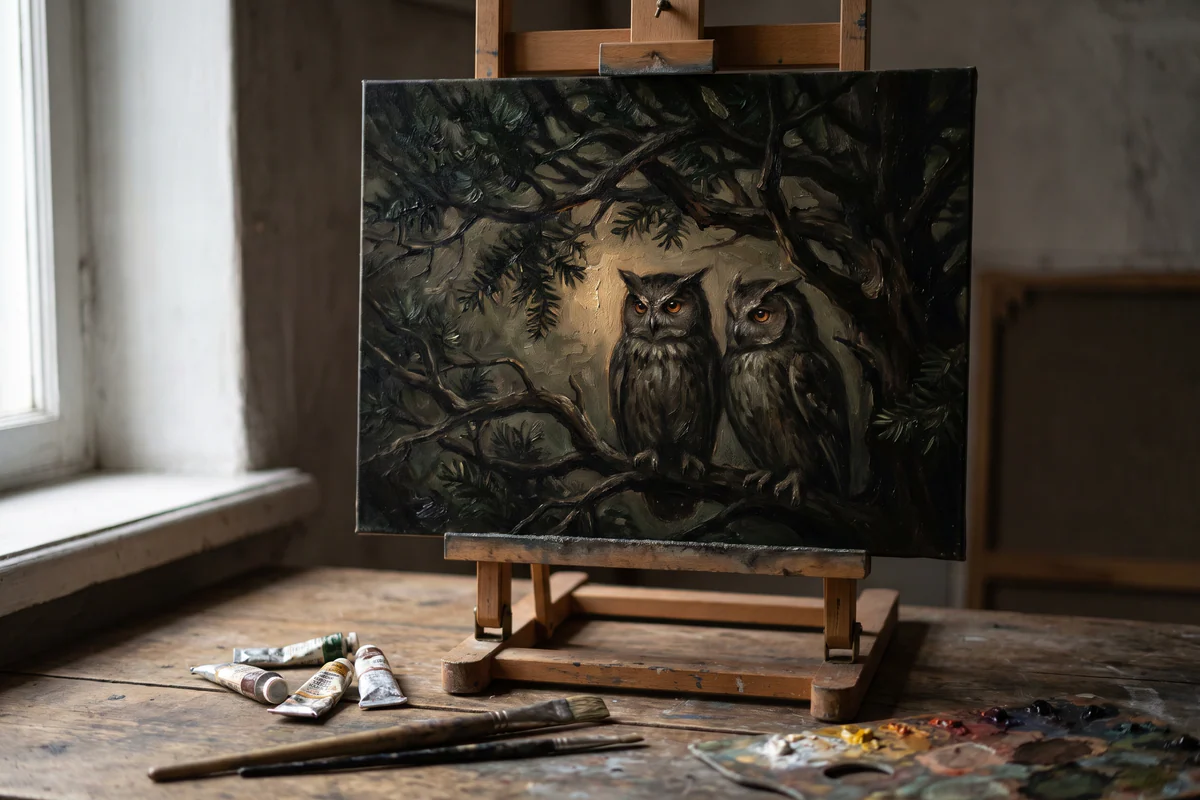
Behind a search for the owl’s spiritual meaning there is often a very real moment: a shape at dusk, a hoot beneath the window, and the wish to know whether it “means” something.
Two things are worth keeping apart:
- what is documented: the owl hunts at night, sees in low light, hears its prey and flies in silence. If it is there, it is most likely hunting;
- what belongs to belief: depending on the tradition, the same owl stands for wisdom (Athens), misfortune (Rome, the Middle Ages) or a message from the gods (the tawny owl in Japan).
So the owl has no single spiritual meaning. No source can tell us which reading is right. These readings say more about what each age admired or feared than about the owl itself. If an owl makes you think of calm, focus or taking a step back, that reading is yours.
The French poet Baudelaire saw a lesson in it. In “Les Hiboux”, a poem from Les Fleurs du mal, his owls sit in a row beneath the black yews, like foreign gods, their red eyes darting, lost in thought. Their stillness, he concludes, teaches the wise to fear, in this world, le tumulte et le mouvement: noise and restless motion. The owl as a master of patience.
Giving an owl: who it suits and what to write
Who it suits
With all these stories behind it, Athena’s bird makes a fitting gift for plenty of people and occasions:
- a graduation, exams or a new school year, as a nod to the owl of schools and universities;
- a teacher, a librarian or a keen reader, for the bird of knowledge;
- a friend who loves the night, the one who sees clearly while others sleep;
- a calm person who takes time to think, like Baudelaire’s owls;
- someone who loves nature and birdwatching.
A few words for the card
- “For someone who sees clearly, even at night.”
- “May Athena’s owl watch over your studies.”
- “A little wisdom to wear.”
Wearing the owl as a brooch
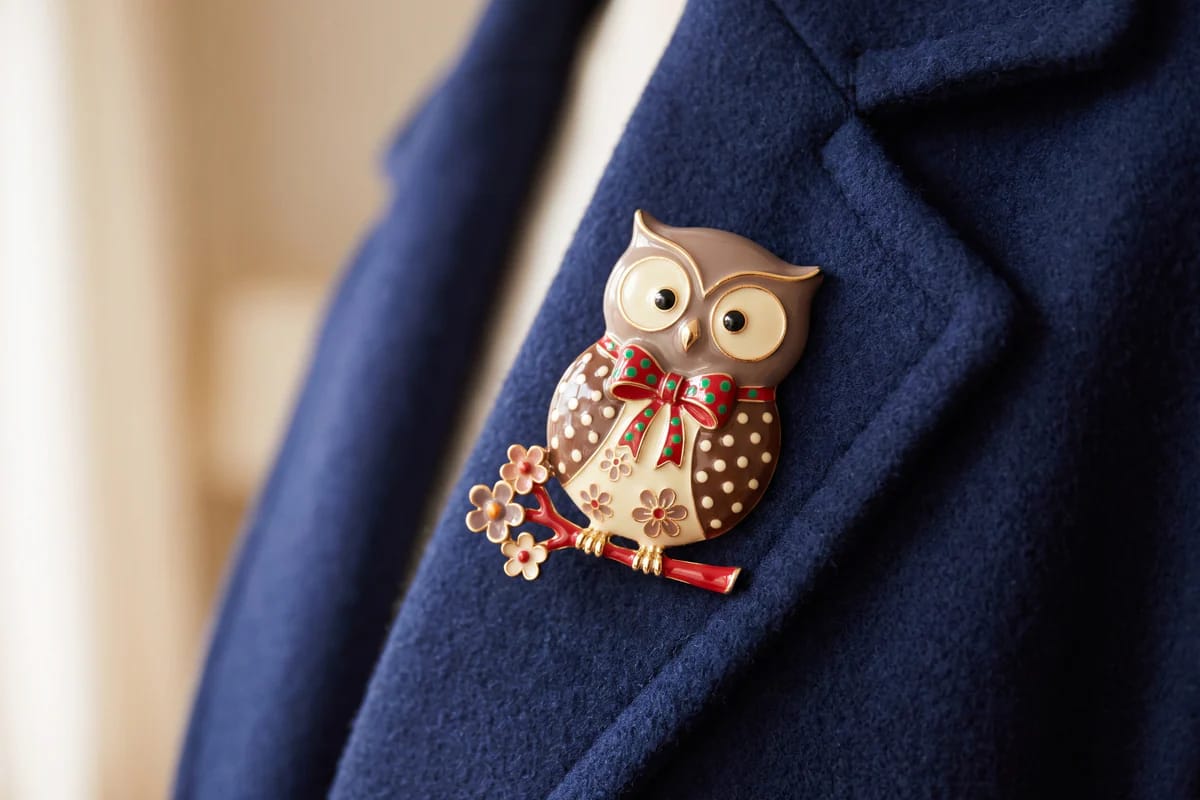
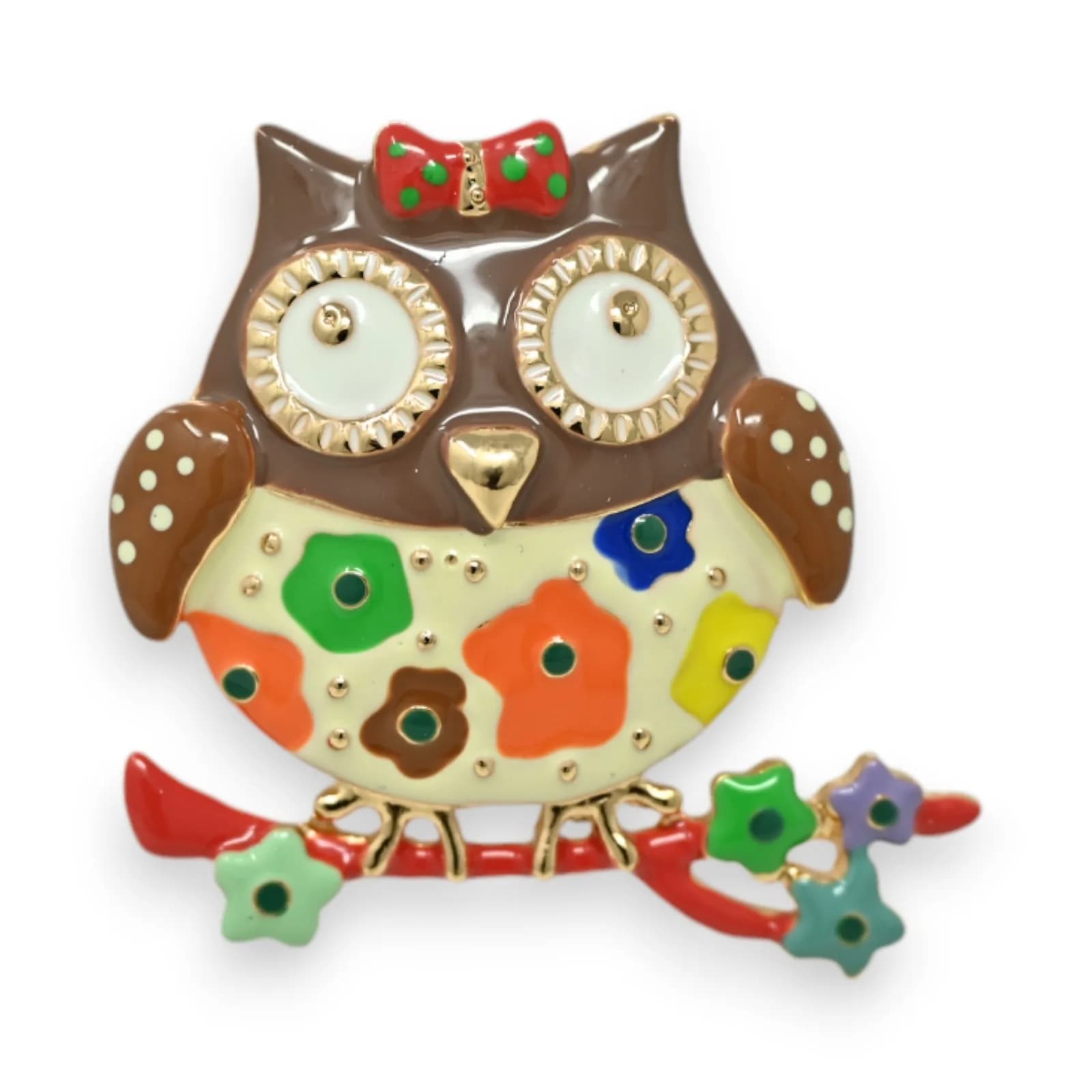
The owl waiting in our shop looks nothing like the eerie bird of legend. It is one of our fashion jewellery brooches: the owl perches on a red branch with four flowers. A taupe-brown head, large cream eyes ringed in a golden tone, brown wings with cream dots, a cream belly covered in flowers: it owes more to fairy tales than to the night. A red bow with green dots completes the picture. It is made of enamel on gold-coloured steel and fastens with a magnetic clasp.
On a navy coat, an ecru cardigan or a camel jacket, its colours stand out well. You will find it among our owl brooches, birds of wisdom. And if you love birds of every kind, other designs have landed among our bird brooches.
Owl symbolism at a glance
One bird, and meanings that pull in opposite directions:
| Tradition or source | Story or figure | What the owl stands for |
|---|---|---|
| Britain (19th century) | The little owl, released on English estates | Athena’s bird at home in the countryside |
| Science (Strigiformes) | Eyes, hearing, silent flight | A hunter of the night |
| Ancient Greece | Athena’s little owl, the “owls” of Athens | Wisdom, knowledge |
| Rome | Minerva’s owl, the hoot on the roof | Wisdom, but also death foretold |
| Middle Ages | The owl nailed to the door, the scholar | Bad luck, and learning |
| Ancient Egypt | The owl with ear tufts | Cold, night, death |
| Aztecs | The god of the underworld | The world of the dead |
| Japan | The barn owl and the tawny owl | A demon, or a messenger of the gods |
| Hegel (1820) | The owl of Minerva | Philosophy |
| Baudelaire | “Les Hiboux” | The patience of the wise |
Frequently asked questions
Do owls see in colour?▾
Probably not: colours may be no more than shades of grey to them. Their strength lies elsewhere, in the amount of light their eyes take in.
How many species of owl are there?▾
All owls, the night birds of prey, belong to the order Strigiformes. According to the French Wikipedia, consulted on 18 October 2026, it has two families and 254 living species.
What links the owl to Egyptian writing?▾
The barn owl lends its profile to a hieroglyph: the one that stands for the letter m.
What is a strix?▾
In Latin, strix means owl and striga means witch. The Romans accused night birds of drinking children’s blood: this is where the myth of the striges comes from.
Where do little owls live in Britain today?▾
Introduced in the 19th century, the little owl has spread across much of England and the whole of Wales. In the United Kingdom it is mainly a lowland bird, usually found below 500 metres.