
Butterfly Meaning and Symbolism: From Caterpillar to Soul
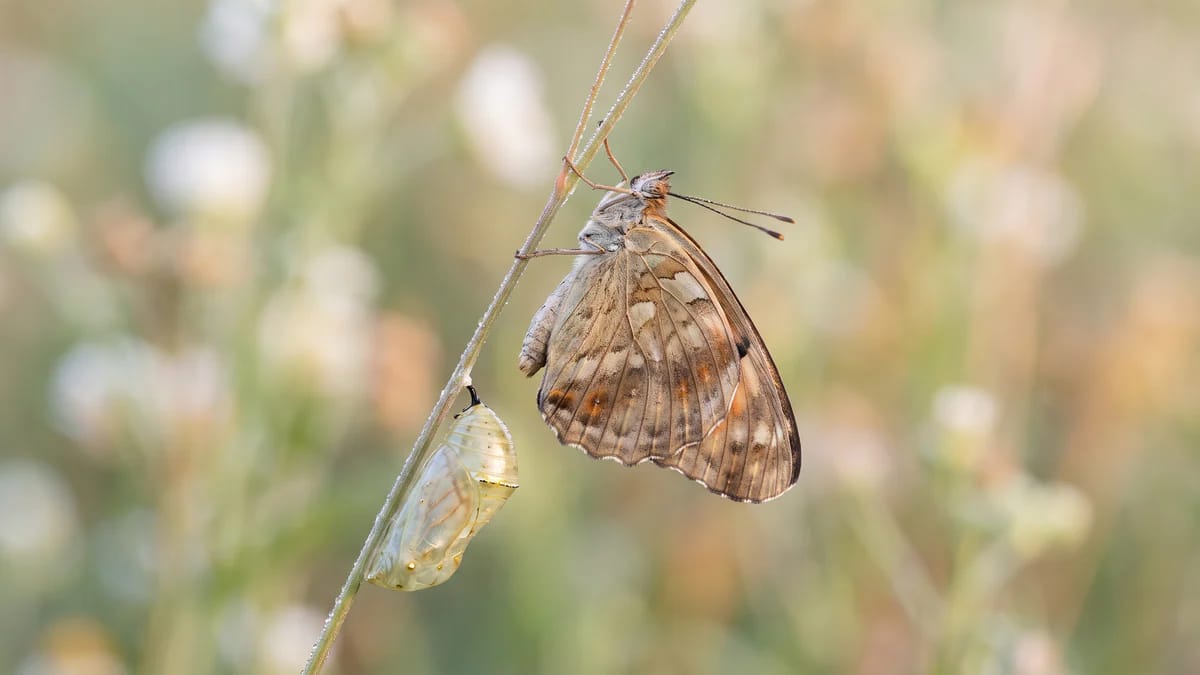
What does a butterfly mean? First transformation, then the soul since ancient Greece. Here are the documented meanings, the beliefs to take with a pinch of salt and how to choose the message you want to give.
The first butterfly meaning is transformation, because the insect begins life as a caterpillar and only becomes an adult after passing through the chrysalis. Since ancient Greece, the butterfly has also stood for the soul: the same word, psyche, was used for both. It is also linked with lightness, and with the other side of lightness, fickleness and brevity. These meanings do not carry the same weight everywhere: in China, a butterfly dream is used to question the line between two states; in Mexico, the monarch is associated with the dead. Colour meanings and omens, on the other hand, are beliefs. Here is what the butterfly's symbolism rests on, what is documented, what is not, and how to choose the meaning that suits a gift.
Why the butterfly symbolises transformation
Butterflies are insects with a complete metamorphosis, unlike the dragonfly, whose larva becomes an adult without ever forming a chrysalis. A butterfly's life goes through four very different stages:
- the egg;
- the caterpillar, which eats and grows;
- the chrysalis, which looks lifeless from the outside;
- the winged adult, which naturalists call the imago.
During the chrysalis stage, the insect's body is reorganised in depth before it emerges, while the outer case seems not to move at all.
That contrast is what made the butterfly an image of change. For days almost nothing shows, then a winged creature appears that looks nothing like the caterpillar. The symbol holds two ideas: a quiet change before a visible one, and continuity, since it is the same creature that transforms.
Wearing or giving a butterfly with this meaning speaks of a passage rather than a break: a new stage of life, a change of career, a recovery. The message is not ‘you are going to become someone else’ but ‘what you are going through can lead somewhere new’.
Psyche: one word for the soul and the butterfly
In ancient Greek, the word ψυχή (psychē) first meant ‘breath’, then the breath of life, and from there the soul, as opposed to the body. Aristotle notes in his History of Animals (book V) that it was also a name for the butterfly, and the Greek-English lexicon of Liddell and Scott still lists ‘butterfly or moth’ among its senses, citing him. The link is not a modern invention: the soul and the butterfly shared one name.
Ancient art gave the idea a face. From the 4th century BC, Psyche appears as a young woman with butterfly wings, often beside Eros, the god of love. In the 2nd century AD, the Latin author Apuleius told her story in his Metamorphoses: Psyche loses her divine husband through curiosity, endures the trials set by Venus, then becomes immortal. Odysseum, the French education ministry's classics site (in French), traces her journey and shows what fairy tales such as Beauty and the Beast owe to it.
The legacy survives in everyday English: psychology, psychic and the word psyche itself all come from the same Greek word. When someone links a butterfly today with the memory of a person, they are often reusing, without knowing it, an image more than two thousand years old.
Elsewhere in the world: two documented readings

Many websites give the butterfly a precise meaning in dozens of cultures, usually without a source. We have kept two examples that can be checked.
China: Zhuangzi's butterfly dream
The Chinese thinker Zhuangzi tells, in chapter 2 of the book that bears his name, how he dreamt he was a butterfly, fluttering about happily, with no idea he was Zhuangzi. On waking, he no longer knew whether he was Zhuangzi who had dreamt of being a butterfly, or a butterfly dreaming of being Zhuangzi. The passage ends on what is usually translated as ‘the transformation of things’.
Here the butterfly stands for neither the soul nor luck. It is used to question the line between dreaming and waking, and the way a point of view can suddenly shift. The Stanford Encyclopedia of Philosophy sees it as the best-known illustration of Zhuangzi's mild scepticism.
Mexico: the monarch, soul of the dead
Every year, from November to March, millions of monarch butterflies gather in the mountain forests of central Mexico. According to UNESCO, which made the forest a World Heritage Site in 2008, the Purépecha people consider the monarch the soul of the dead: its arrival coincides with the Day of the Dead (Día de Muertos), on 2 November.
The same page records a story told by Purépecha grandmothers. When their ancestors were walking from the cold lands and the children and the elderly could go no further, they covered their bodies with orange tree resin and yellow pollen to keep warm, and the resin and pollen turned them into monarchs. The butterfly brings together here the two main meanings already seen, transformation and the soul.
Lightness and fickleness: what everyday English says
The butterfly moves from flower to flower without lingering, and the language has kept the image. Merriam-Webster lists among the senses of butterfly ‘a person chiefly occupied with the pursuit of pleasure’, with the example ‘a social butterfly’. The Cambridge Dictionary defines a social butterfly as a person who likes to attend parties and other social events, often without having serious relationships with other people. French goes one step further with a verb, papillonner: to flit from one thing or one person to another without settling.
The symbol therefore has two sides. On one side, grace, freedom of movement, the cheerfulness of a garden in bloom in spring. On the other, a lack of constancy and brevity: in many species adult life is short, which also makes the butterfly an image of what passes.
English adds a more physical image. Having butterflies, or butterflies in your stomach, is the nervous flutter before a stage appearance or a big day; Merriam-Webster describes it as ‘a feeling of hollowness or queasiness caused especially by emotional or nervous tension or anxious anticipation’.
This double meaning matters when you give one. For someone who has just made a commitment, to a partner or to a project, a butterfly can read as a nod to lightness, or as a hint of fickleness. A few words on the card are enough to clear up any doubt.
Spiritual meanings and colours: separating fact from belief
Colour meanings circulate widely online: a white butterfly would bring peace or protection, a yellow one joy, a blue one dreams come true. They change from one site to the next and point to no old source we have been able to check. The black butterfly shows this well: depending on the page, it announces a death or a renewal, two opposite readings.
The same goes for omens and spiritual messages: a butterfly landing on you would be a good sign, a butterfly that keeps coming back would be a visit from someone who has died, or a guide sent to you at a turning point. These are personal beliefs, sometimes comforting, but no shared tradition allows them to be read as a message.
The fairest approach is to start from the meaning that you, or the person you have in mind, give to the butterfly. If a grandmother loved white butterflies, it is that memory that gives the motif its strength, not a colour chart.
Which meaning to choose for the occasion

Before you choose a butterfly as a gift, decide which meaning you want to bring forward. The table below starts from the documented readings above and suggests a simple line for the card.
| Occasion | Meaning brought forward | Idea for the card |
|---|---|---|
| A new start: moving house, a new job, finishing university | Transformation | ‘For what comes next, and everything it will bring you.’ |
| After a difficult time | The chrysalis, the time it takes to change | ‘Everything in its own time. Thinking of you.’ |
| A change of path or outlook | Zhuangzi's dream, the shifting point of view | ‘You are allowed to see things differently.’ |
| Remembering someone who has died | The soul, from Psyche to the monarch | ‘To keep close what never fades.’ |
| Spring, a birthday, a small gesture | Lightness | ‘A little lightness for your favourite jacket.’ |
One idea per gift is enough. A butterfly given for a new job does not also need to carry the memory of someone who has died: it is better to choose one meaning and stick to it.
Keeping the symbol close
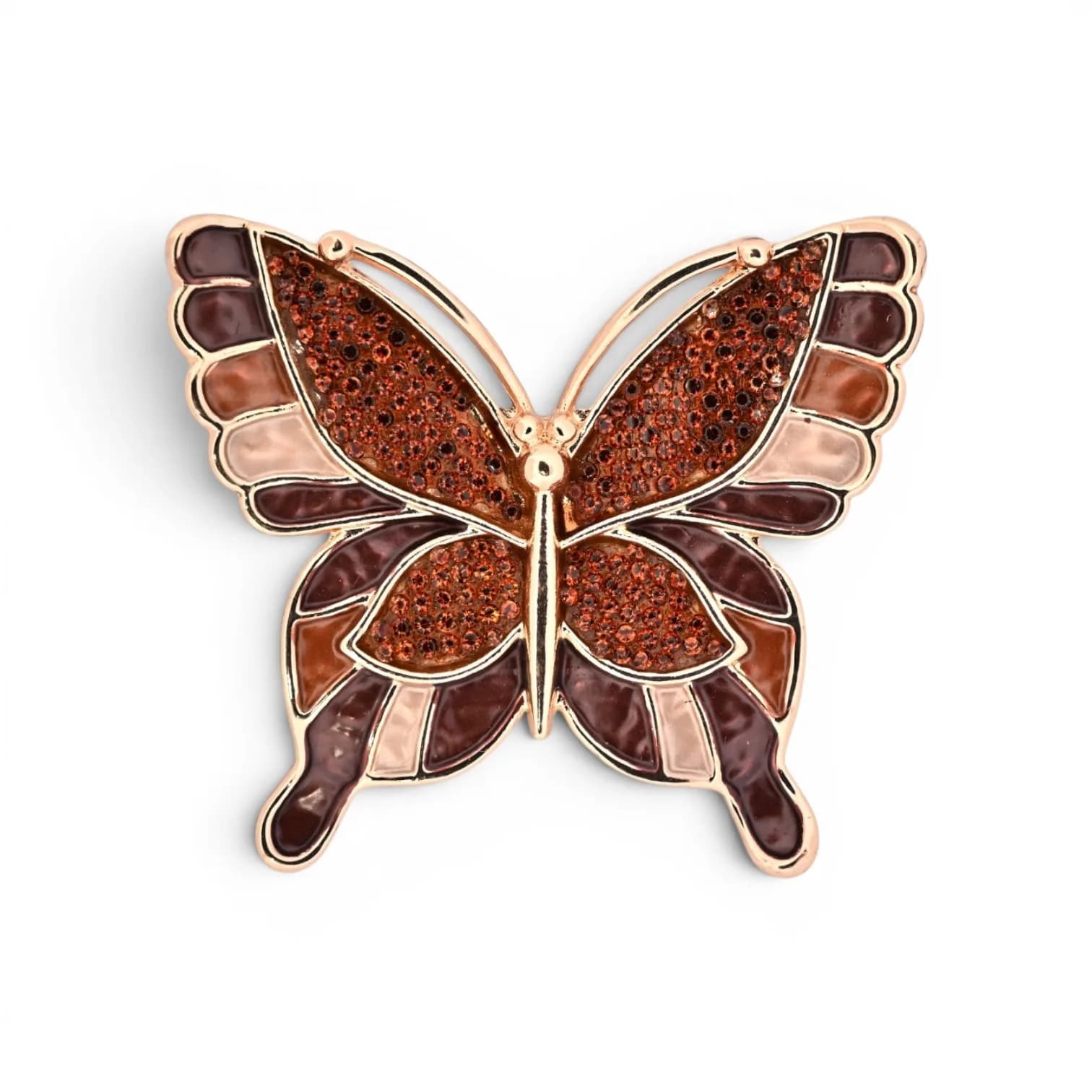
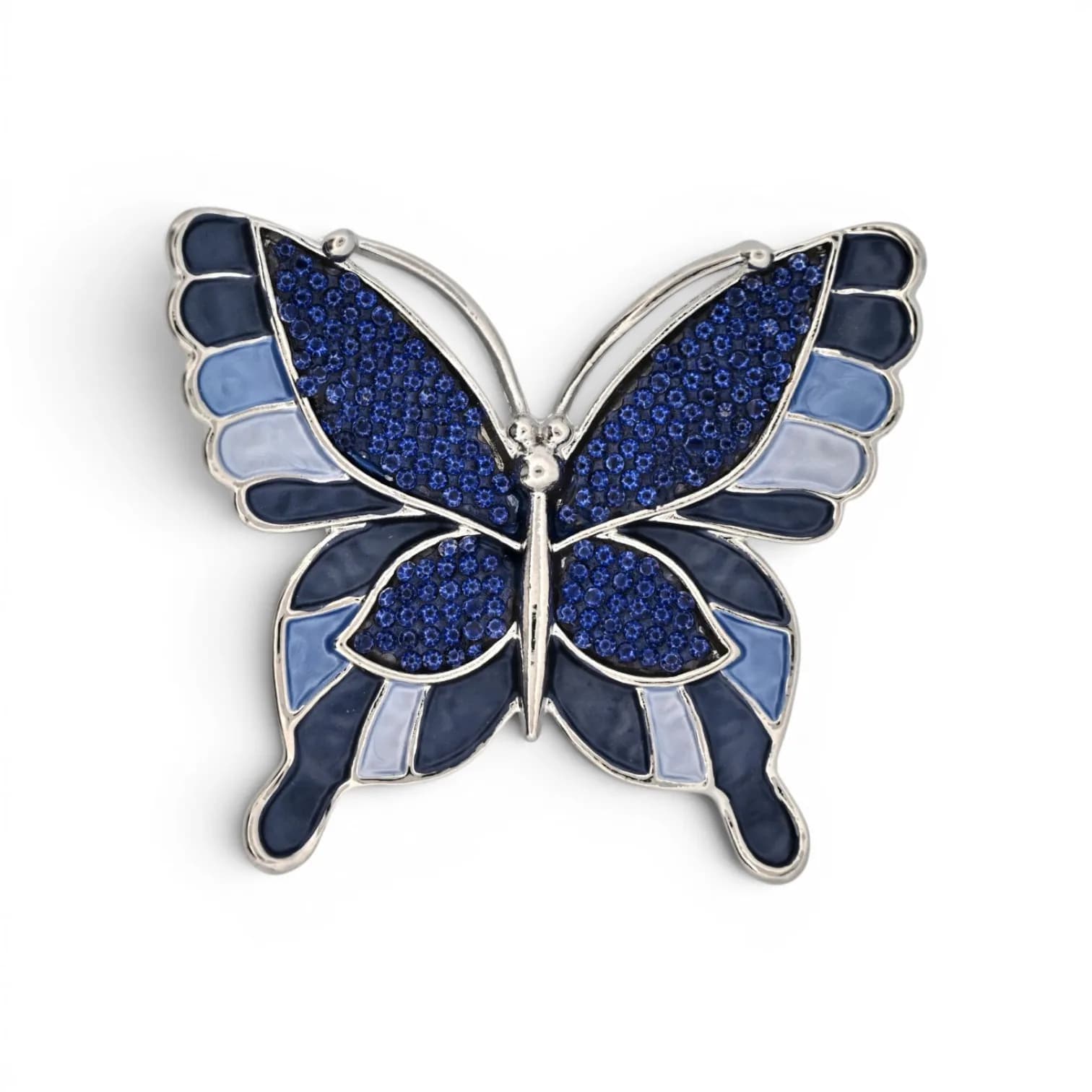
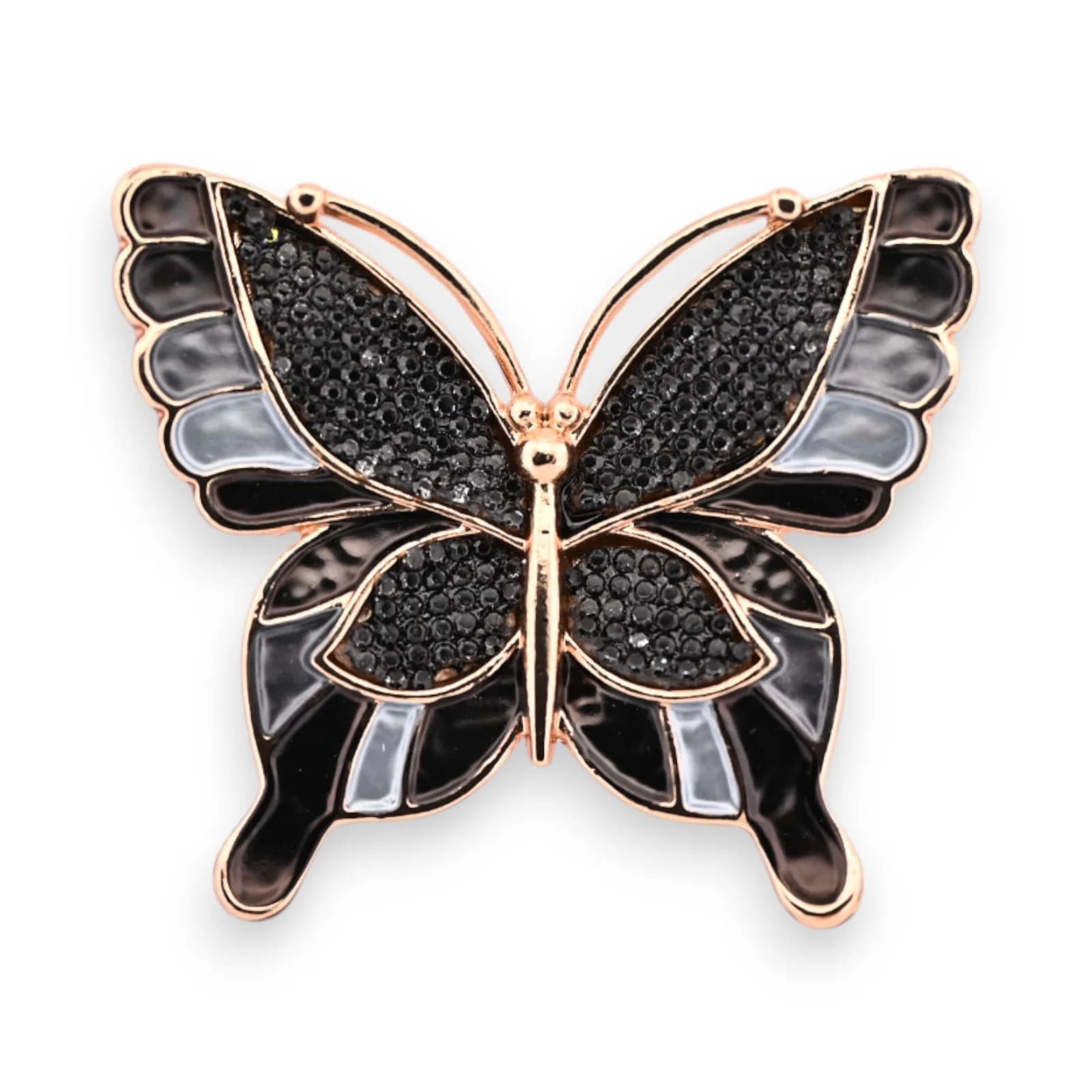
A brooch keeps the motif visible every day, on a coat, a jacket or a scarf. Those from Ma Broche fasten with a magnet: nothing goes through the fabric, and you can move the butterfly around to suit the outfit. They are made of gold-coloured, rose-gold-coloured or silver-coloured steel depending on the model, like every piece in our magnetic collection.
Frequently asked questions
What does it mean when a butterfly comes into your house?▾
We have found no documented tradition that gives this visit a precise meaning. The interpretations you read online range from a good omen to a sign from someone who has died, and they often contradict each other. You are free to see it as a small wink, without treating it as a message. In practice, the simplest thing is to open the window so it can find its way out.
Is the butterfly a symbol of death or of life?▾
Both. Through its metamorphosis, it suggests renewal and life that carries on in another form. Through its link with the soul, it also touches on death: the butterfly soul of ancient Greece, and the monarch that the Purépecha associate with the dead. The context, and the words that come with the butterfly, decide the meaning.
Where does the phrase ‘butterfly effect’ come from?▾
From the title of a talk given by the American meteorologist Edward Lorenz on 29 December 1972 in Washington, before the American Association for the Advancement of Science (AAAS): ‘Predictability: Does the Flap of a Butterfly's Wings in Brazil Set Off a Tornado in Texas?’. The idea is that in an unstable system such as the atmosphere, a tiny difference at the start can lead to very different outcomes. This meaning is scientific, not spiritual.
Can you give a butterfly to someone who is grieving?▾
Yes, if the person is open to that meaning. Present it as a thought for them or for the person they have lost, rather than as a sign from beyond. If in doubt, lean on the chrysalis: a butterfly given ‘for as long as it takes’ speaks of patience and imposes no belief.
Is a butterfly lucky?▾
We have not found a documented tradition that makes the butterfly a lucky charm, in the way the four-leaf clover is for many people. Some websites say it is, without a source. People tend to give a butterfly for what it suggests, change, lightness or remembrance, and it is that meaning, put into a few words, that gives the gift its value.